Everything you have said about the Cobb is right on. Just tell me how you prepare your omelettes, they sound kinda' interesting..............
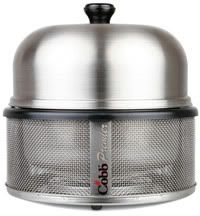
I purchased the Cobb Combo Package which includes a FryPan/Skillet, a Griddle, a Wok, and a Roasting Rack.
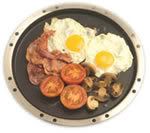
I use the Skillet with a little bit of Olive Oil to make Omelets and to fry the bacon.
Here is a movie about the Cobb Cooking System.
Please note that they show the earlier version of the grill. The latest version has the stainless steel mesh on the outside.
I find that five briquettes seems to work well for two people. The briquettes can be stored in individual zip-lock bags (5 to a bag) to keep them dry and the boat clean. I actually use a vacuum sealer to package the bags. I carried the fire starter sticks onboard last summer in Florida with no problem with the wax melting out of the sticks.
Although blowers are made spark safe for explosive environments, I'm a fan (pun intended) of blowing fresh air into a boat and letting positive pressure exhaust bad odors or fumes from the boat. Leave all hatches, ports, covers, doors and panels open, especially to the bilge areas. Give it time, and use your nose in the case of gasoline, diesel fuel, propane or LPG.
I've seen crews use a shopvac to blow air into bilges with a long plastic hose but I know that static electricity can cause sparks from such hoses under friction so am wary of that technique in the case of flammables.
i have a coleman stove that uses unleaded fuel,has anyone considered using a stove like this? I think that it would be safe enough to use in the cockpit.Its also handy if you want to cook ashore.
You have the same CO issue with charcoal than with propane (actually a much greater hazard since charcoal always burns in oxygen deprivation)
I assume you guys would never use this charcoal grill below decks
All you cruising gals/guys have a CO monitor on board, right? If you dont, get one please. Remember its not just you you have to worry about, its your neighbor too.
CO is nominally the same molecular 'mass' as air so it doesnt sink below decks like propane - once up top it will dissipate safely.
I cant imagine fussing with charcoal two or three times a day honestly, vs a propane tank that fits my shower, stove, and BBQ....
The “fire chamber” is a small stainless steel cup that can be lifted out and dumped over-board.
Dumping things over board seams to be the solution for a lot of folks. Was it ever considered what is happening with the stuff in our lakes and oceans? As vast as they might seam, they too have their limitations in coping with our civilization garbage.
The only thing we “dump” over board is our self when we go swimming. Hopefully not where somebody just dumped his charcoal.
Using unleaded gas inside a boat can be quite dangerous and is not done because of storage issues. Please realize that a spill issue in the cockpit may cause great harm. I would recommend that you soon replace your unlead gas stove with another.
CO monitor. There is quite a few false alarms with these still. Because of this I opted not to have one and keep the hatch somewhat open when having a flame and try to keep it open at night as well. No real cold weather sailing for me.
I usually have a fan blowing and the forward hatch cracked and a vent in the head. This should give me enough air flow for 2 people, if not I would either turn on another fan and blow out or open the hatch.
I agree dumping overboard is a problem but . . .The biggest violators is not the general public though that is not a reason to go willie nillie.
BTW The Cobb is a spendy little guy. Running from $100 to $169.95 for the unit. For sure do some browsing to get a good deal.
I only cook breakfast and dinner onboard. Lunch is strictly sandwiches. Therefore, all cooking is done on the hook with sails down and usually the boom tent in place. I probably would never use the Cobb in the cabin, but it probably would be OK if you placed it under or near the open hatch. But with the boom tent and the bimini in place, it just is not necessary. I agree that you should have a CO2 detector if you do this.
Concerning dumping things in the water, the amount of ash that remains is so small. I believe that someone who smokes cigarettes onboard would probably produce about the same amount of ash in a 24-hour period. Moreover, what is charcoal ash? It is just the remnants of burnt wood. All natural. Nothing else goes over the side except the liquid remnants of Guinness after being processed by my body.
Somewhat of a quibble, but most charcoal briquettes are petroleum based, not wood. Agree though that what remains of a completley burned briquette is about as low impact as you can get. Certainly a lot less than (say) sending your 1 or 1 1/2 lb propane empties to a landfill somewhere, though I've seen recycle bins specifically for these at many marinas.
I love my real charcoal grill at home for cooking a nice steak or barbecuing chicken, but I can't imagine screwing around with charcoal for a pot of coffee.
Alcohol is considerably less dangerous than propane, easy to store, no empties, and unlike propane can be used inside the cabin with proper ventilation. Lower heating value so takes longer than propane to cook. I have a single buner Origo with fiddles in the Mac, and it's worked for me for up to two weeks on about a quart of alcohol. Occasionally wished I had two burners.
Pretty big for a Mac, but my "new" old second boat, a '74 Newport '30, has a fully gimballed three burner alcohol stove with oven. Can't wait to try it as soon as it stops snowing and I can get the Newport back in the water.
Chip Hindes wrote:Somewhat of a quibble, but most charcoal briquettes are petroleum based, not wood. .
Hummmm when I lived in Oregon I lived not all that far from Kingsford and by all means it was wood based. The carbon we have in Mexico is wood based . Where did you hear or read that Charcoal briquettes was a Petro based product??
A Kingsford Company spokeswoman recently stated: "Briquettes are preferred by Americans for their uniform size and stable heat." She pooh-poohs concerns about their ingredients, which include: powdered charcoal, anthracite coal for long burning, limestone to create white ash, starch as binders, and sawdust and sodium nitrate for quick lighting. "The starch is perfectly natural and the coal is high-quality coal".
I actually had read some years ago that briquettes were primarily petroleum. Probably written by someone selling natural hardwood charcoal; and I know most serious barbecue people do not use briquettes. I guess netiher statement is 100% valid, but still they sure seem to have a lot of crap in them other than wood.
Ash is a perfectly natural and is in no way a danger to our oceans and waterways. The containers and wrappings the fuel and food come in are the concern here, pack it in, pack it out. I hang my propane bottles in a canvass bag off the port stern stanchion. To reduce waste and hassle I would like to switch to the refillable bottles. I have seen a couple mods for carrying them but I'm not very happy with the options I have seen so far. I would like to mount one off the stern on the port side while onboard but I worry about it being exposed to collision while on the trailer. If I come up with an inspired solution I'll let you all know!




 Jack
Jack