

Been having issues with docking at my marina, wanted some advice and things I could try. On coming into my marina my slip is the furthest in on the starboard side....against the bulk heads. What I have been doing.....work fine sometimes...not so well others...depending on wind and tides. I'll come in slowly and touch the bow to the bulk head. My mate will hold us on the bulkhead and I'll either try and reach the pilon and pull the back in or attempt to reverse the back to where I need it and pull us in. The last 3-4 times in as we touch the stren is drifting fast to port and I end up reversed....bow in. Seems my engine can cut(turn) far enough in either direction to really give me good control. Also on going out I have to have my mate use the bow lines to pull the bow centered with the channel as I can't make the turn using engines alone...can't cut it sharp enough.
Some things I am considering. 1.) dropping the centerboard maybe halfway down to try and eliminate the drift of the boat. and possible putting the rubbers down to get more side to side control and reduce drift. 2.) Reverse in....would allow me more controll to just back right into the slip.
Any advice or thoughts would be GREAT! Please help.
Docking Tactics
-
Indulgence

- First Officer
- Posts: 206
- Joined: Mon Aug 11, 2008 6:53 pm
- Sailboat: MacGregor 26X
- Location: Calgary, Ab, Canada
Re: Docking Tactics
I think you nailed it, lower the centerboard and rudders.
The center of rotation will be closer to the centerboard instead of at the back of the boat.
The center of rotation will be closer to the centerboard instead of at the back of the boat.
-
Québec 1

- Admiral
- Posts: 1447
- Joined: Thu Dec 27, 2007 1:02 pm
- Sailboat: MacGregor 26M
- Location: Honda BF 50 - MACM0047E303 Lévis, Québec Canada
Re: Docking Tactics
I concur with indulgence:Indulgence wrote:I think you nailed it, lower the centerboard and rudders.
The center of rotation will be closer to the centerboard instead of at the back of the boat.
I always maneuver in the marina with rudders and daggerboard down unless it is impossible due to low water at which point I wait for higher tides or put the rudders down but not tied , so they can swing up if they hit the bottom while I am going forwards and the dagger board down as much as possible. I find the daggerboard can cut through the silt at the bottom of the marina at slow speeds.
Q1
-
corkscrew
- Engineer
- Posts: 140
- Joined: Wed Apr 09, 2008 5:05 am
- Location: Wilmington, DE Macgregor 26X 1997
Re: Docking Tactics
Well I've noticed at low....my slip is about 3 feet....So I would have to only lower my centerboard maybe a foot of line....Not sure how far the rudders draft....last think I need is ripping the center board out....though it's probably2 feet of soft mud and soot there. If it's low tide is reversing in an option for more control? My thoughts are to try try and figure centerboard depths at varying levels of line release. I would expect...releasing a foot or so of line would almost create a 1-2 foot elongated keel....correct? I would expect it would reduce the drift I am seeing and change the center of rotation a bit...correct? How far right an left does your engine turn? Mine seems not vert much....
-
Rick Westlake

- Captain
- Posts: 778
- Joined: Wed Aug 22, 2007 4:05 pm
- Sailboat: MacGregor 26X
- Location: Casa Rio Marina, Mayo, MD; MacGregor 26X, "Bossa Nova" - Bristol 29.9 "Halcyon"
- Contact:
Re: Docking Tactics
Shallow water can be a pain for docking ...
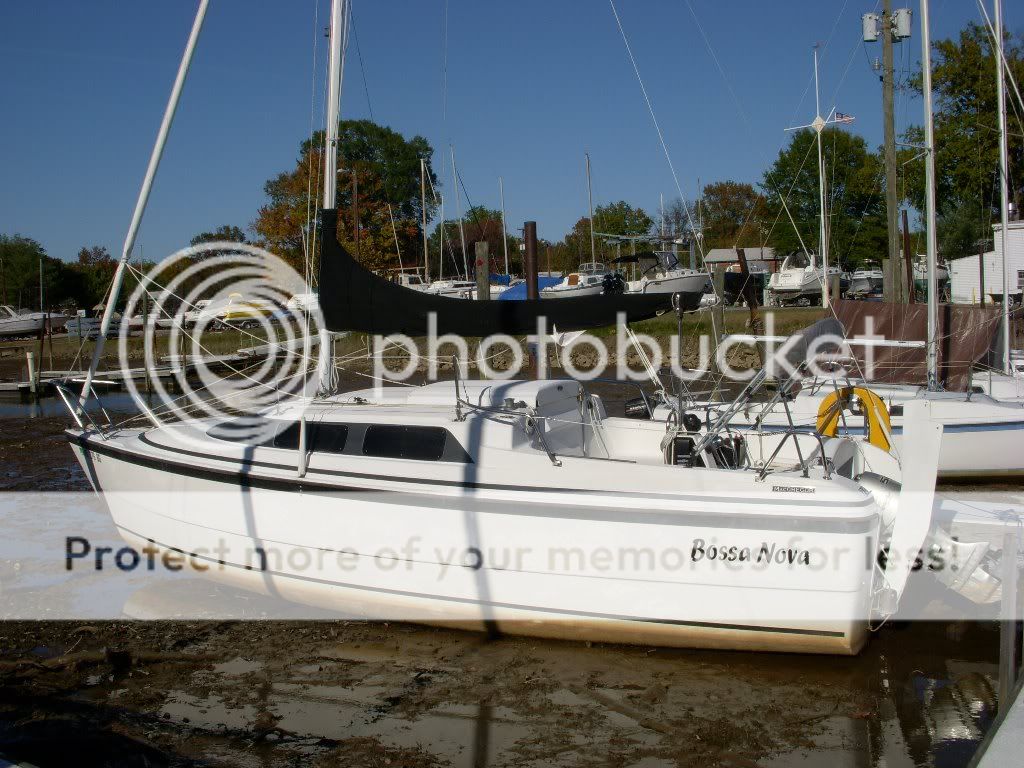
At my previous marina, last October ... and LOOOOWWWW tide!
Not a good day for sailing.

At my previous marina, last October ... and LOOOOWWWW tide!
Not a good day for sailing.


-
rwmiller56

- First Officer
- Posts: 224
- Joined: Wed May 27, 2009 10:10 am
- Sailboat: MacGregor 26M
- Location: SF Bay Area, CA; 2005 MacGregor 26M, "Lazy Lightning", 2015 E-Tec 60 HP
Re: Docking Tactics
Lower the centerboard by 1/3, or as much as you can, and lower the rudders.This will give the boat much better low speed maneuverability.
-
Wind Chime

- Captain
- Posts: 866
- Joined: Sun Jan 21, 2007 4:30 pm
- Sailboat: MacGregor 26X
- Location: Vancouver, B.C. Canada. 2000-26X, Suzuki-50hp, 8' Walker-Bay tender (with sailkit)
- Contact:
Re: Docking Tactics
We ALWAYS use full centerboard and rudders down when docking or maneuvering in a marina. If there is a lot of wind or current, we will also fill the ballast tank.
I like as much control as possible even in calm perfect conditons, just in case. And from a control standpoint, we find she is a completely different boat with "full ballast" and "all flaps down". If not, then she seems to just blow around like a cardboard box on the water.
p.s. - be aware of your prop-walk direction as well.
Darry
I like as much control as possible even in calm perfect conditons, just in case. And from a control standpoint, we find she is a completely different boat with "full ballast" and "all flaps down". If not, then she seems to just blow around like a cardboard box on the water.
p.s. - be aware of your prop-walk direction as well.
Darry
-
parrothead

- First Officer
- Posts: 426
- Joined: Sun Mar 06, 2005 7:25 am
- Sailboat: MacGregor 26M
- Location: Former vessel: '05 M "Blue Heaven" - Nissan 50 TLDI --- Now owner of a Gemini 3400
Re: Docking Tactics
Corkscrew,
I can't say how long the rudders are on an , but on an
  they draw 32".
While having "all fins down" is generally good advice, the situation with your slip sounds similar to ours when we were on the Bohemia River. At extreme low tide we had less than 3' of water, and the conditions were complicated by some pretty dense grass as the season wore on. I would definitely suggest backing in, with the centerboard down to the extent possible and the rudders up. Actually, if you face aft while in reverse, the steering input is simple -- where the motor pulls, the boat will follow. You'll also find it possible to cut a sharper turn with the rudders up, as long as you have some board down for the boat to pivot around. Where we are now, I have to execute a 180 to back into our slip, and even though depth is not an issue here, I always pull the rudders up before making the turn.
I can't say how long the rudders are on an
, but on an they draw 32". While having "all fins down" is generally good advice, the situation with your slip sounds similar to ours when we were on the Bohemia River. At extreme low tide we had less than 3' of water, and the conditions were complicated by some pretty dense grass as the season wore on. I would definitely suggest backing in, with the centerboard down to the extent possible and the rudders up. Actually, if you face aft while in reverse, the steering input is simple -- where the motor pulls, the boat will follow. You'll also find it possible to cut a sharper turn with the rudders up, as long as you have some board down for the boat to pivot around. Where we are now, I have to execute a 180 to back into our slip, and even though depth is not an issue here, I always pull the rudders up before making the turn.
-
Wind Chime
- Captain
- Posts: 866
- Joined: Sun Jan 21, 2007 4:30 pm
- Sailboat: MacGregor 26X
- Location: Vancouver, B.C. Canada. 2000-26X, Suzuki-50hp, 8' Walker-Bay tender (with sailkit)
- Contact:
Re: Docking Tactics
parrothead wrote:You'll also find it possible to cut a sharper turn with the rudders up,
Hi Parrothead,
We have an "X", but are you saying that with an "M", it will turn sharper with rudders up?
Thanks
Darry
-
parrothead
- First Officer
- Posts: 426
- Joined: Sun Mar 06, 2005 7:25 am
- Sailboat: MacGregor 26M
- Location: Former vessel: '05 M "Blue Heaven" - Nissan 50 TLDI --- Now owner of a Gemini 3400
Re: Docking Tactics
For low speed maneuvering that involves some significant turning and backing in tight quarters, rudders-up is the way to go. I think that would be true of the also. Probably the daggerboard on the results in a somewhat more consistent effect, since it provides a pivot point that is always in the same place, regardless of depth of deployment. Wth some board down and the motor at full lock, you can pretty much spin the in its own length.
also. Probably the daggerboard on the results in a somewhat more consistent effect, since it provides a pivot point that is always in the same place, regardless of depth of deployment. Wth some board down and the motor at full lock, you can pretty much spin the in its own length.-
Wind Chime
- Captain
- Posts: 866
- Joined: Sun Jan 21, 2007 4:30 pm
- Sailboat: MacGregor 26X
- Location: Vancouver, B.C. Canada. 2000-26X, Suzuki-50hp, 8' Walker-Bay tender (with sailkit)
- Contact:
Re: Docking Tactics
Parrothead,
Wow ... really? "Rudders UP" on the gives you more control at low speed. Hmmmm.
We find that on our, "Rudders DOWN" gives us more control. When I am out his weekend I will A-B the two, and see what happends. Hey you never know, and if it works it works. I find it's the small things like this, that over the years all add up to a better, safer time on the water.
This would be a good Poll. "Rudders up or Down" (I do not know how to create one on this site, but maybe one of the moderators could, if they thought is was something people wanted to know)
What does everyone else do. "Rudders Up or Down" ?
Wow ... really? "Rudders UP" on the
gives you more control at low speed. Hmmmm. We find that on our
, "Rudders DOWN" gives us more control. When I am out his weekend I will A-B the two, and see what happends. Hey you never know, and if it works it works. I find it's the small things like this, that over the years all add up to a better, safer time on the water.This would be a good Poll. "Rudders up or Down" (I do not know how to create one on this site, but maybe one of the moderators could, if they thought is was something people wanted to know)
What does everyone else do. "Rudders Up or Down" ?
-
parrothead
- First Officer
- Posts: 426
- Joined: Sun Mar 06, 2005 7:25 am
- Sailboat: MacGregor 26M
- Location: Former vessel: '05 M "Blue Heaven" - Nissan 50 TLDI --- Now owner of a Gemini 3400
Re: Docking Tactics
Darry,
A poll would be interesting. I learned about the "face aft when backing up" trick from someone on this board a couple of years ago.
I do want to qualify my comments about "rudders up" as being in response to Corkscrew's docking situation -- low water with a slip situated at 90 degrees to his direction of approach and adjacent to a bulkhead, if I understood it correctly. Sounded very much like our slip at our previous marina [we weren't the in very last slip, but get any closer to the bulkead at low tide and the prop would have been churning bottom].
During our first season, when we were trailer-sailing, I was definitely in "all fins down" mode when approaching the ramp. That certainly seems to be the best mode when going forward and trying to maintain a desired track, especially with a sidewind. Learning to motor "rudders up" was really forced on me during season 2 by our need to come to a stop and then turn 90 degrees and back into our slip, sometimes in less than 3' of water. Our present location does not suffer from lack of depth, but now we have to execute a 180 to back into our silp - which is located between a pair of powerboats whose bow pulpits and anchors protrude beyond the end of their slips. With the rudders down, the maximum angle to which they will turn pretty much defines the arc that boat will cut through the water. WIth the rudders up and the daggerboard down, even only 1' below the bottom of the hull, you can use the motor to pivot the boat around the board, pushing [in forward] or pulling [in reverse] it by the stern, into the desired aligment. The motor is much more efficient in forward than in reverse, so even when backing, course corrections are most effectively made with forward power. For example, if you are backing up in tight quarters and you need to turn, you can shift into neutral while spinning the wheel to opposite lock, give it a quick shot of forward throttle [which will spin the stern in the direction you want it to go], shift back to neutral while centering the wheel, then drop into reverse and continue to back up. With the rudders up, spinning the wheel with the motor in neutral is effortless, and until you apply power in the desired direction, changing the position of the lower unit has no real impact on the heading of the boat. When the rudders are down, they are always "steering" if the boat is in motion, and their surface area resists sudden changes of position.
Have fun experimenting!
Doug
A poll would be interesting. I learned about the "face aft when backing up" trick from someone on this board a couple of years ago.
I do want to qualify my comments about "rudders up" as being in response to Corkscrew's docking situation -- low water with a slip situated at 90 degrees to his direction of approach and adjacent to a bulkhead, if I understood it correctly. Sounded very much like our slip at our previous marina [we weren't the in very last slip, but get any closer to the bulkead at low tide and the prop would have been churning bottom].
During our first season, when we were trailer-sailing, I was definitely in "all fins down" mode when approaching the ramp. That certainly seems to be the best mode when going forward and trying to maintain a desired track, especially with a sidewind. Learning to motor "rudders up" was really forced on me during season 2 by our need to come to a stop and then turn 90 degrees and back into our slip, sometimes in less than 3' of water. Our present location does not suffer from lack of depth, but now we have to execute a 180 to back into our silp - which is located between a pair of powerboats whose bow pulpits and anchors protrude beyond the end of their slips. With the rudders down, the maximum angle to which they will turn pretty much defines the arc that boat will cut through the water. WIth the rudders up and the daggerboard down, even only 1' below the bottom of the hull, you can use the motor to pivot the boat around the board, pushing [in forward] or pulling [in reverse] it by the stern, into the desired aligment. The motor is much more efficient in forward than in reverse, so even when backing, course corrections are most effectively made with forward power. For example, if you are backing up in tight quarters and you need to turn, you can shift into neutral while spinning the wheel to opposite lock, give it a quick shot of forward throttle [which will spin the stern in the direction you want it to go], shift back to neutral while centering the wheel, then drop into reverse and continue to back up. With the rudders up, spinning the wheel with the motor in neutral is effortless, and until you apply power in the desired direction, changing the position of the lower unit has no real impact on the heading of the boat. When the rudders are down, they are always "steering" if the boat is in motion, and their surface area resists sudden changes of position.
Have fun experimenting!
Doug
-
Hardcrab
- Captain
- Posts: 868
- Joined: Tue Sep 19, 2006 8:25 pm
- Sailboat: MacGregor 26M
- Location: "Cease-fire", White 05 M, 90hp, Boggy Bayou, Niceville, FL
Re: Docking Tactics
parrotheads experience is also different than mine.
Full rudders and board down is by far required for the best control, in my experience.
On the technical side, engine steering throw itself is mechanically the same, rudders up or down.
Granted, the turns "lock to lock" is not the same, at least on my M.
I get slightly more steering bar "push" (port turn) than "pull" (stbd turn) due to construction issues.
If the rudders are parallel to each other and aligned parallel to motor thrust, rudder down steering control should be nothing but improved.
Perhaps parrotheads rudders are not parallel to the motor thrust, causing an "adding" effect in one direction and an "opposing" effect in the other?
When he lifts the rudders, nothing fights the engine thrust, making his turns better?
Full rudders and board down is by far required for the best control, in my experience.
On the technical side, engine steering throw itself is mechanically the same, rudders up or down.
Granted, the turns "lock to lock" is not the same, at least on my M.
I get slightly more steering bar "push" (port turn) than "pull" (stbd turn) due to construction issues.
If the rudders are parallel to each other and aligned parallel to motor thrust, rudder down steering control should be nothing but improved.
Perhaps parrotheads rudders are not parallel to the motor thrust, causing an "adding" effect in one direction and an "opposing" effect in the other?
When he lifts the rudders, nothing fights the engine thrust, making his turns better?
-
parrothead
- First Officer
- Posts: 426
- Joined: Sun Mar 06, 2005 7:25 am
- Sailboat: MacGregor 26M
- Location: Former vessel: '05 M "Blue Heaven" - Nissan 50 TLDI --- Now owner of a Gemini 3400
Re: Docking Tactics
Hardcrab,
I know exactly what you are talking about, re: rudders & motor not parallel -- that's how our was delivered. The clue is when you are motoring along at low speed and find that lifting the second rudder requires a change in steering to maintain the same direction. That's been fixed 
I know exactly what you are talking about, re: rudders & motor not parallel -- that's how our
was delivered. The clue is when you are motoring along at low speed and find that lifting the second rudder requires a change in steering to maintain the same direction. That's been fixed