prop size

A forum for discussion of how to rig and tune your boat or kicker to achieve the best sailing performance.
User avatar
trip01
Engineer
Posts: 134
Joined: Sat Sep 12, 2009 3:30 am
Sailboat: MacGregor 26M
Location: Brisbane North, 08 M, Yamaha F60, al trailer

Re: prop size

Post by trip01 »

Tested out the Solas Amita 4 11.8 x 9. With motor trimmed, 5200rpm. Notice the singing sound around 1500 - 2000rpm also. :|
This is the lowest pitch available in a solas 4 blade. I reckon I'll stick with this. :wink: The 4 blade seems to provide more torque. :) Perhaps more fuel usage also. :(

Kind Rgds
Dave
26M 2008 / Yamaha 60hp 4 stroke 2007
User avatar
Terry
Admiral
Posts: 1487
Joined: Thu Feb 19, 2004 2:35 pm
Sailboat: MacGregor 26M
Location: Vancouver, B.C. Canada. '03 26M - New Yamaha 70

Re: prop size

Post by Terry »

trip01 wrote:Tested out the Solas Amita 4 11.8 x 9. With motor trimmed, 5200rpm. Notice the singing sound around 1500 - 2000rpm also. :|
This is the lowest pitch available in a solas 4 blade. I reckon I'll stick with this. :wink: The 4 blade seems to provide more torque. :) Perhaps more fuel usage also. :(

Kind Rgds
Dave
26M 2008 / Yamaha 60hp 4 stroke 2007
That Solas would be an ideal match for a Honda 50 but you have a Yamaha 60, my guess is that you could take that prop to a prop shop and have it re-pitched from 9" to 10" or 10.5" which would increase your rpm to about 5500 and give you a bit more speed. I get my Honda up to 5600 rpm with ballast and about 5900-6000 rpm without ballast with my Solas Alcup 4 X 11.4 X 10.5 prop. I had it re-pitched at a shop to get the 10.5" pitch. The Alcup has a slight bit of cupping on the trailing edge (which is similar to more pitch in the effect it has on rpm) to provide more bite on the water, something the Amita does not have.
:wink:
User avatar
trip01
Engineer
Posts: 134
Joined: Sat Sep 12, 2009 3:30 am
Sailboat: MacGregor 26M
Location: Brisbane North, 08 M, Yamaha F60, al trailer

Re: prop size

Post by trip01 »

Final analysis... (empty ballast - motor trimmed)

Orig 3 blade 11 3/8" x 12" 4300 rpm @ WOT :x
Amita 4 - 11.8" x 9" 5200 rpm @ WOT (sings around 1500 to 2000 rpm) :P
Amita 3 - 12.1" x 9" 5300 rpm @ WOT (very slight sing at low revs) :wink:

Kind Rgds
Dave
08 26M / Yamaha 60 hp 4 stroke.
User avatar
opie
Captain
Posts: 895
Joined: Tue Nov 16, 2004 5:40 am
Sailboat: MacGregor 26X
Location: Wilmington, NC

Re: prop size

Post by opie »

I also have a new-to-me Solas 11.8 x 9 4 -blade prop, but as I said above, I can not use it because of singing and vibration at idle speed (1740 rpm or near there). I need to go idle speed in many places around here for 15 minutes at a time to get from ramp to open water. The CG will wave their palms-down at me when I go over 2000 rpm, honestly.

So I have done a lot of research on singing of Solas props.

First, Solas responded to me direct by email and said that stuff happens and I should just return the prop under warranty. But, I did not buy it. And it is several years old anyway.

Second, here are some web-finds:

---- Propellers: Singing of the propeller is a critical vibration phenomena of the blades, which, in all probability, is the result of fluctuations of the point at which vortices leave the trailing edge of the blade. An anti-singing edge applied to the trailing edge of the propeller blades fixes the separation point of the boundary layer and removes the vibration.

---- edges and tips must be maintained as sharp and clean as called for on the propeller drawing. A propeller can vibrate in many different ways, and each vibration is associated with a definite frequency. Forces that cause vibrations of a definite frequency are sometimes the result of blunt edges on the blades near the tip, and these vibrations result in a noisy or singing propeller. Propellers are dynamically balanced to prevent vibrations when in service.

---- Propeller singing" is produced by periodic vortex shedding. Singing noise is enhanced by torsional and flexural resonances of the propeller blades. Significant frequencies (blade resonances) generally lie above blade rate frequencies. When this occurs, it is very important.

MidLandOne
Registered User, Join Date: Sep 2007, Location: New Zealand, Posts: 1,058
As GreatKetch says it is likely a resonance and not unusual to find it on a new boat or one repropped. The usual cure is to grind a little off the trailing edge of the prop blades but I would recommend that you get some advice on this from a prop specialist appropriate to your prop type (sail boat optimised, conventional, etc). I have come across it while on new 100 foot plus cats during commissioning and the resonance on larger props can be very loud, especially as they are twin engined of course - but a touch with the grinder in the right hands kills it completely.
If it is not too bad you may find it goes away once the prop is fouled a little. Our own prop (a narrow bladed sail boat optimised one) sings a little for a while just after it has been polished until it has fouled a little.

Singing Propellers
What makes a propeller "sing"? Some propellers produce an audible high-pitched tone which has come to be known as "singing". More of an annoyance than anything harmful, the hydrodynamics of singing have been a source of debate for decades. The most widely-held opinion is that the tone is produced by alternating vortices which roll off of the trailing-edge of the blade. Singing is produced if the vortices develop into a well-behaved system (e.g., a continuous steady "train" of eddies) and the frequency of this "train" is in the audible range. The most frequent cure for a singing propeller is the popular "anti-singing edge". This is a chamfer applied to the trailing-edge to promote separation of the vortices.

Mitigation of singing
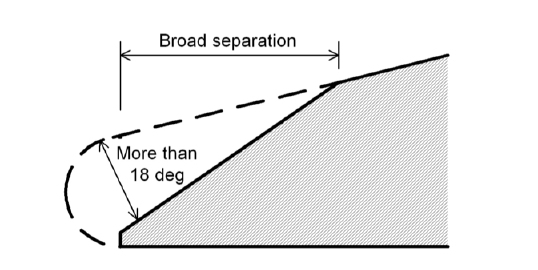
These relationships also tell us that singing is a function of propeller diameter and rpm, boat speed, and trailing-edge size (thickness) and "roundness”. We cannot do much about diameter, rpm or speed, but we can modify the edge geometry. This has been the strategy for all efforts to eliminate singing. Most propeller professionals (and others) are familiar with the “anti-singing edge” – a chamfering of the trailing edge, typically on the suction side. (Trailing edge is the edge of the blade that does not cut the water.) The intent of this shape is to avoid the creation of curving flow eddies by cleanly separating the flow off of the blade. The following graphic illustrates the desired geometry of an anti-singing edge, where points of flow separation are spaced both in thickness and in flow-stream position Many sources recommend that the anti-singing edge be applied from the 40% radius (0.4R) fully to the tip, or even slightly beyond [Carlton, 1993]. It has also been noted that erosion of the blade edge is a risk if the new edge were made too thin. There is also some evidence that cup can be an effective anti-singing technique. Cupping, however, changes the thrust and power characteristics of the propeller, where an “anti-singing edge” would not measurably alter performance.
Image


So, in conclusion, based on the above, (and ready to listen to anyone of you with advice on this matter) I will chamfer the trailing edge
of my Solas 4 blades to match the picture above. I will also sand the blades to a satin finish rather than the shiny white surface I have now. (Sorta the same thing as fouling the prop over hours of use and hitting the soft sand a few times.)

Any advice is welcome. Otherwise I will post results when I get to the water again.
User avatar
DaveB
Admiral
Posts: 2543
Joined: Mon Jan 07, 2008 2:34 pm
Sailboat: MacGregor 26X
Location: Cape Coral, Florida,1997 Mac. X, 2013 Merc.50hp Big Foot, sold 9/10/15

Re: prop size

Post by DaveB »

If you change to a higher pitch (9 to a 10) you will lower top end RPM's.
My Honda 50 after trying out the Alcup and Amita has a 11.8 x 10 ,4 blade Solas Amita.
Top RPM's is 4800 and thats ok with me as I cruise between 5.5-6 knots and with the higher pitch I can do that between 2000-2500 rpms in 1-2 ft.waves ,no current.
I only get 13.8 knots on a fully loaded boat compared to 15.1 knots on my 3 blade prop. but I perfer the handling and grip the 4 blade has and the lower rpm's at my cruise speed especially coming into a ramp thats open to 15 knots of wind with empty ballast.
Dave

Kind Rgds
Dave
26M 2008 / Yamaha 60hp 4 stroke 2007[/quote]
That Solas would be an ideal match for a Honda 50 but you have a Yamaha 60, my guess is that you could take that prop to a prop shop and have it re-pitched from 9" to 10" or 10.5" which would increase your rpm to about 5500 and give you a bit more speed. I get my Honda up to 5600 rpm with ballast and about 5900-6000 rpm without ballast with my Solas Alcup 4 X 11.4 X 10.5 prop. I had it re-pitched at a shop to get the 10.5" pitch. The Alcup has a slight bit of cupping on the trailing edge (which is similar to more pitch in the effect it has on rpm) to provide more bite on the water, something the Amita does not have.
:wink:[/quote]
User avatar
atzserv
Engineer
Posts: 149
Joined: Thu Dec 21, 2006 5:58 am
Sailboat: MacGregor 26M
Location: 06 26M, Honda 50, Ocean Gate, New Jersey

Re: prop size

Post by atzserv »

Need your help.

I have a Michigan 12 X 9 prop I bought for my Honda 50 that goes on my 2006 26M. I can"t tell the size of the original prop it came with, it is a 3 blade prop.

The original prop gets 3500 rpm at full throttle and the gps shows 14.5 kts ot 16.7 mph. the 4 blade prop gets 3500 prm max and I forget the max speep but it is a little less, being a 4 blade prop.

My question is this, why the 3500 max rpm?

I didn't have a tach originally but was OK with almost 17 mph. Now that the tach says 3500 at WOT I want more, lol. I see that the solas 4 blade that is 11.8 X 9 on a honda that is on a 26m is getting 5800 rpm but only the same mph I get.

Is the tach wrong? Does anyone see an obvious problem?

Thanks Gary
valdez53
Just Enlisted
Posts: 11
Joined: Fri Mar 19, 2010 10:41 am
Sailboat: MacGregor 25

Re: prop size

Post by valdez53 »

I have a Prop Size Question.... My Mac 25 has a "souped up" 1976 Evinrude 9.9 two-stroke on it...(totally re-built with a 55 amp 1 wire delco altnerator mounted on top) what would be the best "pusher" prop??? I get so confused!
User avatar
Love MACs
Captain
Posts: 587
Joined: Tue Jan 08, 2008 10:56 pm
Sailboat: MacGregor 26X
Location: Eddyville, KY; 2002 X, 50hp Merc-4 stroke: Dream Chaser
Contact:

Re: prop size

Post by Love MACs »

Any truth to the statement that you shouldn't use stainless steel props with outboards :?: :| The reason I was given was that they, stainless steel props, are so tough to break, that if you hit a hard obstacle with it, your lower unit is more likely to be damaged as the prop is not likely to break off like the aluminum ones.

I had never heard this before until yesterday.

Allan
User avatar
opie
Captain
Posts: 895
Joined: Tue Nov 16, 2004 5:40 am
Sailboat: MacGregor 26X
Location: Wilmington, NC

Re: prop size

Post by opie »

Finally got to test the theory I put forward above about fixing the singing and vibration on Solas 4 blade props. I ground off the cups on all blades and roughed up the surface and made the bevel per the detail shown above.. On the water test last week proved that the singing is gone and vibration also.
User avatar
DaveB
Admiral
Posts: 2543
Joined: Mon Jan 07, 2008 2:34 pm
Sailboat: MacGregor 26X
Location: Cape Coral, Florida,1997 Mac. X, 2013 Merc.50hp Big Foot, sold 9/10/15

Re: prop size

Post by DaveB »

Stainless Props are for high performance on power boats. If you cruise in thin waters get the much lower cost Aluminum Prop.
Stainless props will do much more damage to your lower unit than a Aluminum Prop.
They tend to bend or completely brake off a blade compared to a Aluminum blade that usually nicks,or in hard grounding bend the blades but usually able to power boat at low speeds.
On a Mac. Aluminum is the choice, besides many want to change props or change pitch and Cup.
You can spend 3-4 times the cost of a Aluminum prop. and may not get good end results.
Dave
Love MACs wrote:Any truth to the statement that you shouldn't use stainless steel props with outboards :?: :| The reason I was given was that they, stainless steel props, are so tough to break, that if you hit a hard obstacle with it, your lower unit is more likely to be damaged as the prop is not likely to break off like the aluminum ones.

I had never heard this before until yesterday.

Allan
Post Reply