I also have a new-to-me Solas 11.8 x 9 4 -blade prop, but as I said above, I can not use it because of singing and vibration at idle speed (1740 rpm or near there). I need to go idle speed in many places around here for 15 minutes at a time to get from ramp to open water. The CG will wave their palms-down at me when I go over 2000 rpm, honestly.
So I have done a lot of research on singing of Solas props.
First, Solas responded to me direct by email and said that stuff happens and I should just return the prop under warranty. But, I did not buy it. And it is several years old anyway.
Second, here are some web-finds:
---- Propellers: Singing of the propeller is a critical vibration phenomena of the blades, which, in all probability, is the result of fluctuations of the point at which vortices leave the trailing edge of the blade. An anti-singing edge applied to the trailing edge of the propeller blades fixes the separation point of the boundary layer and removes the vibration.
---- edges and tips must be maintained as sharp and clean as called for on the propeller drawing. A propeller can vibrate in many different ways, and each vibration is associated with a definite frequency. Forces that cause vibrations of a definite frequency are sometimes the result of blunt edges on the blades near the tip, and these vibrations result in a noisy or singing propeller. Propellers are dynamically balanced to prevent vibrations when in service.
---- Propeller singing" is produced by periodic vortex shedding. Singing noise is enhanced by torsional and flexural resonances of the propeller blades. Significant frequencies (blade resonances) generally lie above blade rate frequencies. When this occurs, it is very important.
MidLandOne
Registered User, Join Date: Sep 2007, Location: New Zealand, Posts: 1,058
As GreatKetch says it is likely a resonance and not unusual to find it on a new boat or one repropped. The usual cure is to grind a little off the trailing edge of the prop blades but I would recommend that you get some advice on this from a prop specialist appropriate to your prop type (sail boat optimised, conventional, etc). I have come across it while on new 100 foot plus cats during commissioning and the resonance on larger props can be very loud, especially as they are twin engined of course - but a touch with the grinder in the right hands kills it completely.
If it is not too bad you may find it goes away once the prop is fouled a little. Our own prop (a narrow bladed sail boat optimised one) sings a little for a while just after it has been polished until it has fouled a little.
Singing Propellers
What makes a propeller "sing"? Some propellers produce an audible high-pitched tone which has come to be known as "singing". More of an annoyance than anything harmful, the hydrodynamics of singing have been a source of debate for decades. The most widely-held opinion is that the tone is produced by alternating vortices which roll off of the trailing-edge of the blade. Singing is produced if the vortices develop into a well-behaved system (e.g., a continuous steady "train" of eddies) and the frequency of this "train" is in the audible range. The most frequent cure for a singing propeller is the popular "anti-singing edge". This is a chamfer applied to the trailing-edge to promote separation of the vortices.
Mitigation of singing
These relationships also tell us that singing is a function of propeller diameter and rpm, boat speed, and trailing-edge size (thickness) and "roundness”. We cannot do much about diameter, rpm or speed, but we can modify the edge geometry. This has been the strategy for all efforts to eliminate singing. Most propeller professionals (and others) are familiar with the “anti-singing edge” – a chamfering of the trailing edge, typically on the suction side. (Trailing edge is the edge of the blade that does not cut the water.) The intent of this shape is to avoid the creation of curving flow eddies by cleanly separating the flow off of the blade. The following graphic illustrates the desired geometry of an anti-singing edge, where points of flow separation are spaced both in thickness and in flow-stream position Many sources recommend that the anti-singing edge be applied from the 40% radius (0.4R) fully to the tip, or even slightly beyond [Carlton, 1993]. It has also been noted that erosion of the blade edge is a risk if the new edge were made too thin. There is also some evidence that cup can be an effective anti-singing technique. Cupping, however, changes the thrust and power characteristics of the propeller, where an “anti-singing edge” would not measurably alter performance.
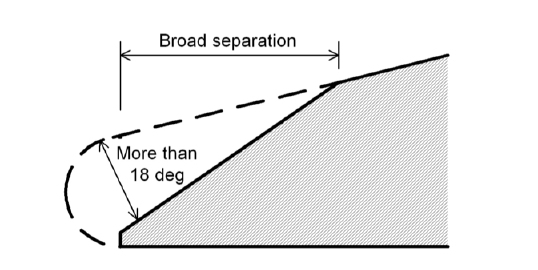
So, in conclusion, based on the above, (and ready to listen to anyone of you with advice on this matter) I will chamfer the trailing edge
of my Solas 4 blades to match the picture above. I will also sand the blades to a satin finish rather than the shiny white surface I have now. (Sorta the same thing as fouling the prop over hours of use and hitting the soft sand a few times.)
Any advice is welcome. Otherwise I will post results when I get to the water again.


 The 4 blade seems to provide more torque.
  Perhaps more fuel usage also.


