

I was looking into cooking alternatives in last years defender mag. To me, electricial burner seemed logical. I have that on my boat already, and am not adding anything flammable.
Defender didn't have even a single burner unit that ran only on 12 volts. I assumed that's just the way it is. Has anyone seem 1?
About power... for those folks like me who only seem to use the lights and radio. What do I need to closely monitor my batteries other that the stupid voltage meter. I read 12 volts on both batteries, but couldn't get the motor cranked. Luckily it was just a quick splash of her hiney only before going in for the Etec recall.... this time.
thanks,
Erik
Solar Panel
-
March

- Captain
- Posts: 970
- Joined: Wed May 24, 2006 7:54 am
- Sailboat: MacGregor 26X
- Location: Iowa, MacGregor 26X, Yamaha 4 stroke 50 HP
Re: Solar Panel
Xantrex link 2000 will allow you to monitor two batteries. It's not cheap, but it delivers--once you figure out the controls and set it correctly
-
Sumner

- Admiral
- Posts: 2375
- Joined: Sun Jan 04, 2009 3:20 pm
- Sailboat: MacGregor 26S
- Location: SE Utah
- Contact:
Re: Solar Panel
I doubt you are going to find a 12 volt burner that would amount to anything for the reasons posted above about the hair dryer. To get any kind of heat output it would be drawing so many amps (about 10 times as many as an equivalent 110-120 volt one) that you would have to be running really large wires to it and you battery would be very short lived.Sea Striker wrote:I was looking into cooking alternatives in last years defender mag. To me, electricial burner seemed logical. I have that on my boat already, and am not adding anything flammable.
Defender didn't have even a single burner unit that ran only on 12 volts. I assumed that's just the way it is. Has anyone seem 1?
About power... for those folks like me who only seem to use the lights and radio. What do I need to closely monitor my batteries other that the stupid voltage meter. I read 12 volts on both batteries, but couldn't get the motor cranked. Luckily it was just a quick splash of her hiney only before going in for the Etec recall.... this time.
thanks,
Erik
I don't know how accurate of a voltmeter you are using, but......
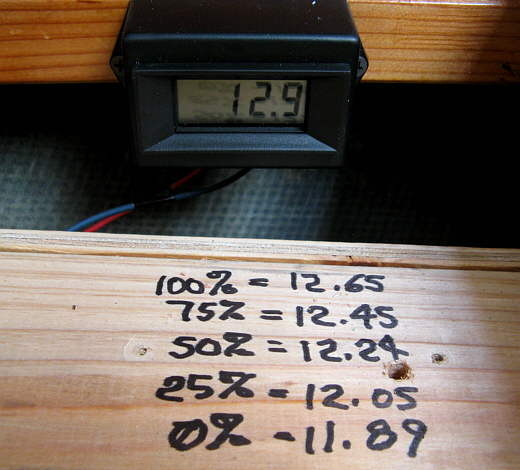
.....if you were reading 12 volts with no load (before starting the outboard) the battery was close to dead. I use the $35 digital voltmeter in the picture.....
http://purplesagetradingpost.com/sumner ... de-12.html
.... and it does the job for me, but won't tell you as much as a good battery monitor would and I have to revert to the written cheat sheet scribbled on the piece of wood by it. I have, but haven't installed it yet, a digital amp meter that looks just like that voltmeter and it will help me better decide when I might want to stop running the generator I have. I'll also be able to accurately measure how many amps different appliances draw.
c ya,
Sum
Our Trips to...
Our Mac Pages
Mac Links
-
Nautek

- First Officer
- Posts: 253
- Joined: Mon Jul 14, 2008 2:55 am
- Sailboat: MacGregor 26X
- Location: Tingoora, Queensland, Australia ~ "MacSea"
Re: Solar Panel
An auto electrician once told me 30 years ago when I was setting up my motorhome to forget the amp meter and go for volt meter
He said you can be pumping out 50 amps but if the battery is not taking it then it is all for naught.
A volt meter shows you the correct state of the batteries.
He was right and I have never installed an amp meter since.
However they are good for seeing what things draw but with 12 volt it is pretty easy to work that out
Allan
He said you can be pumping out 50 amps but if the battery is not taking it then it is all for naught.
A volt meter shows you the correct state of the batteries.
He was right and I have never installed an amp meter since.
However they are good for seeing what things draw but with 12 volt it is pretty easy to work that out
Allan
-
March
- Captain
- Posts: 970
- Joined: Wed May 24, 2006 7:54 am
- Sailboat: MacGregor 26X
- Location: Iowa, MacGregor 26X, Yamaha 4 stroke 50 HP
Re: Solar Panel
On the other hand, if you don't have the amps, you can connect two 9 volt pocket batteries to your engine and, much to your surprise, your engine will refuse to start.
Imagine the batteries as a recipient with liquid on a shelf. You plunge a rubber tube in it, and want to move the liquid into a lower recipient (if you add a little watermill in between, that would be your "consumer" i.e., the engine, or a bulb) The voltage is the difference in level between the wto recipients. If they are on the same level, the water won't flow. The voltage will be zero. The higher one is set, the higher the voltage.
The amperage is the quantity of water flowing through the tube. The bigger the tube, the more water will trickle (if the difference in height is significant). The tube is the "resistance" of the conductor and of the device
In order to keep your little watermill turning, you need a significant quantity of water. That's the amperage. You can have the difference in level, but if your water simply triclkles cuz you don't have the amperage, it won't turn the wheel. If your tube is bigger and the quantity of water is significant, it will turn the wheel if you set the "battery" at a significant height. If the height is not high enough (so not enough voltage) then no matter what the quantity of water, the wheel will still refuse to turn.
Imagine the batteries as a recipient with liquid on a shelf. You plunge a rubber tube in it, and want to move the liquid into a lower recipient (if you add a little watermill in between, that would be your "consumer" i.e., the engine, or a bulb) The voltage is the difference in level between the wto recipients. If they are on the same level, the water won't flow. The voltage will be zero. The higher one is set, the higher the voltage.
The amperage is the quantity of water flowing through the tube. The bigger the tube, the more water will trickle (if the difference in height is significant). The tube is the "resistance" of the conductor and of the device
In order to keep your little watermill turning, you need a significant quantity of water. That's the amperage. You can have the difference in level, but if your water simply triclkles cuz you don't have the amperage, it won't turn the wheel. If your tube is bigger and the quantity of water is significant, it will turn the wheel if you set the "battery" at a significant height. If the height is not high enough (so not enough voltage) then no matter what the quantity of water, the wheel will still refuse to turn.
-
Sumner
- Admiral
- Posts: 2375
- Joined: Sun Jan 04, 2009 3:20 pm
- Sailboat: MacGregor 26S
- Location: SE Utah
- Contact:
Re: Solar Panel
Well I agree with most of what he is saying, but the reason I want the amp-meter is primarily to help us when charging with .....Nautek wrote:An auto electrician once told me 30 years ago when I was setting up my motor home to forget the amp meter and go for volt meter
He said you can be pumping out 50 amps but if the battery is not taking it then it is all for naught.
A volt meter shows you the correct state of the batteries.
He was right and I have never installed an amp meter since.
However they are good for seeing what things draw but with 12 volt it is pretty easy to work that out
Allan
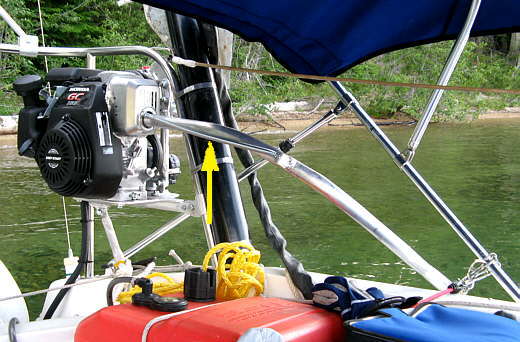
http://purplesagetradingpost.com/sumner ... de-13.html
....the Honda/Alternator Generator. If the batteries are low and I start the generator it will put out more amps to the batteries, but as they move to full charge their ability to take the same amperage charge goes down and I get to the point of diminishing returns. I don't really know where that is right now with just the volt meter. Right now I usually stop charging when the voltage gets to about 14.1 volts. I can charge longer and get it higher, but at a slower rate of return.
With the amp-meter if the charge goes from say an initial charge rate of 30 amps down to 4-5 I might consider I'm done. Of course once I know where that point is I can look at the voltmeter and use its voltage at that point in the future for a reference point also. The amp-meter and voltmeter are about $40 each and for that it is worth it as we have to deal with the batteries every day we are out.
With the amp-meter that reads in 1/10th of an amp increments I'll also have a real life idea of exactly what any 12 volt appliance I'm using draws. I just need to turn the one item on I'm interested in or notice the difference between old and new amperage as I use it. I'm really interested in seeing what the new......
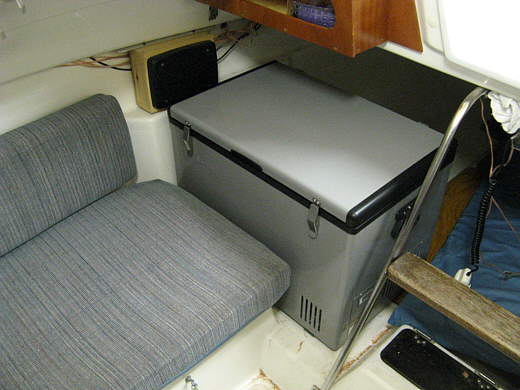
http://purplesagetradingpost.com/sumner ... de-22.html
....frig does in actual use and to also see the amperage draw of the new outboard we are getting while starting to make sure I have an adequate size wire from the batteries in the cabin to it.
One last thing about using voltage and that is trying to use that to determine the charged state of the batteries depends on quite a bit of variables, such as is it being charged by anything at the moment, is it being discharged by anything at the moment, how long since it had a charge or a load on it. Still I think the subject can be nit-picked to pieces and I have used the voltage method to decide when to charge our batteries with ok results to this point. There are ways to lengthen the life of your batteries, but for us it is use them and when we need new ones we will have to spend the money on them. Since we spend virtually every night on the boat on the road and on the water, just saving one night at a motel almost buys a battery
 .
.c ya,
Sum
Our Trips to...
Our Mac Pages
Mac Links

-
Inquisitor

- Captain
- Posts: 926
- Joined: Mon Apr 23, 2007 5:24 pm
- Sailboat: MacGregor 26M
- Location: North Carolina Mountains
Re: Solar Panel
With hints like this, I'd take a WAG and say you're heading toward electric propulsion. I surely can't think of anything else on a boat needing that kind of load for that long. At first glance, I discounted electric propulsion. The idea of converting gas to rotation (inefficient) to electricity (inefficient) to storage (inefficient) back to rotation seemed Rube Goldbergesque. I later learned that running the motor at optimum speed as a “generator” can be more efficient and thus overcome the other inefficiencies in the total system.Duane Dunn, Allegro wrote:... Also in my case, a Honda generator / high output charger combo can't really produce the power I need. 8 amps is out of the question, even a 30-40 amp charger won't cut it. My 'special' application needs 50-80 amps of 12v power for hours on end. It's much easier to produce this with a small 12v generator. At times I may want to charge my 450 amp hour battery bank so the variable amp output up to a max of 80 amps will be handy for this as well.
I really like the idea of suspending the generator for noise isolation. I'm going to have to work on that idea, the bow won't work in my case but there is a lot of space on a X transom if a particularly large object in the middle is removed.
For a sailboat the most common case of firing of the iron jenny just to motor to/from the dock can easily be handled totally with batteries in an electric system and then slowly recharged (while sailing) using solar, wind or even water generators (regenerative or independent).
The down side being, for long motoring times (that we hope to avoid) we have to have a fuel powered charging source.
I had gotten this far, but hadn’t started down the logic path of AC versus DC generation. Your and other’s proposal that a direct to 12 VDC generator would be more efficient than using one of these 120 VAC generators and then having to convert it back to 12 VDC to charge the batteries and/or run the propulsion motors seems obvious at first glance (like my first glance above). However, with the technology that Honda can bring to bear on the problem. For example…
(1) Electronic - speed control based exactly on electric requirements.
(2) Mechanical – the generator is directly connected to the drive shaft and even the fly wheel has been removed as the generator acts as the fly wheel versus geared or belt driven automotive generators.
(3) Just knowing that to command their prices ~$1000 for Honda 1000W versus $89 for a Harbor Freight special, they have to be better in many ways… sound, fuel efficiency, sine wave versus modified and so on…
Although, these 12 VDC generators may use a Honda engine, the electronics, mechanical systems and sound deadening have not been optimized for power generation. I’m just wondering if maybe on second site a total system (including the 120 VAC to 12 VDC charging unit) might not be more efficient than these direct 12 VDC systems????
Since you have obviously researched many things... have you seen any comparisons of "real world" end to end efficiencies?
-
Inquisitor
- Captain
- Posts: 926
- Joined: Mon Apr 23, 2007 5:24 pm
- Sailboat: MacGregor 26M
- Location: North Carolina Mountains
Re: Solar Panel
Are these numbers good for any 12V battery? Or are they just lead/acid batteries? Or do they change based on vendors or styles? If yes... even to the hundredths decimal place you have here?Sumner wrote:
Thanks, this will be a great help!
-
Sumner
- Admiral
- Posts: 2375
- Joined: Sun Jan 04, 2009 3:20 pm
- Sailboat: MacGregor 26S
- Location: SE Utah
- Contact:
Re: Solar Panel
Lead acid for sure, but even then if you google it you will see some charts are slightly different. Also the numbers should be read with a very small load on the battery and not while charging obviously. I just use it as a guide and not an absolute. Once you know your system it will fall into place.Inquisitor wrote:Are these numbers good for any 12V battery? Or are they just lead/acid batteries? Or do they change based on vendors or styles? If yes... even to the hundredths decimal place you have here?Sumner wrote:
Thanks, this will be a great help!
I got the volt meter from solarblvd.com and also an amp meter just like it, but haven't installed it yet. I'm hoping the amp meter will do a couple things for me. One is that I can turn just one thing on and actually see what it draws to the tenth of an amp so I have an idea of how it is effecting my battery/electrical demands. The other is I'll be able to watch my charge rates while charging with my gas engine driven alternator. When the charge rates drop to a certain point I'll stop charging. Now I look at the volts while charging and generally stop when the charge voltage gets to about 14.1.
c ya,
Sum
Our Trips to..
Our Mac Pages
Mac Links
-
Duane Dunn, Allegro

- Admiral
- Posts: 2459
- Joined: Fri Jan 02, 2004 6:41 pm
- Sailboat: MacGregor 26X
- Location: Bellevue, Wa '96 26x, Tohatsu 90 TLDI and Plug In Hybrid Electric drive
- Contact:
Re: Solar Panel
One thing to keep in mind, using voltage to measure the charge state of a battery is not accurate if the battery has recently had a load on it. Voltage is only an accurate measurement of the charge state after the battery has been rested without a load for 4 - 8 hours. In practice this is not useful at all when actively cruising in a boat.
Scroll down to the "State-of-charge reading based on terminal voltage" section at this link
http://www.batteryuniversity.com/partone-13.htm
The only way to really know the charge state of a battery in active use is an amp hour meter that keeps track of the actual flow of amps in and out of the battery. Voltage alone will not do it, nor will a simple amp meter. The amp meter only gives you an indication of the load going out or charge going in at that instant. An amp hour meter keeps a running tally of all the ins and outs allowing you to really know how much juice is usable. They also use sophisticated algorithms that account for a batteries varying efficiency with different sized loads.
There is lots of good info on them here
http://www.xantrex.com/web/id/273/p/1/pt/7/product.asp
http://www.xantrex.com/web/id/274/p/1/pt/7/product.asp
Scroll down to the "State-of-charge reading based on terminal voltage" section at this link
http://www.batteryuniversity.com/partone-13.htm
The only way to really know the charge state of a battery in active use is an amp hour meter that keeps track of the actual flow of amps in and out of the battery. Voltage alone will not do it, nor will a simple amp meter. The amp meter only gives you an indication of the load going out or charge going in at that instant. An amp hour meter keeps a running tally of all the ins and outs allowing you to really know how much juice is usable. They also use sophisticated algorithms that account for a batteries varying efficiency with different sized loads.
There is lots of good info on them here
http://www.xantrex.com/web/id/273/p/1/pt/7/product.asp
http://www.xantrex.com/web/id/274/p/1/pt/7/product.asp
Last edited by Duane Dunn, Allegro on Mon Apr 05, 2010 10:13 am, edited 1 time in total.
-
Duane Dunn, Allegro
- Admiral
- Posts: 2459
- Joined: Fri Jan 02, 2004 6:41 pm
- Sailboat: MacGregor 26X
- Location: Bellevue, Wa '96 26x, Tohatsu 90 TLDI and Plug In Hybrid Electric drive
- Contact:
Re: Solar Panel
Inquisitor,
You are correct about electric propulsion on my boat.
I'm slowly getting info on my prototype up here
http://www.rudderprop.com
I'm making a rough prototype of my custom props for more testing this week.
You are correct about electric propulsion on my boat.
I'm slowly getting info on my prototype up here
http://www.rudderprop.com
I'm making a rough prototype of my custom props for more testing this week.
-
bubba

- Captain
- Posts: 896
- Joined: Fri Mar 21, 2008 11:04 am
- Sailboat: MacGregor 26M
- Location: Richland,WA Columbia River Lake Wallula "INSPIRATION" w/70 suz. 9' Merc dingy
- Contact:
Re: Solar Panel
I came across this solar pannel product in the Lattititudes and Attitudes magizine. http://www.aurinco.com/index.html The panels are some what flexiable for mounting and you can walk on them if needed and only 3/16 inch thick and very light. Were going to install them over our fading M stripes, bow windows ( which we cover always ) and sliding hatch on our M. My wifes laptop uses 90 watts and is on for work 8 hours a day so probably 5 big batteries or more with one for the motor, just to power the laptop, autopilot, chartplotter, radar, TV and XM radio. I told my wife she would have to bring less clothings because of the extra batteries and she said fine.
-
Sumner
- Admiral
- Posts: 2375
- Joined: Sun Jan 04, 2009 3:20 pm
- Sailboat: MacGregor 26S
- Location: SE Utah
- Contact:
Re: Solar Panel
I agree that you won't have a "precise charge state", but like I said...Duane Dunn, Allegro wrote:One thing to keep in mind, using voltage to measure the charge state of a battery is not accurate if the battery has recently had a load on it. Voltage is only an accurate measurement of the charge state after the battery has been rested without a load for 4 - 8 hours. In practice this is not useful at all when actively cruising in a boat.........
It has worked just fine for us being out up to a month at a time. We have never been out of electricity when we needed it... I just use it as a guide and not an absolute. Once you know your system it will fall into place.
 . I just need to know when the batteries are down and it they are about charged. I have no problem if someone wants to spend their money on a good charge monitoring system, we just don't need to ourselves,
Sum
Our Trips to...
Our Mac Pages
Mac Links
Last edited by Sumner on Mon Apr 05, 2010 12:38 pm, edited 1 time in total.
-
Sumner
- Admiral
- Posts: 2375
- Joined: Sun Jan 04, 2009 3:20 pm
- Sailboat: MacGregor 26S
- Location: SE Utah
- Contact:
Re: Solar Panel
Have you thought about maybe a 12 volt computer? The one I'm building should be under 40 watts total for the computer/monitor.....bubba wrote:....... My wifes laptop uses 90 watts and is on for work 8 hours a day....
http://purplesagetradingpost.com/sumner ... Index.html
I got a lot of ideas from this guy.....
http://74.125.47.132/search?q=cache:4Rm ... clnk&gl=us
...and his will be a little faster (more computing power) than what I'm building, but still seems to work on about 40 watts minus the monitor (my monitor is 10 watts).
Are you using an inverter to 110 or a 12 volt inverter to the computer input voltage. The second might save you some wattage also. See the Lind that was talked about before....
http://www.lindelectronics.com/cgi-bin/ ... _products/
c ya,
Sum
Our Trips to...
Our Mac Pages
Mac Links