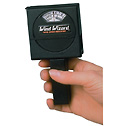
As Russ points out, the masthead position is more likely to be in a clean, undisturbed airstream. The masthead position will also give a better indication of the relative wind direction, so the two instruments, often combined, are both located there conveniently at the same time.
Assuming both upper and lower windspeed measurements are taken in unimpeded and non backwinded locations, they will be equally accurate, but different, because friction with the surface causes the wind speed to be greater the higher the measurement is taken. By how much varies with how strong the winds are (and a few other things). Which is why sails must be twisted to get maximum power, as I mentioned in another recent post.
You will notice that a gust leads higher up, so it will hit the top of the sail before it hits the lower parts of the boat. It's most notable if you watch the ripples on the water, the boat will heel well before the ripples reach the hull. It's magical, almost like witchcraft.

By “accurate”, it means it is a reading very close to the actual wind speed at that particular location, so that also varies with the instrument used. The cup-type is non-directional and very sensitive in low-wind conditions. Just this evening it was dead calm (heat wave on here now

) and we could feel no perceptable wind, and yet the cups on the (ground-based) anemometer were still turning very slowly.