

I have 26X '99 model year.
I've had intermittent problems with starting since I bought it. It can get very frustrating and on one occasion cost me $500 to tow. I've solved the problem by buying lithium starter pack. I decided to try and spend some time looking at the wiring. I was thinking that the problem may be that the wiring is old and too long. So I though about moving the battery back. Then I thought why not set it up so that I can clip in the starter back under the transom and use it as a starter batter. I would then keep the other batteries isolated from it so that it won't get drain; eliminating another concern. I would need to know how to set it up so that it would not get drained. I would charge it using a usb port connected to the cabin batteries. The engine would keep the cabin batteries charged. However I don't have, yet, the electrical knowledge to set this up. Any suggestion or dire warnings would be appreciated.
thank you bruce
Lithium Jump starter for main starter battery.
-
Bilgemaster

- First Officer
- Posts: 467
- Joined: Sun Apr 26, 2015 5:03 pm
- Sailboat: MacGregor 26X
- Location: Woodbridge, Virginia--"Breakin' Wind" 2001 26X, Honda BF50A 50hp engine
Re: Lithium Jump starter for main starter battery.
Ummm...I'm no expert in electrickery, but there's a lot to unpack there...some of it kinda "sketchy-sounding". So, I'm just gonna go all "bullet pointy" and blurt out random thoughts as I re-read your posting, OK? Hopefully, someone far more talented and knowledgeable about such things will come along soon...
- Describing your batteries might be a good place to start: What brand, size and type are they? How old? How do their connections look, especially at the terminals? Any green crud near the cable ends or crusty whitish stuff on the terminals? Where are they? Can we see some pictures? What are their precise voltages (to, say, 10ths of a volt) as read with a multimeter across the terminals after a night or three of rest? Sure, that's not a proper "load test", which you can get done for free at many auto parts joints, but could still be a fair indicator of their state of health.
- Tell us about this "lithium battery" you describe--its make and model or better yet a simple link would be most time efficient
- I am sceptical that you might find a 12 volt lithium battery that charges itself using a typically 5 volt/half Amp current USB port. Some "jump start pack" types often have USB ports for the charging of phones or other devices, but they are not themselves charged via such USB ports.
- You know what? Never mind these bullet points fired in the dark. While you're waiting for someone who really has a clue to come around, why not grab yourself a copy of Don Casey's superb Sailboat Electrics Simplified right here:
It's superb, VERY straightforward for the layperson, and quite possibly the one reason my own 26X hasn't burned down to the waterline. He's got the answers to all your questions. Still not convinced? Of all the dozens of sailing, how-to and fix-it books I've bought, IT'S the one still on my boat.
Re: Lithium Jump starter for main starter battery.
Ya it's sketch, just a thought that came to mind that seemed worth exploring. thus my post. I have two costco batteries new last year and 2 others that are 3 years old. all the terminals are clean no crud:) I've checked the wiring to the point were it connects to the new cables for the 3 year old engine. you are right about charging the jumper battery, but when I've used it uses very little of the charge per start. Maybe 2%, so if I had to take it out and plug it in it would not be very often. An inverter might work to charge it with the cabin batteries.
when the engine won't start, hooking the jump pack to the battery doesn't work. I have to connectg he cables directly to the engine. that's difficult because the cables are maybe a foot long. that means taking off the cowling and holding the pack while turning the key. not something I'd want to do when the water is rough. well not something I ever want to have to do again period. The Lithium battery is pretty powerful, it will start a 6L diesel. I tried it.
I'll get that book thanks.
bruce
when the engine won't start, hooking the jump pack to the battery doesn't work. I have to connectg he cables directly to the engine. that's difficult because the cables are maybe a foot long. that means taking off the cowling and holding the pack while turning the key. not something I'd want to do when the water is rough. well not something I ever want to have to do again period. The Lithium battery is pretty powerful, it will start a 6L diesel. I tried it.
I'll get that book thanks.
bruce
-
kurz

- Admiral
- Posts: 1304
- Joined: Mon Dec 06, 2010 9:07 am
- Sailboat: MacGregor 26M
- Location: Zürich, Switzerland, Europe
Re: Lithium Jump starter for main starter battery.
ok. I had some similar with my 
You have to solve the problem properly.
I had the problem that the cable form the battery was connected to the cable that came from the OB. There in the bilge the connection corroded so sometimes there was to less amps arriving the ob.
So I completely changed the cables to the ob that there is NO connection underway. Works great now.
So I took big cables, 35mm2. Took some time crimping and routing it new, but it is worth the work.
For a test: take the cable away from the starting battery and connect it DIRECTELY to the jump starter. If you cannot start the ob then there is a problem in the cables. If it works properly you have a problem with the starting battery (or with loading the starting battery).
Do not run the motor to long as a jump starter is not made for this. Or close the kill switch then the more you can see how good the starter is working.
You have to solve the problem properly.
I had the problem that the cable form the battery was connected to the cable that came from the OB. There in the bilge the connection corroded so sometimes there was to less amps arriving the ob.
So I completely changed the cables to the ob that there is NO connection underway. Works great now.
So I took big cables, 35mm2. Took some time crimping and routing it new, but it is worth the work.
For a test: take the cable away from the starting battery and connect it DIRECTELY to the jump starter. If you cannot start the ob then there is a problem in the cables. If it works properly you have a problem with the starting battery (or with loading the starting battery).
Do not run the motor to long as a jump starter is not made for this. Or close the kill switch then the more you can see how good the starter is working.
-
pitchpolehobie

- Captain
- Posts: 592
- Joined: Wed Dec 18, 2019 8:46 pm
- Sailboat: MacGregor 26X
- Location: USA, OH
Re: Lithium Jump starter for main starter battery.
Bruce, I bet you'll spend less having someone do it correctly. The bad thing about a weird custom wiring job is then no one will have any idea how to fix it and that $$ will be a sunk cost. Another poster mentioned amperage loss in the wiring and that sounds reasonable-ish could also be a host of other issues though. Somebody with some electrical know-how and a multimeter could help with an accurate diagnosis.
2002 MacGregor 26X: Remedium
Tohatsu 25HP
Cruising Area: Inland Ohio, Lake Erie
Tohatsu 25HP
Cruising Area: Inland Ohio, Lake Erie
-
Russ

- Admiral
- Posts: 8305
- Joined: Thu Oct 11, 2007 12:01 pm
- Sailboat: MacGregor 26M
- Location: Bozeman, Montana "Luna Azul" 2008 M 70hp Suzi
Re: Lithium Jump starter for main starter battery.
I keep a jumper pack onboard for emergencies. But I wouldn't want to depend on that in heavy seas as I'm drifting toward rocks.
Honestly, I would figure out what's wrong rather than Rube Goldberg it.
Honestly, I would figure out what's wrong rather than Rube Goldberg it.
--Russ
-
Be Free

- Admiral
- Posts: 1891
- Joined: Fri Nov 23, 2012 6:08 pm
- Sailboat: MacGregor 26X
- Location: Steinhatchee, FL
Re: Lithium Jump starter for main starter battery.
Bilgemaster started you out on the right track but we still need some of the info he requested.
On the top of your Costco batteries you will see some stickers. They will either list your CCA (cold cranking amps), MCA (marine cranking amps), or AH (amp hours). It is possible that you have two or more of these numbers. We need those numbers to begin the diagnosis.
Do you have a single start battery and one or more house batteries or do you have everything connected together? Is there a battery switch in the circuit?
Knowing the voltage in the batteries is essential to troubleshooting your problem. A digital multimeter would be better but even an analog volt meter would be a start. Either one can be had for under $10.
What engine are you trying to start (make and horsepower)?
In answer to your original question: NO. Do not try to wire the lithium start pack into your boat.
On the top of your Costco batteries you will see some stickers. They will either list your CCA (cold cranking amps), MCA (marine cranking amps), or AH (amp hours). It is possible that you have two or more of these numbers. We need those numbers to begin the diagnosis.
Do you have a single start battery and one or more house batteries or do you have everything connected together? Is there a battery switch in the circuit?
Knowing the voltage in the batteries is essential to troubleshooting your problem. A digital multimeter would be better but even an analog volt meter would be a start. Either one can be had for under $10.
What engine are you trying to start (make and horsepower)?
In answer to your original question: NO. Do not try to wire the lithium start pack into your boat.
Bill
2001 26X Simple Interest
Honda BF40D
"If I were in a hurry I would not have bought a sailboat." Me
2001 26X Simple Interest
Honda BF40D
"If I were in a hurry I would not have bought a sailboat." Me
-
C Buchs
- Captain
- Posts: 605
- Joined: Thu Apr 23, 2015 6:49 pm
- Sailboat: MacGregor 26X
- Location: Camas, WA 98607
Re: Lithium Jump starter for main starter battery.
I would suggest checking the full length of the wires that run from your outboard to your batteries.
A friend and I just replaced the outboards on our and were surprised to find that the cables on both boats were spliced. Mine run from my outboard to the two batteries that are just aft of the galley. My friend's boat has one battery in the same spot as mine and one battery under the aft dinette seat.
Here's what my wiring looked like:
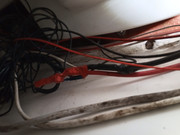
Under those balls of red and black electrical tape are ring connectors that were bolted together. A little sketchy. At least they were staggered .
.
Here's what my friend's looked like after we pulled the shrink tubing off his splice:
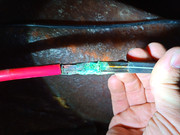
Again, NOT GOOD!
We replaced the full run of wiring with new wire from here: https://www.bestboatwire.com/
It will require crawling around in the back and digging through the bilge, but you may find that your boat is wired the same and that your splice is in worse shape than ours were.
Jeff
A friend and I just replaced the outboards on our
and were surprised to find that the cables on both boats were spliced. Mine run from my outboard to the two batteries that are just aft of the galley. My friend's boat has one battery in the same spot as mine and one battery under the aft dinette seat.Here's what my wiring looked like:
Under those balls of red and black electrical tape are ring connectors that were bolted together. A little sketchy. At least they were staggered
.Here's what my friend's looked like after we pulled the shrink tubing off his splice:
Again, NOT GOOD!
We replaced the full run of wiring with new wire from here: https://www.bestboatwire.com/
It will require crawling around in the back and digging through the bilge, but you may find that your boat is wired the same and that your splice is in worse shape than ours were.
Jeff
-
OverEasy
- Admiral
- Posts: 2885
- Joined: Mon Sep 28, 2020 11:16 am
- Sailboat: MacGregor 26X
- Location: NH & SC
Re: Lithium Jump starter for main starter battery.
Ditto…C Buchs!
It sounds like what you are experiencing is a primary cable lead intermittent opening condition (the opposite of a short). As the cable moves it breaks contact between the engine and battery (bank). This can be caused by a loose connection, a loose splice, corrosion or some combination of them.
To actually fix the issue you are experiencing requires that you physically inspect the entire length of the power cables between your battery (bank) and the engine inputs.
If there is wire running through the bilge especially if it has any splice and has ever been wet the capillary action will wick moisture into the splice and wire strands leading to corrosion.
Cut the insulation back from the splice and if you see the wire strands looking green OR black instead of bright copper (automotive grade wire) or tinned (marine grade wire) the cable has gotten wet at sometime and has corroded. Any corrosion is bad and will generally continue once started.
(Realistically your wire replacement cost is going to be the relatively insignificant cost. You aren’t saving yourself much attempting to salvage a couple feet of old compromised cable. Remove and replace with proper type and grade. It is worth skipping a few cold ones to have the peace of mind knowing it was done right, especially if you ever have a crisis to contend with…)
If you find corrosion you should Replace both the cables with marine use rated grade ones. The wire strands will be tinned and the insulation jacket is formulated for wet environments. It is not the same as Automotive grade or construction or equipment grade cable.
If at all possible make your positive wire run from the battery (bank) to a marine grade isolation fuse/circuit-breaker then to a marine grave battery selector/isolation switch and then a continuous un interrupted run to the input terminal on the engine.
(Note: Current practice is that there should be an isolation fuse located either on your positive battery terminal or immediately after the battery isolation switch to preclude the danger of a dead short. One can weld plate steel with the current available in just one automotive/marine battery. One wouldn’t really want that to happen in the bottom back of one’s vessel with all that nice fiberglass around it….
 especially when it could be avoided)
If at all possible make a continuous run for the negative wire run from the battery (bank) to the input terminal on the engine.
If at all possible keep your wiring out of the bilge where it can get wet or chafed. This can be done several different ways.
One way is to run the cables through liquid-tight flex conduit and throughly seal each end with marine 5200 sealant or silicone for about an inch or two. This is what we chose to do so we wouldn’t have this type of an issue in the future on our planned extended cruises.
Running any wiring through a potentially or known wet location without adequate protection or mitigation is just gonna pose problems later….
Hope this helps.
Let us know what you find.


It sounds like what you are experiencing is a primary cable lead intermittent opening condition (the opposite of a short). As the cable moves it breaks contact between the engine and battery (bank). This can be caused by a loose connection, a loose splice, corrosion or some combination of them.
To actually fix the issue you are experiencing requires that you physically inspect the entire length of the power cables between your battery (bank) and the engine inputs.
If there is wire running through the bilge especially if it has any splice and has ever been wet the capillary action will wick moisture into the splice and wire strands leading to corrosion.
Cut the insulation back from the splice and if you see the wire strands looking green OR black instead of bright copper (automotive grade wire) or tinned (marine grade wire) the cable has gotten wet at sometime and has corroded. Any corrosion is bad and will generally continue once started.
(Realistically your wire replacement cost is going to be the relatively insignificant cost. You aren’t saving yourself much attempting to salvage a couple feet of old compromised cable. Remove and replace with proper type and grade. It is worth skipping a few cold ones to have the peace of mind knowing it was done right, especially if you ever have a crisis to contend with…)
If you find corrosion you should Replace both the cables with marine use rated grade ones. The wire strands will be tinned and the insulation jacket is formulated for wet environments. It is not the same as Automotive grade or construction or equipment grade cable.
If at all possible make your positive wire run from the battery (bank) to a marine grade isolation fuse/circuit-breaker then to a marine grave battery selector/isolation switch and then a continuous un interrupted run to the input terminal on the engine.
(Note: Current practice is that there should be an isolation fuse located either on your positive battery terminal or immediately after the battery isolation switch to preclude the danger of a dead short. One can weld plate steel with the current available in just one automotive/marine battery. One wouldn’t really want that to happen in the bottom back of one’s vessel with all that nice fiberglass around it….
especially when it could be avoided)If at all possible make a continuous run for the negative wire run from the battery (bank) to the input terminal on the engine.
If at all possible keep your wiring out of the bilge where it can get wet or chafed. This can be done several different ways.
One way is to run the cables through liquid-tight flex conduit and throughly seal each end with marine 5200 sealant or silicone for about an inch or two. This is what we chose to do so we wouldn’t have this type of an issue in the future on our planned extended cruises.
Running any wiring through a potentially or known wet location without adequate protection or mitigation is just gonna pose problems later….
Hope this helps.
Let us know what you find.

-
Inquisitor

- Captain
- Posts: 926
- Joined: Mon Apr 23, 2007 5:24 pm
- Sailboat: MacGregor 26M
- Location: North Carolina Mountains
Re: Lithium Jump starter for main starter battery.
As far as using the Li Jump starter (not the wiring issues).
It probably isn't a good idea. I haven't checked, but I doubt the Li battery jump device is designed to recharge via the battery connection. The issue becomes how does it get recharged after use. If you just plan to AC charge it at home, you'd be fine. But... Li batteries are known to burn out the voltage regulators in the alternator as they will draw every amp it can... lead-acid batteries are kinder to alternators. Other electronic regulators or an alternator rated for 100% duty cycle must be used with Lithium batteries.
It probably isn't a good idea. I haven't checked, but I doubt the Li battery jump device is designed to recharge via the battery connection. The issue becomes how does it get recharged after use. If you just plan to AC charge it at home, you'd be fine. But... Li batteries are known to burn out the voltage regulators in the alternator as they will draw every amp it can... lead-acid batteries are kinder to alternators. Other electronic regulators or an alternator rated for 100% duty cycle must be used with Lithium batteries.
Odysseus, expert on the Siren's call
-
OverEasy
- Admiral
- Posts: 2885
- Joined: Mon Sep 28, 2020 11:16 am
- Sailboat: MacGregor 26X
- Location: NH & SC
Re: Lithium Jump starter for main starter battery.
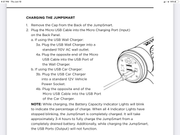
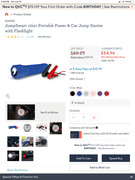
Just an FYI aspect on Li jump batteries….
They come in a variety of flavors nowadays…. Some are “designed” to charge via the car 12 VDC outlet directly without monitoring and some are designed to charge from a 5 VDC USB port which then uses DC/DC voltage conversion to raise it up to the 12+ VDC required for storage and engine starting. Not cheap but they are out there……
They come in a variety of flavors nowadays…. Some are “designed” to charge via the car 12 VDC outlet directly without monitoring and some are designed to charge from a 5 VDC USB port which then uses DC/DC voltage conversion to raise it up to the 12+ VDC required for storage and engine starting. Not cheap but they are out there……
-
Inquisitor
- Captain
- Posts: 926
- Joined: Mon Apr 23, 2007 5:24 pm
- Sailboat: MacGregor 26M
- Location: North Carolina Mountains
Re: Lithium Jump starter for main starter battery.
You're probably right that there are versions that do... but the one you show is charging via 12 VDC to USB converter. It is not back charging via the jumper cables themselves. The issue comes when a larger lithium battery might need to charge for hours at the full rating of the OB's alternator. My OB alternator is rated at 18 amps. If a lithium battery draws this full rating for more than the duty cycle of the alternator, the alternator will overheat and burn out.OverEasy wrote: ↑Thu Jun 10, 2021 1:33 pm Just an FYI aspect on Li jump batteries….
They come in a variety of flavors nowadays…. Some are “designed” to charge via the car 12 VDC outlet directly without monitoring and some are designed to charge from a 5 VDC USB port which then uses DC/DC voltage conversion to raise it up to the 12+ VDC required for storage and engine starting. Not cheap but they are out there……
That said... I didn't know what size you were talking about. This flashlight size doesn't have enough capacity to be an issue.
https://www.youtube.com/watch?v=jgoIocPgOug
Odysseus, expert on the Siren's call
-
OverEasy
- Admiral
- Posts: 2885
- Joined: Mon Sep 28, 2020 11:16 am
- Sailboat: MacGregor 26X
- Location: NH & SC
Re: Lithium Jump starter for main starter battery.
Hi Inquisitor
Yup!
It an itsy bitsy little teeny weeny thingamabobduhicky that advertises it can provide 8 jumps to a V8 or about 24 tries for a 3 cylinder 50 Hp outboard.
If one already has the 12 VDC system and it was too flat to start aforementioned 50 HP outboard then it could be the Hail Mary Pass to having a day on the water or a trip home. The generator on the outboard should recharge the existing 12 VDC battery and if one has a 12 VDC plugin outlet the jump pack as well!
Ta-Da!
Just leave itsy bitsy little teeny weeny thingamabobduhicky plugged in to recharge till next time…and itsy bitsy little teeny weeny thingamabobduhicky also has it’s own USB use ports.
Yup!
It an itsy bitsy little teeny weeny thingamabobduhicky that advertises it can provide 8 jumps to a V8 or about 24 tries for a 3 cylinder 50 Hp outboard.
If one already has the 12 VDC system and it was too flat to start aforementioned 50 HP outboard then it could be the Hail Mary Pass to having a day on the water or a trip home. The generator on the outboard should recharge the existing 12 VDC battery and if one has a 12 VDC plugin outlet the jump pack as well!
Ta-Da!
Just leave itsy bitsy little teeny weeny thingamabobduhicky plugged in to recharge till next time…and itsy bitsy little teeny weeny thingamabobduhicky also has it’s own USB use ports.
-
Inquisitor
- Captain
- Posts: 926
- Joined: Mon Apr 23, 2007 5:24 pm
- Sailboat: MacGregor 26M
- Location: North Carolina Mountains
Re: Lithium Jump starter for main starter battery.
That is really impressive from such a little package!OverEasy wrote: ↑Thu Jun 10, 2021 3:23 pm Hi Inquisitor
Yup!
It an itsy bitsy little teeny weeny thingamabobduhicky that advertises it can provide 8 jumps to a V8 or about 24 tries for a 3 cylinder 50 Hp outboard.
If one already has the 12 VDC system and it was too flat to start aforementioned 50 HP outboard then it could be the Hail Mary Pass to having a day on the water or a trip home. The generator on the outboard should recharge the existing 12 VDC battery and if one has a 12 VDC plugin outlet the jump pack as well!
Ta-Da!
Just leave itsy bitsy little teeny weeny thingamabobduhicky plugged in to recharge till next time…and itsy bitsy little teeny weeny thingamabobduhicky also has it’s own USB use ports.
Odysseus, expert on the Siren's call