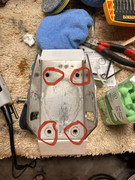
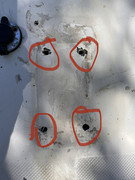
I think you are on the right track but;
I just don't think you are going to get a good long lasting reliable seal if
you leave that deck as it is and slap that step plate on there.
Those ragged edges of gel coat, gel coat cracks, and not having a countersink
is not going to do your butyl tape any favors.
What I would do; grind off all of the gel coat to the shape of the foot print of the mast step.
I would then mix up some splooge (thickened epoxy or poly resin), lay proud in the foot print,
put the bolts in your mast step, and slap that mast step down into the splooge
(wax the bottom of the mast step - or a stretched plastic bag works- and bolts to keep from sticking to the splooge)
Put a brick on it until it sets up (or put the nuts/washers on).
Now the deck and the mast step will be in perfect harmony.
Redrill your holes from below, use a counter sink on the top of the holes.
Use this method:
https://marinehowto.com/bed-it-tape/
To apply your butyl tape
Seems like a lot I know but if this spot has any chance at all of leaking - it will leak.
There is significant downward pressure on that step when the rig is up.
I think the majority of damage and seal breaking occurs when the mast step is torqued around
by the mast during raising/lowering, especially if anything goes awry during those operations.
It don't take much with that long long mast as a lever...
Some of us go as far a putting a backing plate inside under the deck just because.
I used a 1/8" alum plate. Plywood will work, or very stiff plastic sheeting, whatever floats your boat.
Its just there to spread the load of the bolts and help keep the step from torquing around.
At a minimum you should clean up that ragged gel coat around the holes and try to countersink somehow
so that your butyl tape has a place to live around the bolts.
Just my take - been there more than once and learned the hard way.....