


90 HP Outboard (2-stroke or 4)
-
Frank C
From Suzuki DF60-DF70 Marketing BrochureChip Hindes wrote: ... This is obvously only an estimate, but it won’t be off by more than a few %. If we had torque or HP /speed curves for both motors we could do a more thorough direct comparison. ...
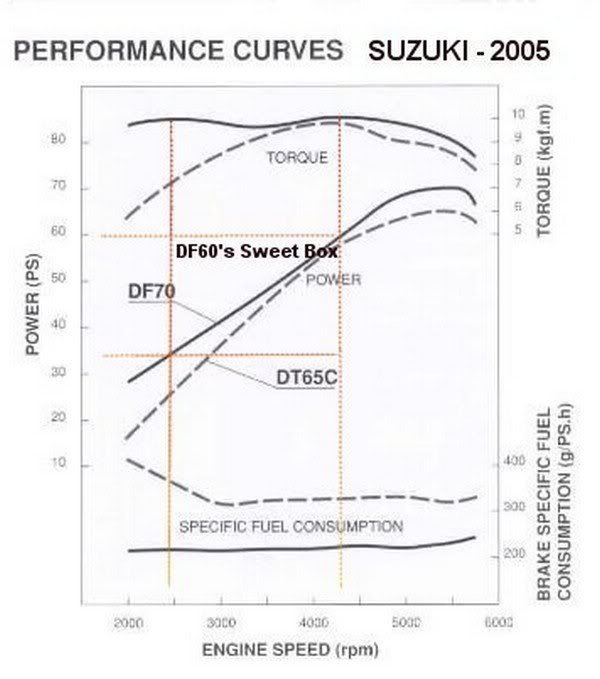
How's this look? (the DT65 comparison curves are for Suzuki's 2-stroke)
... looks like a pretty broad 'n flat torque curve, from here. Tohatsu doesn't publish similar graphics (that I could find), but I'm guessing that flat torque delivery is why I'm so pleased w/ performance of the Suzi-60.
Bobby observed that his DF-50 was constantly at WOT to accomplish 15 kn. The main reason I oversized to the DF-60 was precisely to avoid that operating mode. I can cruise 13 kn. at 3800 rpms ... and likely get better economy than any 2S in that operating range.
Last edited by Frank C on Wed Apr 26, 2006 12:50 am, edited 3 times in total.

delevi,
Your Etec50 is not making it to the required RPM range. You should definately re-prop to a lower pitch. Your outboard will run smoother and as quiet at a little higher RPM, and you won't be overtorquing it. Your engine warrantee may specify that running with a prop that can't achieve the required range may void the warrantee, I don't know how they would prove it though.
..
Rule of thumb for a 50hp pushing a Mac26X is get the prop that would push a big pontoon boat or houseboat since the Mac26X is a very heavy load for a 50hp. motor. The lower pitch props are made for high thrust or a better grip on the water with larger blade area which makes them excellent for quick stop and go around the dock.
..
By your top speed I'll assume your 5400 RPM with a 13 pitch is witout ballast. Then I'd go down at least to an 11 pitch maybe try a 10 pitch first with the goal to have both the loaded and unloaded RPMs fall inside the required RPM range. In my prop testing I found that high thrust type propellers had a smaller diffrence between loaded and unloaded max RPM. The diffrence in RPM with and without ballast was anywhere from 250to 400 RPM.
..
In rough seas or when the boat is heavily loaded the max RPM will be lower for a prop with good grip on the water, so if you anticipate the weight of your boat going up, size the prop closer to the top of the RPM range. This is how I propped my boat, 2.27 gears Suzuki DF50 at 9 pitch and 12.25 inches in diameter 3 blade and my spare prop was a 9 pitch 11.8 inch diameter four blade. Moe posted your Etec gear ratio is 2.67 and you might have a larger diameter prop so I don't think the 9 pitch would be right for your motor.
..
If you never go fast with ballast, prop for empty ballast (12 Pitch should get you an extra 100 to 200 RPM easily), you might get slightly better fuel economy.
Your Etec50 is not making it to the required RPM range. You should definately re-prop to a lower pitch. Your outboard will run smoother and as quiet at a little higher RPM, and you won't be overtorquing it. Your engine warrantee may specify that running with a prop that can't achieve the required range may void the warrantee, I don't know how they would prove it though.
..
Rule of thumb for a 50hp pushing a Mac26X is get the prop that would push a big pontoon boat or houseboat since the Mac26X is a very heavy load for a 50hp. motor. The lower pitch props are made for high thrust or a better grip on the water with larger blade area which makes them excellent for quick stop and go around the dock.
..
By your top speed I'll assume your 5400 RPM with a 13 pitch is witout ballast. Then I'd go down at least to an 11 pitch maybe try a 10 pitch first with the goal to have both the loaded and unloaded RPMs fall inside the required RPM range. In my prop testing I found that high thrust type propellers had a smaller diffrence between loaded and unloaded max RPM. The diffrence in RPM with and without ballast was anywhere from 250to 400 RPM.
..
In rough seas or when the boat is heavily loaded the max RPM will be lower for a prop with good grip on the water, so if you anticipate the weight of your boat going up, size the prop closer to the top of the RPM range. This is how I propped my boat, 2.27 gears Suzuki DF50 at 9 pitch and 12.25 inches in diameter 3 blade and my spare prop was a 9 pitch 11.8 inch diameter four blade. Moe posted your Etec gear ratio is 2.67 and you might have a larger diameter prop so I don't think the 9 pitch would be right for your motor.
..
If you never go fast with ballast, prop for empty ballast (12 Pitch should get you an extra 100 to 200 RPM easily), you might get slightly better fuel economy.
-
They Theirs

- Captain
- Posts: 790
- Joined: Tue Dec 27, 2005 1:42 pm
Chip
You are right Chip, I did exaggerate the weight of the propeller and long shaft, but in the same sense the manufacturer states they use the lightest of the TLDI 50 for their engine weight chart. We must agree on the fact most outboard manufacturers are not disclosing any weight specific information in their attempt to present more power at considerably less weight than competitors.
I did however add a 5lb onto the Suzuki DF50 at 238lbs for the Oil, but did not feel the need to disclose other than the total weight for comparison.
You are right Chip, I did exaggerate the weight of the propeller and long shaft, but in the same sense the manufacturer states they use the lightest of the TLDI 50 for their engine weight chart. We must agree on the fact most outboard manufacturers are not disclosing any weight specific information in their attempt to present more power at considerably less weight than competitors.
I did however add a 5lb onto the Suzuki DF50 at 238lbs for the Oil, but did not feel the need to disclose other than the total weight for comparison.
-
Chip Hindes

- Admiral
- Posts: 2166
- Joined: Mon Jan 05, 2004 6:13 am
- Location: West Sand Lake, NY '01X, "Nextboat" 50HP Tohatsu
Thanks Frank, this help a lot in the explanation. I know I've seen similar comparisons of TLDI vs carbed 2S and 4S for the Tohatsu when they first began marketing the TLDI, but they seem to have disappeared. Wonder if that's because they don't look as good anymore.Frank wrote:How's this look? (the DT65 comparison curves are for Suzuki's 2-stroke)
... looks like a pretty broad 'n flat torque curve, from here. Tohatsu doesn't publish similar graphics (that I could find), but I'm guessing that flat torque delivery is why I'm so pleased w/ performance of the Suzi-60.
A couple things worth noting. The DF has an impressively flat torque curve; I'm not sure this is characteristic of all four strokes or only this motor. If we scale the DT65 curve to 70HP, (or the DF70 to 65HP), we see that the DF has a pretty decent torque advantage from off idle up through around 3200RPM, at which point the "peakier" DT crosses over and both power and torque will exceed that of the DF for the upper range. Assuming when you firewall them both motors will come up to 3200RPM pretty quickly (the DT slightly less quickly) it appears the 2S will easily out-holeshot the 4S; I believe this is consistent with most people's experience.
The DF has impressively flat BSFC, and note how poorly the DT fares in comparison thoroughout the entire speed range, but the cuves are somewhat misleading and I hesitate to make many general conclusions. They're obtained at WOT (which in the real world you can't do except at top speed) and therefore don't take into account the throttling losses for both motors due to part throttle operation. For this comparison at least, the DF is considerably more economical at top speed; I was under the impression that the carbed 2S and carbed 4S had similar BSFC at top speed, so this could be a reflection of the advantage of EFI over carburetion on the 4S. Note as well the characteristic kickup of the DT at low engine speeds; we know this is present at part throttle as well as full throttle which is why 2S in general get such crappy mileage at low speeds and have seriously high idle fuel comsumption.
Part throttle is where the TLDI is supposed to shine.

Are you suggesting that the increase in prop diameter might be a detriment to these slow boats? Surely, you agree that issue just doesn't exist until you get into much faster boats... For us, bigger is better...Moe wrote:True, but at the cost of increasing the frontal area component of total drag.
Huh? The school I went to taught me that Torque = Distance X Force. So, for a given Force, Torque increases with Distance. Or, said in a more applicable way, to effectively use a rated HP with a bigger prop, your engine must produce more torque...Moe wrote:Also don't forget that by moving the average area for the blade away from the prop shaft, there's some reduction in torque applied to the water.
The ETEC produces more torque than a comparable HP 4stroke, and therefore can spin a larger diameter prop, thereby reducing slip, thereby getting more actual performance...
For me, at least, the logic seems right... All the 'tests' I have read about support this conclusion. Yeah, I'll admit that almost all of those tests are conducted by, or on behalf of, someone with an interest, such as the manufacturer or a dealer. But, my own experience also supports it. My 40HP ETEC seems to get about as good performance as the 50HP 4strokes on this board, based on figures people have posted...
My understanding is that you have to replace the whole EMM. An upgrade chip would be nicer, and I'd certainly like to find one...delevi wrote:Also, does anyone know how to tweak an Etec 50 to make it a 60? The 40/50/60 is the same engine, with the only difference being the programming of the engine computer. I wonder if there is a chip one can buy...
Either way, this type of "upgrade" will void any factory warranty, at least if they catch you...
Yes. Drop down to 11 pitch. Your RPM will go up to around 5800, right where you want it to be... This should produce better performance and is at least better on the engine...delevi wrote:Ok, so if I'm getting a maximum of 5400 RPM on my etec 50 with a 13 pitch prop (not sure the diameter) and that gives me a top speed of 21 mph, would it be beneficial to downsize? My operating range is 5500-6000 RPM.
TLDI performance comparison, TLDI 4stroke no battery needed
http://www.toppfritid.no/baat/baatogmot ... DI_FAQ.htm
TLDI FAQ page with comparison charts TLDI vs 4 Stroke (carb?) vs 2 stroke carb. They detail the comparison of Weight, Acceleration, Top Speed, Fuel consumption at idle and at various speeds including WOT. These are for the 90hp the charts might look a lot different compared to best power to weight ratio fuel injected 4 strokes and it would be nice to add the newer version 320lb. Etec instead of the 362lb. Ficht. INHO the Etec would be hard for the TLDI to beat on these charts and the Fuel injected 4strokes would be hard to beat too.
..
http://www.tohatsu.co.jp/en/boat/products/mfs25fe.html
Also interesting outboard motor technology the Tohatsu/Mercury 25 & 30hp Fuel injected outboards that will run without a battery. It seems that the 4 strokes are getting TLDI also. This Mercury 25hp is a 3 cylinder inline motor with 526cc.
..
The strange thing is that Tohatsu lists its 25hp at 179lb. while the Mercury version lists it as 157lb.? The Tohatsu site has a 25EFI movie and that shows the 157lb. So I guess it is a 157lb. motor. I like the Mercury manual control with shifting on the handle. Will consider this or the new Suzuki DF25VT V-Twin 25hp 538cc outboard also at 159lb with shift on the cowl because I am partial to Suzuki, this outboard will be for a 20 foot flat bottom pointy front boat for fishing with the kids.
http://www.tohatsu.com/outboards/25_4st_spec.html
http://www.mercurymarine.com/25_efi
http://www.suzukimarine.com/sr06/df25vt ... _specs.php
TLDI FAQ page with comparison charts TLDI vs 4 Stroke (carb?) vs 2 stroke carb. They detail the comparison of Weight, Acceleration, Top Speed, Fuel consumption at idle and at various speeds including WOT. These are for the 90hp the charts might look a lot different compared to best power to weight ratio fuel injected 4 strokes and it would be nice to add the newer version 320lb. Etec instead of the 362lb. Ficht. INHO the Etec would be hard for the TLDI to beat on these charts and the Fuel injected 4strokes would be hard to beat too.
..
http://www.tohatsu.co.jp/en/boat/products/mfs25fe.html
Also interesting outboard motor technology the Tohatsu/Mercury 25 & 30hp Fuel injected outboards that will run without a battery. It seems that the 4 strokes are getting TLDI also. This Mercury 25hp is a 3 cylinder inline motor with 526cc.
..
The strange thing is that Tohatsu lists its 25hp at 179lb. while the Mercury version lists it as 157lb.? The Tohatsu site has a 25EFI movie and that shows the 157lb. So I guess it is a 157lb. motor. I like the Mercury manual control with shifting on the handle. Will consider this or the new Suzuki DF25VT V-Twin 25hp 538cc outboard also at 159lb with shift on the cowl because I am partial to Suzuki, this outboard will be for a 20 foot flat bottom pointy front boat for fishing with the kids.
http://www.tohatsu.com/outboards/25_4st_spec.html
http://www.mercurymarine.com/25_efi
http://www.suzukimarine.com/sr06/df25vt ... _specs.php
-
Chip Hindes
- Admiral
- Posts: 2166
- Joined: Mon Jan 05, 2004 6:13 am
- Location: West Sand Lake, NY '01X, "Nextboat" 50HP Tohatsu
Thanks Robert; their comparisons are a little less useful than the curves we got for the Suzuki.
AFAIK the Suzuki DF90 is EFI only, no carbed model available.
I'd be interested to know how they got different top speeds from the same HP; one mph or so has to be in the noise, but they got over three mph, 8% difference in two motors which ought to be functionally identical - the carbed and TLDI versions of their own motor. We'd have to see the full power curves to know for sure, but I suspect it has mostly to do with prop optimization and not any inherent difference in the motors. There are several external variables imposed by the boat which affect prop selection, and it's probable a "perfect" prop isn't available for each boat-motor combination.
Haven't spent any time researching the ETEC but I assume the technology of that and the TLDI are similar, performance likewise.
AFAIK the Suzuki DF90 is EFI only, no carbed model available.
I'd be interested to know how they got different top speeds from the same HP; one mph or so has to be in the noise, but they got over three mph, 8% difference in two motors which ought to be functionally identical - the carbed and TLDI versions of their own motor. We'd have to see the full power curves to know for sure, but I suspect it has mostly to do with prop optimization and not any inherent difference in the motors. There are several external variables imposed by the boat which affect prop selection, and it's probable a "perfect" prop isn't available for each boat-motor combination.
Haven't spent any time researching the ETEC but I assume the technology of that and the TLDI are similar, performance likewise.
-
Terry

- Admiral
- Posts: 1487
- Joined: Thu Feb 19, 2004 2:35 pm
- Sailboat: MacGregor 26M
- Location: Vancouver, B.C. Canada. '03 26M - New Yamaha 70
Prop Pitch
To address delevi, DLT wrote:

Be careful how much you reduce the pitch, it is not so linear as you might think, ie 2" of pitch = 400 rpm increase. It took me two attempts at re-pitching to get my 4 X 11.4 X 9.75 Solas in the groove. It started out stamped at 4 X11.4 X 10 and I took it in to be reduced to 9 pitch to gain 150-200 rpm. Prop shop discovered that in reality it was 4 X 11.4 X10.5 and reducing it to 9 took me from 54-5500 to 61-6200 rpm. I had to take it back and have it repitched again back up to 9.75 wich was about half the original pitch reduction. Now I am at 57-5800 rpm, in the groove for a Honda-50Yes. Drop down to 11 pitch. Your RPM will go up to around 5800, right where you want it to be... This should produce better performance and is at least better on the engine...
Thats true... But, ~200RPM to spare should be enough to cover to possibilities...
If it were me, I would not get my 13p repitched to 11p, as a first step. 11 is gonna be real close, but may not be perfect. So, I'd just buy a new 11p and see what happens... If it is perfect, then I'd repitch the old one to 11p. If not perfect, then I'd repitch the old one just above or below 11p in order to get it perfect.
This way, you'll end up with at least one perfect pitch and a spare at least real close for the cost of one new prop and one trip to the prop shop.
This is assuming, of course, that you'd like to have a spare prop anyway...
If it were me, I would not get my 13p repitched to 11p, as a first step. 11 is gonna be real close, but may not be perfect. So, I'd just buy a new 11p and see what happens... If it is perfect, then I'd repitch the old one to 11p. If not perfect, then I'd repitch the old one just above or below 11p in order to get it perfect.
This way, you'll end up with at least one perfect pitch and a spare at least real close for the cost of one new prop and one trip to the prop shop.
This is assuming, of course, that you'd like to have a spare prop anyway...
-
Bobby T.-26X #4767

- Captain
- Posts: 906
- Joined: Mon Jan 05, 2004 10:48 am
- Sailboat: MacGregor 26X
- Location: Oceanside Harbor, CA
the TLDI is low pressure direct injection. the upside is that it's easy technology on the inner workings...low heat, low pressure. downside is that performance declines significantly as altitude increases. works best at sea level.Chip Hindes wrote:Haven't spent any time researching the ETEC but I assume the technology of that and the TLDI are similar, performance likewise.
ETEC, on the other hand, is extremely high pressure injection. very high tech. in fact they tout using aerospace materials/metals inside the engine that can manage the high heat and pressure. the upside is that it works far better than the TLDI at altitude & is a very clean burning 3-star rated.
they are so sure of their product that they give an extra long warranty and promise zero maintenance.
bottom line...both technologies are injection based, but one is low pressure, the other high pressure.
and as i compare the two today, the ETEC technology appears to be the #1 choice for those interested in upgrading to a lightweight 90hp.
Bob T.
"DaBob"
'02X w/ '04 90 TLDI
-
Frank C
Note: admitting up-front that I'm a dedicated Suzuki fanboy ... it seems to me that the Suzi-70 delivers quiet, midrange economy & performance that's ideal for a Macgregor powersailer. And the Suzi-DF70 (at 1300 cc) is essentially the same transom weight as the 1300 cc 2-stroke 90, just not delivering that same WOT peak hp. The 4-stroke is a good choice for midrange cruising.Chip Hindes wrote:AFAIK the Suzuki DF90 is EFI only, no carbed model available.
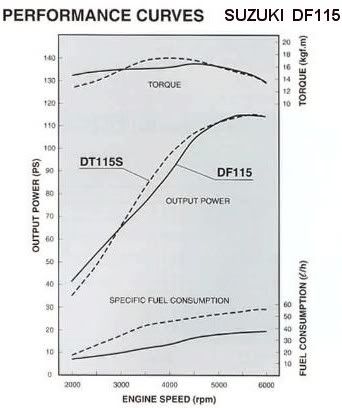
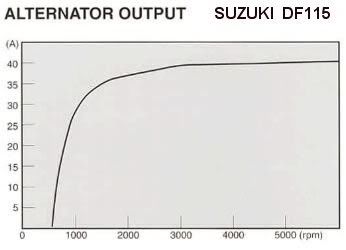
All Suzukis now use sequential mutli-port EFI (high-pressure injection), save for the portables, DF30 and smaller, which use Mikuni carbs. Suzuki's FAQ page describes (in classic puffery) why their technology is superior ... sounds compelling nonetheless. Tuned intake runners, variable valve timing, and sequential port injection, all contribute to deliver that flat torque curve (see FAQuote 1). Apparently they have it well-in-hand, as the DF115 also shows a very flat torque curve. Curiously, they manage similar utility in their alternator output - both the DF70 (25 amps) and this one below (40 amps) reach full-monty by ~1500 rpms.
Suzuki now manufactures only 4-stroke outboards, up to a V-6 250 hp. In so doing, they claim to lead the marine industry in an inevitable migration from 2-strokes (FAQuote 2). The comparative DT models (DT=two, DF=four) are no longer manufactured. Right now, Suzuki is backing up their confidence in the technology with a full six years factory warranty at no added cost.FAQuote 1 wrote:Variable intake valve timing (advancing or retarding the opening of the intake valve) provides a stronger power stroke in the midrange, while reducing fuel emissions and improving fuel economy.
. . . This tuned intake system is similar to a tuned exhaust system. Length and shape determine running characteristics. A comparatively long branch design helps to increase the mid-range torque . . .
I can happily attest to the instant starting of their EFI described just above. It has me convinced that I really don't need to dedicate a separate battery to starting chores (saving ~60 bilge-lbs).FAQuote 2 wrote:Though Digital EFI can be found in almost every automobile on the road, in the marine outboard industry, Suzuki is the only manufacturer to offer a full line of digitally-controlled EFI V-6 engines, the 140 and 115 in-line 4 and also the DF40-70 four-strokes. Only through years of experience with Digital EFI systems in its automobiles and motorcycles has Suzuki been able to bring this technology to the marine outboard market.
. . . it is only logical that Digital EFI will eventually become the system of choice for outboard motors as well. . . . what will become the industry-wide norm.
. . . The 200 EFI, Offshore 150 EFI, Bass 150 EFI, 140 EFI, 115 EFI and DF40-70 EFI four-strokes have incorporated a sequential multi-point fuel injection system. Fuel is delivered to the engine through four (or six) high-pressure injectors. These injectors have a delivery timing that is directly related to the ignition timing. . . . The result of all this high technology is an outboard motor that starts instantly in all weather conditions, runs cleaner and has a quicker and crisper throttle response under all types of loads.
Last edited by Frank C on Wed Apr 26, 2006 12:48 am, edited 1 time in total.