

Many thanks for the explanations Duane!
One last question(s):
I notice in the photos your mast is not stepped.
- Do you have to move the Bruce anchor, to attach the forestay to the tang?
- Do you have a roller furling, and does the Bruce get in the way of the roller drum?
Thanks
Darry
Anchors for Out island trip?
-
Wind Chime

- Captain
- Posts: 866
- Joined: Sun Jan 21, 2007 4:30 pm
- Sailboat: MacGregor 26X
- Location: Vancouver, B.C. Canada. 2000-26X, Suzuki-50hp, 8' Walker-Bay tender (with sailkit)
- Contact:
-
Dimitri-2000X-Tampa

- Admiral
- Posts: 2043
- Joined: Fri Jan 02, 2004 5:36 am
- Sailboat: MacGregor 26X
- Location: Tampa, Florida 2000 Mercury BigFoot 50HP 4-Stroke on 26X hull# 3575.B000
Re: Anchors for Out island trip?
I think it is the 6 lb Aluminum Guardian (G11) Danforth which still fits in the anchor locker of the 26X and that is what I have with about 10 feet of chain. In sandy muddy western Florida, this has always worked great for me, even with other boats rafted up or overnight storms kicking up to 40mph or so. It won't set very well if it is grassy, but there are usually bare spots even in the flats which you can snag and get a good grip. From my one visit there and what I read, my impression is that the Bahamas are very sandy too.
I think what Duane refers to is called a Bahamian Moor with both opposing (at 180 degrees) anchors attached to the bow.

What I frequently do to completely avoid any of that awful swing is attach one anchor to the stern. This is also known as a Mediterranean Moor (used to maximize the number of boats anchored in a port).

But its also very useful at Florida beachs with no other boats around, backing the Mac right up to a beach where you can walk off in 18-24 inches of water. I presume that is what Duane is doing with his big spool on the back. When spending the night like this, you want to be careful about expected wind direction cause if it hits you on the beam with no swing, it puts a lot more force on the ground tackle. But for most cases, this is the most comfortable way to anchor in my book.
If I'm in some basin with a bunch of other boats close by, then you have to be able to swing with the boats and that drives me nuts if the wind picks up even a bit since the Mac swings like a bat out of hull. Better to leave the crowd and find a nice shallow spot that only a Mac can get into and then set up for a Med Moor with the bow heading towards wind (or anticipated wind). Since it will be closer to shore, you may have some more bugs there though, so bring your hatch screens.
I think what Duane refers to is called a Bahamian Moor with both opposing (at 180 degrees) anchors attached to the bow.
What I frequently do to completely avoid any of that awful swing is attach one anchor to the stern. This is also known as a Mediterranean Moor (used to maximize the number of boats anchored in a port).
But its also very useful at Florida beachs with no other boats around, backing the Mac right up to a beach where you can walk off in 18-24 inches of water. I presume that is what Duane is doing with his big spool on the back. When spending the night like this, you want to be careful about expected wind direction cause if it hits you on the beam with no swing, it puts a lot more force on the ground tackle. But for most cases, this is the most comfortable way to anchor in my book.
If I'm in some basin with a bunch of other boats close by, then you have to be able to swing with the boats and that drives me nuts if the wind picks up even a bit since the Mac swings like a bat out of hull. Better to leave the crowd and find a nice shallow spot that only a Mac can get into and then set up for a Med Moor with the bow heading towards wind (or anticipated wind). Since it will be closer to shore, you may have some more bugs there though, so bring your hatch screens.
-
kmclemore

- Site Admin
- Posts: 6255
- Joined: Sun Feb 08, 2004 9:24 am
- Sailboat: MacGregor 26X
- Location: Ambler, PA -- MACX2018A898 w/ Suzuki DF60AV -- 78 BW Harpoon 4.6 -- 2018 Tahoe 550TF w/ 150 Merc
Re: Anchors for Out island trip?
Just for sake of completeness, I'll re-post Frank's nifty method, and it does indeed greatly reduce swing at anchor...
Frank C wrote:If you haven't yet experienced a Mac swinging at anchor? ... it compares to taking a toddler on the Merry-go-round. I explained my stab at the underlying logic in an earlier thread, as below. But Sloop is correct, a bridle is mandatory if you want to avoid extraneous solutions, like a stern anchor or a drag anchor.
You can quickly test the concept. Anchor at the bow cleat and enjoy the Merry-go-round for a half-hour. Then go to the bow and pull ten feet of slack rode from the locker (behind where you're already cleated). Lead the slack rode outside the pulpit and tie-off securely to the aft pulpit stanchion, then release your original belay at the bow cleat. The boat will now be tethered at the aft pulpit stanchion, the bow will remain on the wind, but the swing will be reduced by two-thirds of its prior arc.
Once you've experienced the difference in anchoring on the forequarter (somewhat aft from the bow) you'll make it SOP. A dockline makes an easy bridle back to a winch or the aft cleat. Rigging a bridle is especially easy with a Montana cinch (Jeff Stagg's hint) on your anchor rode about 7 feet out from the bow cleat. All chain rode? ... then just tie the bridle into a link. To rig a bridle, see below.
Edit: Anchoring & Bridling ExamplesFrank C wrote:The Mac's anchor-tacking in an anchorage full of keelboats is actually embarrassing. But snubbing the rode at the forequarter completely eliminates the tacking and allows her to ride just like the keelboats.
Roger's Powersailor hull "sails on anchor" because a bow-attached rode encourages the hull's "tacking" on the anchor rode. The wind creates lift across the Mac's generous freeboard, causing a swing to one side. The swing ends as the wind "sucks" this hull-lift to its stalling point. But now wind pressure on that aft windward hull surface PUSHES the hull toward the lee side. Since our very light weight hull is tethered on a long rope it swings like a pendulum. As it crosses the eye of the wind, the lee bow becomes a lifting surface, amplifying the swing in this new direction -- until it stalls again. Repeat continuously!. The hull likes to sail out to ~65 degrees, so the swing-arc is ~ 130-degrees ... makes me dizzy, especially the view through the companionway from down in the cabin~!
NOW ... attach the rode to a point 20% aft from the bow. The Mac will remain constantly on a single tack versus the prevailing breeze. The hull is now a less efficient pendulum with more aero-drag, and it cannot cross the eye of the wind. Eliminate the anchor-tacking and reduce the anchor-arc to about 35 degrees. The further aft you set the rode's attachment to the hull, the smaller her hunting arc becomes ... to a point. The hull will ride bow-to-wind with the anchor rode holding at about 35 degrees off-wind, keeping wind waves on the bow. Obviously, a bridle permits tweaking the anchored position, like trimming an upwind jib sheet.
An anchor bridle helps to keep the rode's attach point lower to the water, but a bridle is not essential to my solution. You can just tether the hull at either fore-quarter, rather than the bow, by having a line chock at the quarter-rail. Rode led through this line chock will be fore-quartered regardless of location of the cleat, or even use mast itself. You can test the concept by tying your rode at either pulpit aft stanchion.
To rig a bridle, cleat the rode at the bow, then tie a dockline directly onto your rode, about 7 feet down from the bow cleat. Now snub the other end of the dockline-bridle with 3 wraps on the winch, and into the cam-cleat. The bridle simply permits you to "tune the arc" by changing length on the dockline. If you object to tying a loop into your rode (like me), insert a Montana cinch (Jeff Stagg's hint) onto your anchor rode about 7 feet out from the bow cleat.
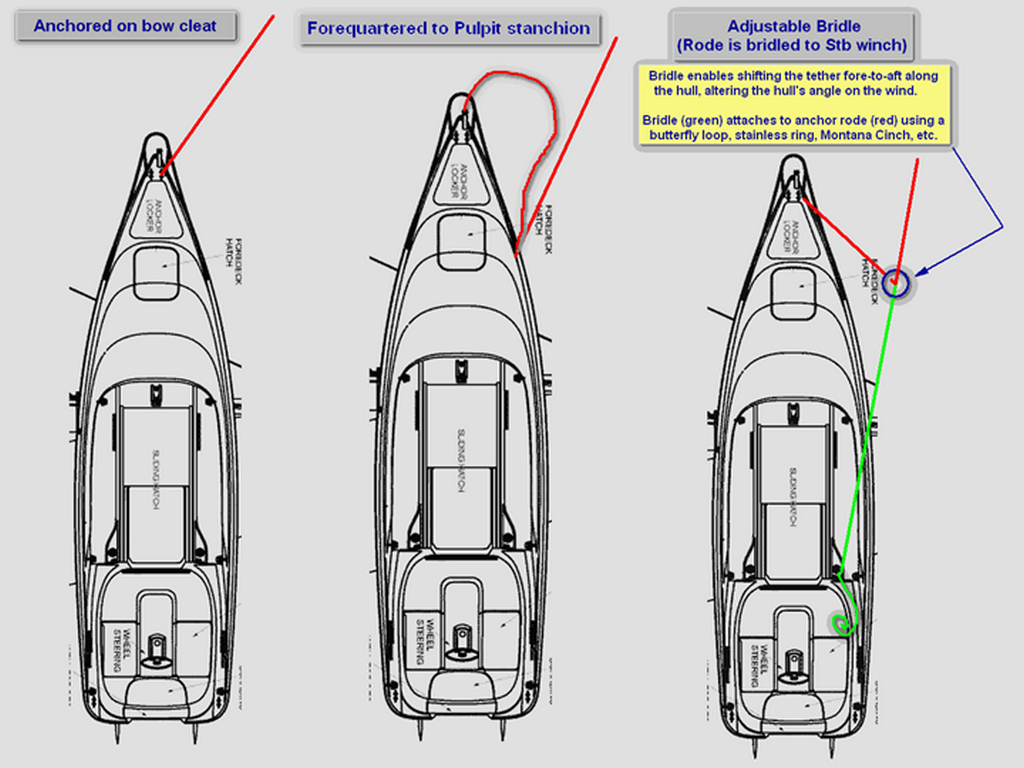
1) It's pretty easy to picture how the anchor can "wag the dog" with a perfect fulcrum at a bow tether (first drawing). By contrast, the forequartered hull simply cannot swing as effectively.
2) When tethered aftward enough the hull simply cannot cross the eye of the wind, which eliminates the Mac's habitual anchor-tacking. Use this for testing, but it's clearly not good SOP to anchor to a stanchion.
3) There are many alternate ways to rig a bridle. I was partial to one that went from the port bow cleat, down through the boweye, then back to the Stb winch. It tied to the rode in about the same position, always with rode still slack-cleated to the bow for safety. That bridle permits more flexibility in shifting the tether. But it's very important to be able to quickly weigh anchor. This bridle approach (third drawing) adds zero-delay to making a quick departure.

-
Dimitri-2000X-Tampa
- Admiral
- Posts: 2043
- Joined: Fri Jan 02, 2004 5:36 am
- Sailboat: MacGregor 26X
- Location: Tampa, Florida 2000 Mercury BigFoot 50HP 4-Stroke on 26X hull# 3575.B000
Re: Anchors for Out island trip?
I tried this bridle method one night when I got stuck in a (supposedly protected) basin with a bunch of boats swinging around in an all night wind that brought waves into the basin too. Although it did reduce the swing somewhat, there was still enough swing to be very uncomfortable and render a very poor night's sleep for the captain. Perhaps I did it the wrong way since I attached at the stern cleat instead of the winch. But I did try varying the attachment point of the rode on the bridle and I still couldnt get it to settle down much. Also, I was attached to a mooring ball so not sure if that made a difference. If it wasn't dark and windy in a place I wasn't that familiar with (and I didn't have two sleeping kids on board), I would have left in the middle of the night and tried to find a gunk hole. Funny how kids can sleep through anything though 
-
Wind Chime
- Captain
- Posts: 866
- Joined: Sun Jan 21, 2007 4:30 pm
- Sailboat: MacGregor 26X
- Location: Vancouver, B.C. Canada. 2000-26X, Suzuki-50hp, 8' Walker-Bay tender (with sailkit)
- Contact:
Re: Anchors for Out island trip?
The first time I anchored the boat, I tied the rode off on the bow cleat ... only to wake up the next moring with the bow lights torn off hanging by the wires. 
Since then, I always tie off to the back stantion of the pulpit (and then to the cleat for saftey) and I have not lost a light since .
By the look of Duane's photos of the inside of the bow, the stantions are just as strong as the cleats, as long as you tie off low,
Darry
Since then, I always tie off to the back stantion of the pulpit (and then to the cleat for saftey) and I have not lost a light since .
By the look of Duane's photos of the inside of the bow, the stantions are just as strong as the cleats, as long as you tie off low,
Darry
-
c130king

- Admiral
- Posts: 2730
- Joined: Sun Nov 05, 2006 5:30 pm
- Sailboat: MacGregor 26M
- Location: Wiggins, MS --- '05 26M "König" w/ 40hp Merc
- Contact:
Re: Anchors for Out island trip?
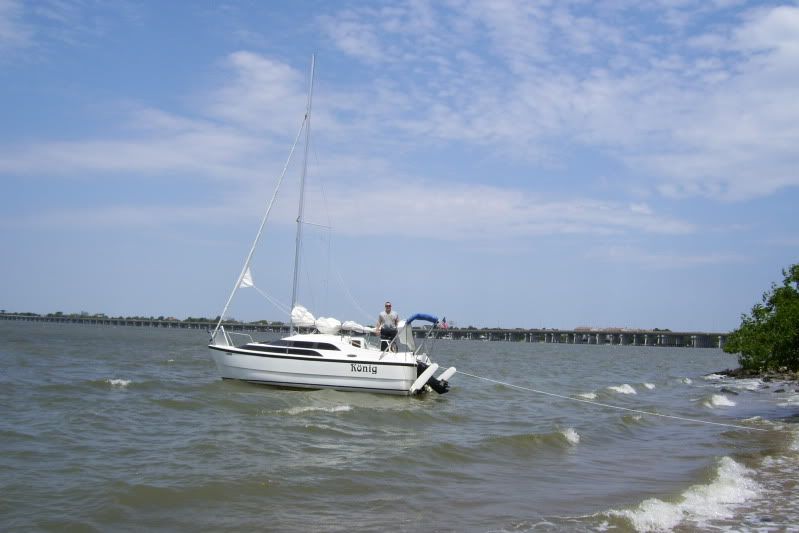
If you do this and you like to wear those type of cargo shorts that reach almost down to your knees then don't put your cell phone in your pocket. The material of your shorts will wick up and get the phone wet...salt water and cell phones don't seem to mix well. Been there done that. Live and learn I guess...Dimitri-2000X-Tampa wrote: But its also very useful at Florida beachs with no other boats around, backing the Mac right up to a beach where you can walk off in 18-24 inches of water.
And of course take your stern anchor up on the beach and set it...or tie of a line to a tree or something.
Ahhhh....memories.
Jim
-
Divecoz

- Admiral
- Posts: 3803
- Joined: Sat Oct 16, 2004 2:54 pm
- Sailboat: MacGregor 26M
- Location: PORT CHARLOTTE FLORIDA 05 M Mercury 50 H.P. Big Foot Bill at Boats 4 Sail is my Hero
Re: Anchors for Out island trip?
Thank's to all and Duane for the above info which I feel bears repeating so I quoted him.Duane Dunn, Allegro wrote:You have a good combination that will cover any bottom you encounter. You didn't specify their weight, but I'm assuming they are the correct size for the Mac. The right Claw (Bruce clone) is the 16.6lb model. If your danforth is steel you should have a 14lb one, if aluminum the 7lb one is right. I've used the 16lb claw and the 7lb aluminum Guardian for years with great success. In general we turn to the Claw first as our bottoms up here better match it's strengths. It's only failed to do the job in real soft mud. The danforth fouls easily in rock and shell and won't punch into our harder bottoms.
The only thing I would change in your setup is to add a longer chain to at least one if not both. 15'-25' is fine. While the standard size that get's paired with 3/8" rode is 3/16" chain I prefer the slightly heavier 1/4". No need for anything heavier. You could buy a new 1/4" 25' one for your primary anchor and use the other two chains connected together on your second one. Be sure to wire up you shackles so they can't unscrew.
Make sure you have both anchors setup in a way that you can deploy either in a moments notice. To this end I feel the Mac anchor lockers are only good for rode storage, not for storing the anchors themselves. It's best if you get both on the bow and/or bow pulpit. Here's how I mount mine.
I also divided my locker so both rodes have separate areas and don't ever end up on top of each other or tangled.
Use the Danforth in soft bottoms and the Claw in harder or foul bottoms. Mark the rode in some way so you know how much rode you have deployed. Set the anchor well on at least 5:1 scope and you should be fine overnight on as little as a 3:1 scope. If you have room, use as much scope as possible. Don't forget to account for the tidal change in your scope calculation. Up here that can be as much as a 14' change in depth overnight.
Also don't hesitate to use both anchors. If you have a consistant wind or current set them ahead 90 degrees apart. If you expect the wind or current to shift, set one ahead and the other aft 180 degrees apart. This will keep you parked in the exact spot you want no matter what the conditions do. This is actually really easy to do, drop the first head to the wind, fall back to the bitter end of your rode, power back on the anchor to set it well, then drop the second, pull back in to the midway point and set the second one. You're now parked for the night.
I find this particularly useful in a tight anchorage. Usually I have tucked in close to shore inside everyone else and setting both at 180 degrees allows me to limit swinging to a small circle where they meet at the bow. If the wind is contrary to the waves and wakes you can also bring the aft anchor rode to a stern cleat and keep the bow pointed to the waves with no swinging in the wind at all.
The one other item we keep in our anchoring tool kit is a 400' spool of 1/4" poly line. This is used as a stern shore tie. Set an anchor and back toward the beach, then take the line from the boat to shore, run it around something and back out to the boat. This will park you nicely in one place. Many of the Canadian park anchorages actually have rings on shore spaced all around the anchorage for this exact purpose.


Very Good Info and I will be adding chain length to my anchors.