

Inqism-03: Electrifying
-
Starscream

- Admiral
- Posts: 1561
- Joined: Tue Nov 03, 2009 10:08 am
- Sailboat: MacGregor 26X
- Location: Montreal, Quebec. 2002 26X - Suzi DF90A
-
Jimmyt

- Admiral
- Posts: 3402
- Joined: Sat Jul 18, 2015 9:52 am
- Sailboat: MacGregor 26M
- Location: Mobile AL 2013 26M, 60 Etec
Re: Inqism-03: Electrifying
Ouch!Starscream wrote: ↑Fri Jan 29, 2021 4:25 pm
PS i have a buddy who performs songs about sewing. He's a Singer-songwriter, or sew it seams.

Jimmyt
P-Cub-Boo
2013 26M, Etec 60, roller Genoa, roller main
Cruising Waters: Mobile Bay, Western Shore, Fowl River
P-Cub-Boo
2013 26M, Etec 60, roller Genoa, roller main
Cruising Waters: Mobile Bay, Western Shore, Fowl River
-
Inquisitor

- Captain
- Posts: 926
- Joined: Mon Apr 23, 2007 5:24 pm
- Sailboat: MacGregor 26M
- Location: North Carolina Mountains
Re: Inqism-03: Electrifying
I'm not sure which is worse... the pun or that I still busted a gut.Starscream wrote: ↑Fri Jan 29, 2021 4:25 pm ...PS i have a buddy who performs songs about sewing. He's a Singer-songwriter, or sew it seams.


Odysseus, expert on the Siren's call
-
Inquisitor
- Captain
- Posts: 926
- Joined: Mon Apr 23, 2007 5:24 pm
- Sailboat: MacGregor 26M
- Location: North Carolina Mountains
Re: Inqism-03: Electrifying
The LiFePO4 battery cells are finally in! I have spun-off a thread viewtopic.php?f=8&t=28149 to do the actual build of just the battery. I'm hoping it will be of use to someone and make it easier to avoid all the moving pieces of this thread that might confuse the issue.

Odysseus, expert on the Siren's call
-
OverEasy
- Admiral
- Posts: 2899
- Joined: Mon Sep 28, 2020 11:16 am
- Sailboat: MacGregor 26X
- Location: NH & SC
Re: Inqism-03: Electrifying
Hi!
I must admit this is still pretty impressive work!!!
It is a fantastic project with a lot of creativity!!
Please keep your project postings going for those of us who appreciate the technical side of what you are accomplishing!
Thank you!

I must admit this is still pretty impressive work!!!
It is a fantastic project with a lot of creativity!!
Please keep your project postings going for those of us who appreciate the technical side of what you are accomplishing!
Thank you!

-
Inquisitor
- Captain
- Posts: 926
- Joined: Mon Apr 23, 2007 5:24 pm
- Sailboat: MacGregor 26M
- Location: North Carolina Mountains
Re: Inqism-03: Electrifying
Thank you for your encouragement. I'm sure it has crossed more than one person's mind, that... surely Inquisitor has ADHD flipping from one project to another. Although true, I also contend, it's because I don't really have a workshop to do projects in the winter. When I do wood staining/painting/epoxy, I do it out on the front porch and bring it into a bathroom to cure/dry. Boat's in the side yard and trooping through rain/snow/cold is not my idea of an enjoyable project... so I flip to another one. With that in mind, I'll update the status of the various projects...
- Daggerboard - Updated in that thread.
- Foo Foo project - Done / Installed
- Electrifying (this project) - Its in the splinter project of the battery build. It'll be the longest duration project since most of the electric stuff can't go in till all the other wood projects get in.
- Forward cabin - Designed, but way too much sawing, staining, pollying to be doing outside just now. I'm also really taking to mind some of the comments. I tend to go beyond the KISS principle sometimes.
- Moved Head - Update in that thread.
- Cushions - I'm a little leery of the sewing machine. A lot of money in materials to screw up. It may be next winter's project since my cushions are serviceable.
- I'm finishing up an electronics project and will be posting soon. Its one that JimmyT is the catalyst. He had a great idea on remote water tankage... I just had to pursue.
- Building a workshop - I started this past fall, but I refuse to do concrete work with freezing temperatures. Have been around two houses with concrete work that saw freezing temperatures before curing and I won't have mine done that way. And when I say building... I'm doing the block work, carpentry work, electrical work, plumbing work... not other people.
- Honey due projects - Although the Admiral is really good about not loading up the list. She's a self starter.
- ... ah... the rest of life duties.
Odysseus, expert on the Siren's call
-
Inquisitor
- Captain
- Posts: 926
- Joined: Mon Apr 23, 2007 5:24 pm
- Sailboat: MacGregor 26M
- Location: North Carolina Mountains
Existing Wiring Diagram
A concerned citizen of our forum poked me privately about a photo in another thread... "Are you using Romex?"
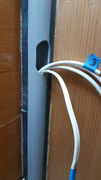
Although most of the Electrifying project will not get going till after the furniture gets finished, some things have progressed... some rough wiring has begun. I wanted to document here some of what I have found so others can make informed decisions about their mods.
I could not find many details of the wiring on my 2007 . This schematic from the manual is about all that I've found.
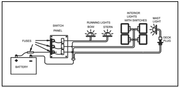
Looking on the forum, I didn't find any other details and even posed a question about how it is routed that got no responses. I found this surprising as many people had talked about re-wiring and finding Lamp Cord was used by the factory. Although, I can't find the reference, it seems like I've read here that even early's were using this lamp cord.
Aside - Did you know, that the tinning is not a requirement? https://www.practical-sailor.com/system ... yth-busted Maybe not... but as many times as I've replaced trailer wiring that the copper has gone black and failed, I think its a good call to have tinned wire.
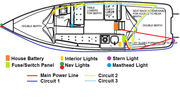
Here is what I've found on my 2007 ...
Although most of the Electrifying project will not get going till after the furniture gets finished, some things have progressed... some rough wiring has begun. I wanted to document here some of what I have found so others can make informed decisions about their mods.
I could not find many details of the wiring on my 2007
. This schematic from the manual is about all that I've found. Looking on the forum, I didn't find any other details and even posed a question about how it is routed that got no responses. I found this surprising as many people had talked about re-wiring and finding Lamp Cord was used by the factory. Although, I can't find the reference, it seems like I've read here that even early
's were using this lamp cord.Aside - Did you know, that the tinning is not a requirement? https://www.practical-sailor.com/system ... yth-busted Maybe not... but as many times as I've replaced trailer wiring that the copper has gone black and failed, I think its a good call to have tinned wire.
Here is what I've found on my 2007
...- All wiring was Marine grade, tinned, 2 conductor (red/black) 14 AWG
- The Main Power Line ran through an in-line fuse, aft to the transom and then forward to the fuse panel on the upper port liner. (~ 22 feet)
- Circuit 1 ran two lines from the circuit panel to the port upper liner edge (just above galley). One aft to the Stern Light. One forward to the bi-color Nav Light.
- Circuit 2 and Circuit 3 ran from the circuit panel between the liner and upper cockpit shell, probably around the seating area to a point about half way back of the starboard cockpit seat. They then ran forward.
- Circuit 2 runs directly to the light above the Galley and forward. At the first light over the seat at the bulkhead it splits, goes to the light and continues forward to the head/forward berth lights.
- Circuit 3 runs to the Masthead Light.
Odysseus, expert on the Siren's call
-
OverEasy
- Admiral
- Posts: 2899
- Joined: Mon Sep 28, 2020 11:16 am
- Sailboat: MacGregor 26X
- Location: NH & SC
Re: Inqism-03: Electrifying
Nice work!
Yes, I agree with you that tinned wire is preferable.
I have seen instances of the blackened oxidation of wires run through an entire 30 foot length of #6 AWG conductor that had previously only gotten wet for only a couple of hours but then sat for a year or two. I kept cutting the insulation back and back and back hoping to find clean wire but to no avail . That hurt the wallet back then in that it was ‘relatively’ new wire.
The black oxide not only inhibits connection conductivity it also causes embrittlement of the copper wire strands and makes pinhole corrosion pits which reduces the actual cross section of the wire that conducts DC power.
The marine grade insulation is of importance too as prolonged water contact of non marine grade can lead to permeation through the jacket and possible embrittlement of the jacket.
The problem is that for many people the availability to get marine grade tinned wire can be problematic in some regions short of the internet retailers. Even there one has to look carefully at what they are buying.
I really admire the thought and consideration that is going into your ambitious project!
Really nice work!
Yes, I agree with you that tinned wire is preferable.
I have seen instances of the blackened oxidation of wires run through an entire 30 foot length of #6 AWG conductor that had previously only gotten wet for only a couple of hours but then sat for a year or two. I kept cutting the insulation back and back and back hoping to find clean wire but to no avail
 . That hurt the wallet back then in that it was ‘relatively’ new wire.
 The black oxide not only inhibits connection conductivity it also causes embrittlement of the copper wire strands and makes pinhole corrosion pits which reduces the actual cross section of the wire that conducts DC power.
The marine grade insulation is of importance too as prolonged water contact of non marine grade can lead to permeation through the jacket and possible embrittlement of the jacket.
The problem is that for many people the availability to get marine grade tinned wire can be problematic in some regions short of the internet retailers. Even there one has to look carefully at what they are buying.
I really admire the thought and consideration that is going into your ambitious project!
Really nice work!
-
Idiotfool
- Engineer
- Posts: 173
- Joined: Sun Aug 07, 2016 5:44 pm
- Sailboat: MacGregor 26M
- Location: Homestead, FL
Re: Inqism-03: Electrifying
Love the thread and all the info, but I can’t read the thread title without getting Grease’s “You’re the one that I want” stuck in my head
-
OverEasy
- Admiral
- Posts: 2899
- Joined: Mon Sep 28, 2020 11:16 am
- Sailboat: MacGregor 26X
- Location: NH & SC
Re: Inqism-03: Electrifying
Hi Inquisitor
Did you get a chance to look into your 1500 watt inverter efficiency vs your 300 watt?
We are getting close to placing Over Easy in the water and are trying to wrap up our projects...one of which is to include a 2500 watt inverter &/or a minimal 300 watt unit for computer charging and other potentiall low wattage needs.
On item of higher wattage is a 1500 watt induction cook top for the new galley. We were figuring we could use it in the Marina when connected to shore power but should get a hot meal or two when at sea when the weather is rough and we didn’t want to pull out the propane stove.
The 2500 watt inverter number for a 1500 watt load may now bot seem to be an optimal choice.
Any suggestions?
Did you get a chance to look into your 1500 watt inverter efficiency vs your 300 watt?
We are getting close to placing Over Easy in the water and are trying to wrap up our projects...one of which is to include a 2500 watt inverter &/or a minimal 300 watt unit for computer charging and other potentiall low wattage needs.
On item of higher wattage is a 1500 watt induction cook top for the new galley. We were figuring we could use it in the Marina when connected to shore power but should get a hot meal or two when at sea when the weather is rough and we didn’t want to pull out the propane stove.
The 2500 watt inverter number for a 1500 watt load may now bot seem to be an optimal choice.
Any suggestions?
-
Inquisitor
- Captain
- Posts: 926
- Joined: Mon Apr 23, 2007 5:24 pm
- Sailboat: MacGregor 26M
- Location: North Carolina Mountains
Re: Inqism-03: Electrifying
Thank you for reminding me... I've probably overloaded with too many projects (again). I do it to myself.OverEasy wrote: ↑Wed Mar 31, 2021 10:41 pm Hi Inquisitor
Did you get a chance to look into your 1500 watt inverter efficiency vs your 300 watt?
We are getting close to placing Over Easy in the water and are trying to wrap up our projects...one of which is to include a 2500 watt inverter &/or a minimal 300 watt unit for computer charging and other potentiall low wattage needs.
On item of higher wattage is a 1500 watt induction cook top for the new galley. We were figuring we could use it in the Marina when connected to shore power but should get a hot meal or two when at sea when the weather is rough and we didn’t want to pull out the propane stove.
The 2500 watt inverter number for a 1500 watt load may now bot seem to be an optimal choice.
Any suggestions?
 But with my goal to do the Mug Race at the end of April, I have a hard deadline. It will be a frenzy between now and then. Still need to get Inqism-01 done. 03 - I need the battery finished for the fridge for the beer. 04 will be deferred, 05 will only get the head in... shower will be deferred. My buddy and I can stand each other's stink for a weekend. But still need to get new tires, re-attach the rudders and see if I can still remember how to raise the mast and set the sails. Need more cheese with that whine!?
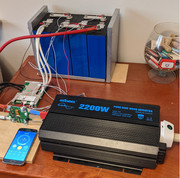
 I ended up getting a 2200 watt Inverter. My LiFePO4 battery's BMS will kick out at 130 Amps => 1730 watts. However, I posed a question on the other forum: Are there any benefits to be gained by over spec'ing an Inverter? The "gut feel" from those with far more experience with Inverters was that:
- That not running at max capacity would improve the life of the Inverter.
- That not running at max capacity might be somewhat more efficient. Not really enough to justify anything.
To answer your actual question: I've only done the total discharge 0.2C rate test on the LiFePO4 battery using the Inverter to draw 54 amps (700 watts). I'm also doing a lazy test... self discharge where I just let them sit over time. To give you a real accurate number, I need to:
- re-assemble the battery
- set up the test using 2200 watt inverter with a ~70 watt load and get the efficiencies.
- to be fair, I need to re-run the 300 watt inverter with the same ~70 watt load on the LiFePO4 battery and get the efficiencies. There was a comment on the other forum that Inverters like voltage. I used the old deep-cycle lead-acid battery to do the original 300 watt Inverter test and that battery sagged below 12 volts running at ~6 amps load. The LiFePO4 won't even notice that kind of load and will be putting out at least 13.3 to 13.5 volts.
I have two days of sub freezing nights / low 40's days - Read - I don't work out in the boat when its that cold!
 I should be able to get to those tests by the weekend when it gets back up into the 60's.
 However, the 300 watt unit was only 85% efficient at ~70 watts. My gut feeling before running the above tests is that the 2200 watt unit isn't going to be enough worse than this 85% to justify wiring both into the boat. In my case, the 300 watt unit was going to be installed remote from the battery, thus requiring a fairly expensive cable to run the distance. If I just use the 2200 watt unit (at the battery) and run 120 VAC wiring to the remote location to just a receptacle, I will come out ahead... at least that is my "guess" for now.

Odysseus, expert on the Siren's call
-
C Buchs
- Captain
- Posts: 605
- Joined: Thu Apr 23, 2015 6:49 pm
- Sailboat: MacGregor 26X
- Location: Camas, WA 98607
Re: Inqism-03: Electrifying
I've been avoiding 120V devices on my boat. I'm trying to keep it simpler. For my laptop, I've used a 12V charge adapter. New job this year, so I have a new laptop and I need to get a new adapter. This is the one I'm considering https://www.lenovo.com/us/en/accessorie ... 14QAvD_BwE. Of course it tells you its output voltage and amperage, but not the inputs. I never ran a test on my old one. Has anyone run tests on these to see how efficient they are? It has to be more efficient than converting DC to AC and then back to DC.
Jeff
-
Inquisitor
- Captain
- Posts: 926
- Joined: Mon Apr 23, 2007 5:24 pm
- Sailboat: MacGregor 26M
- Location: North Carolina Mountains
Re: Inqism-03: Electrifying
Growing up in the Great Smoky National Park I was an avid backpacker and liked to tease my mother with carrying the kitchen sink when our family went "tent" camping. Our forum here does certainly have the full gambit and I'm obviously going hog-wild toward the creature-comfort end of the spectrum as fast as I can. I've never had an Inverter before and certainly wouldn't add one for just a laptop. Although I tout a laptop, I'm really just using it as a classification of a general class of items. One could just as easily substitute TV, but that gets even further from the backpacking mentality. At least laptop sounds like it can be used for work and/or chart planning and/or navigation duties, not to mention researching the eating establishments near the city dock you've landed for the night as you work up the ICW. A 300 watt unit makes a lot of sense for these type items that may not have a 12 VDC converter option.C Buchs wrote: ↑Thu Apr 01, 2021 7:39 am I've been avoiding 120V devices on my boat. I'm trying to keep it simpler. For my laptop, I've used a 12V charge adapter. New job this year, so I have a new laptop and I need to get a new adapter. This is the one I'm considering https://www.lenovo.com/us/en/accessorie ... 14QAvD_BwE. Of course it tells you its output voltage and amperage, but not the inputs. I never ran a test on my old one. Has anyone run tests on these to see how efficient they are? It has to be more efficient than converting DC to AC and then back to DC.
Jeff
Aside - The more I rationalized having a large battery bank/large inverter opened up the possibility of electric cooking. With that mindset, an Inverter becomes a far safer, simpler, and quicker cooking device. Running propane lines from an external locker to a propane stove/oven and making it all ABYC compliant is very complex and subject to wear and vibration. Popping a casserole in a microwave or a pot of soup on an Inverter hotplate makes a lot of sense and keeps from heating the interior to unbearable levels.
Back to your laptop converter. You are completely correct! As I'm finding out even these fairly high-end Inverter brands are only in the 80% to 85% efficiency range when dealing with such small wattages (< 100 watts). The typical (cheap) laptop brick may only be around 60% efficient. Although they can make them more efficient, we're only talking about dimes/year when used on a power grid. Efficiency is just not a design requirement. Good DC to DC converters like the one you are suggesting are upwards of 95% efficient and you only do the one conversion. The DC-DC converter we're using in the water level project viewtopic.php?f=8&t=28178 only cost about a $1 and claims 98% efficiency. It says it can handle up to 3 amps. Obviously a laptop needs more current, but not much more. The point being, I'm sure it would easy and inexpensive for companies to build laptop capable versions.
The one caveat to that is making sure you get one that is for your laptop. Besides getting the voltage right (many are in the 19.5V range) some have "smarts" in them. Obviously yours is a USB-C and certainly will have them. I've found the older Lenova brand ones did not have smarts and were simple converters. I use them for some of my electronics projects. But, older Dell ones are notoriously complex. The brick won't even fire up unless the computer tells it exactly what it needs to hear.
Odysseus, expert on the Siren's call
-
Inquisitor
- Captain
- Posts: 926
- Joined: Mon Apr 23, 2007 5:24 pm
- Sailboat: MacGregor 26M
- Location: North Carolina Mountains
Inverter Efficiency Results
Theory - That small Inverters might handle smaller loads more efficiently than a large Inverter trying to support that same small load. In general, Pure Sine Wave Inverters tend to be more efficient toward their stated, maximum values. Company's Engineers are under the assumption that if you purchased a 2200 watt Inverter, it'd be better if it was efficient there versus at 70 watts. They optimize at the 2200 watt number. This held to be true in the earlier 300 watt Inverter test. EVEN at near 300 watts output and the fan going full-tilt, the efficiency was significantly better than at 70 watts and no fan running.
Test - Using the same LiFePO4 battery (could just as well be a large bank of AGM) use two different Pure Sine Wave Inverters (300 watt and 2200 watt units) to power a 70 watt load. Calculate their efficiency. Each Inverter ran for three hours to improve the accuracy of the test equipment.
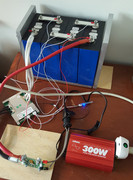
Results

Interpret
For example - If you have a usable 100 Ah battery, you can run the 70 watt device for:
300 watt Inverter: 100 Ah * 12 volts / 70 watts * 86% = 14.7 hours
2200 watt Inverter: 100 Ah * 12 volts / 70 watts * 78% = 13.4 hours
Summarizing
Inq
Test - Using the same LiFePO4 battery (could just as well be a large bank of AGM) use two different Pure Sine Wave Inverters (300 watt and 2200 watt units) to power a 70 watt load. Calculate their efficiency. Each Inverter ran for three hours to improve the accuracy of the test equipment.
Results
Interpret
For example - If you have a usable 100 Ah battery, you can run the 70 watt device for:
300 watt Inverter: 100 Ah * 12 volts / 70 watts * 86% = 14.7 hours
2200 watt Inverter: 100 Ah * 12 volts / 70 watts * 78% = 13.4 hours
Summarizing
- Is the efficiency improvement valid? - For these specific Inverters, yes. For all Inverters... probably for higher end models. For modified sine wave Inverters, probably not. My only other data point, for top-of-the-line Inverters, we have a $2000 Victron 5kW Inverter that was only 65% efficient at 70W. It is probably safe to say that as the maximum capacity is increased the efficiency at a low wattage gets worse.
- This test is certainly not valid for modified sine-wave Inverters. These are also harmful to sensitive electronics and motors.
- Should you use a two Inverter solution? For myself, I already have both. Having two gives a level of redundancy. If I was before the purchase, I certainly would not do it. In fact, I probably will only mount the large one and simply expose a 12 VDC socket in case the first one goes out OR I'm in a critical situation where I need to be more efficient.
Inq
Odysseus, expert on the Siren's call
-
OverEasy
- Admiral
- Posts: 2899
- Joined: Mon Sep 28, 2020 11:16 am
- Sailboat: MacGregor 26X
- Location: NH & SC
Re: Inqism-03: Electrifying
Thank You for sharing your time and understanding of these things!
It is really appreciated your taking the time to not only actually test these in a relevant context but write it up in a way that makes sense!
We will be going ahead with the larger inverter but are going to make sure it is a pure sine wave type.
Some of the items we would want to use this for occasionally is a small wet/dry vacuum (~700 watts), an induction cook top (1500 watts) as well as lap tops / IPads. Hopefully not all at the same time.
Again, Thank you!
It is really appreciated your taking the time to not only actually test these in a relevant context but write it up in a way that makes sense!
We will be going ahead with the larger inverter but are going to make sure it is a pure sine wave type.
Some of the items we would want to use this for occasionally is a small wet/dry vacuum (~700 watts), an induction cook top (1500 watts) as well as lap tops / IPads. Hopefully not all at the same time.
Again, Thank you!