On fuel management - mpg in heavy seas

A forum for discussing topics relating to MacGregor Powersailor Sailboats
Kelly Hanson East
Admiral
Posts: 1786
Joined: Sat Apr 19, 2008 2:35 pm
Sailboat: MacGregor 26X
Location: Kelly Hanson Marine........Mac 26M Dealer......Freedom Boat Works

On fuel management - mpg in heavy seas

Post by Kelly Hanson East »

Just wanted to create a separate thread for this topic, which I learned the medium hard way.

As a beginning boater, it is easy to underestimate the effect of heavy seas on your fuel consumption.
Here is a post from James on his experience offshore

My gas milage in crossing to Bimini was around 8 mpg. Towing a Dinghy and fully loaded. Your next stop from Bimini is the Berry Islands or Andro's. 90 miles. I was going dead into the wind and seas. My milage droped to 5 mpg. I am glad I had 30 gal's of gas with me.
Note his mph drops almost 2x when he is facing seas - this is partly due to the load of the wind on the boat, but also, of course, when the seas are up and down, you have to move the boat a longer distance

Calm seas _______________

Rough seas /\/\/\/\/\/\/\/\/\

When I started I was lulled into thinking of boat mpg much like a car - you get what you get, and there are small variations with load and hills and such.

Boating mpg can change a lot more.
User avatar
KayakDan
Captain
Posts: 507
Joined: Wed Jun 21, 2006 1:10 pm
Sailboat: MacGregor 26M
Location: Apple Valley,Ohio, ........... 2006 26M "Spice" Honda 50

Re: On fuel management - mpg in heavy seas

Post by KayakDan »

I found this to be true when doing a 12 mile crossing from Fox Island Thoroughfare to Rockland ME, in seas that were 6-8 ft ,steep and fairly close. Knowing how rough it was getting,I stopped at the Marina in North Haven and bought fuel,just in case. Good choice,as I used most of it,probably more like 2-3 mpg. We were getting slammed going head in,so we ended up "tacking"across the bay to avoid bringing the rigging down.
Next year we faced the same conditions to cross,and opted for a layover day on a mooring in Perry Creek,reading sailing mags,and drinking cold beer. Much better choice. 8)
User avatar
bastonjock
Admiral
Posts: 1161
Joined: Fri May 25, 2007 10:41 pm
Location: Lincolnshire United Kingdom Mac 26X

Re: On fuel management - mpg in heavy seas

Post by bastonjock »

Over here on the Uks east coast,it is important to include the tide in your estimation for mpg.At springs i can end up with a 2.5 knot tide.I tend to work on 6-8 hour long travel slots,i try to leave at HW+2 if i am intending to head south as thats the direction of the tide and after HW+4 the tide starts to turn against you,HW+3 and HW+5 is okay but after that its hard work,ive seen me doing 1.5 knots at 1500rpm with the tide against me and with the tide for me i hit 4 knots.

Trying to make any head way into the wind on a lumpy sea can get through a lot f fuel very quickly,last time that i had to do it,i was getting about 20 miles to a 6 gall tank.
User avatar
Rick Westlake
Captain
Posts: 778
Joined: Wed Aug 22, 2007 4:05 pm
Sailboat: MacGregor 26X
Location: Casa Rio Marina, Mayo, MD; MacGregor 26X, "Bossa Nova" - Bristol 29.9 "Halcyon"
Contact:

Re: On fuel management - mpg in heavy seas

Post by Rick Westlake »

I am "playing very hard" with the notion of adding a fuel-flow meter to Bossa Nova ...

The "pro" is that I could explore the actual gallons-per-hour that my boat & engine can give me. Like, "I'm running at 2000 RPM, getting X.X knots on the GPS ... how would I do at 1500? Or 2500?" This could translate to knowing what speed will get me "there" in a reasonable time, without slurping up all my fuel on the way.

The "con", of course, includes: price - yet another piece of electronics - and how much practical use would I get out of it?

A fuel-flow sensor with NMEA 2000 output, made by my GPS manufacturer, is about $75 plus shipping. For $200 I can get it with its own display, and choose whether-or-not to interface it with my GPS.

Any thoughts from the experienced hands on this site?
User avatar
Love MACs
Captain
Posts: 587
Joined: Tue Jan 08, 2008 10:56 pm
Sailboat: MacGregor 26X
Location: Eddyville, KY; 2002 X, 50hp Merc-4 stroke: Dream Chaser
Contact:

Re: On fuel management - mpg in heavy seas

Post by Love MACs »

I think the flow-meter would give you good information if you are sailing on a flat lake. But otherwise you have to take into account any current and which way is it flowing, with you or against you; is there tide and is it coming in or out and what relation does that have to your boat's course; is there a following or head wind and its strength and is it making waves and of what size? So I would think there there are many variables other than just throttle speed. Your RMPs may remain constant but your conditions way not.

Allan
User avatar
Don T
Admiral
Posts: 1084
Joined: Fri Jan 02, 2004 7:13 pm
Sailboat: MacGregor 26X
Location: 95 2600 "SS OTTER" - Portland OR - Tohatsu 50 - Hull#64 (May 95)

Re: On fuel management - mpg in heavy seas

Post by Don T »

Hello,
I use time in my calculations. I know how long I can run at the throttle settings I normally use. Now all I need to know comes from the gps. Distance to destination and velocity made good. I have how long my fuel will last and how long it will take me under current conditions to get there, all variables taken into account.................except for the conditions changing of course.
User avatar
Duane Dunn, Allegro
Admiral
Posts: 2459
Joined: Fri Jan 02, 2004 6:41 pm
Sailboat: MacGregor 26X
Location: Bellevue, Wa '96 26x, Tohatsu 90 TLDI and Plug In Hybrid Electric drive
Contact:

Re: On fuel management - mpg in heavy seas

Post by Duane Dunn, Allegro »

A cheaper and very useful addition is a speed through water transducer. With this you can get two speed readings on the GPS, speed over water from the paddle wheel and speed over ground from the GPS. This let's you see the effect of any current.

It's pretty easy over time to know how much your engine consumes at a given rpm level, and this never changes. The tendency however it to adjust the throttle to hit a target speed instead of an rpm number. This happens both in heavier conditions and against currents. This leads to using a higher rpm setting than you intend to use and burning more fuel. For some reason we never are happy with the slower speed a contrary current gives, and when we have positive current help we never back down the rpms either instead we just enjoy the extra boost.

Another simple addition is to spend a bit more money for the enhanced tide and current tables for your area instead of the simple tide book. At least up here in the Northwest, just because there is a flood tide it doesn't mean all the water is flowing south through the sound. Having this little extra information will let you plan the route and time that will give you the most current help under sail or power.

I've been very happy with the Navionics Gold charts I have in my GPS. They contain excellent tide and current information that is overlayed on the chart with a direction and velocity current arrow in real time that helps make the best choices for planning and during a passage. The stations are scattered all over the chart giving far more information than a typical book version gives you. Being able to simply place the cursor over a station and see this information without leaving the chart view is great. Using this has saved a lot of fuel over the years. I now have the exact same charts, tides, and currents in the Navionics application on my iPod touch.

In the Northwest an excellent resource is the Canadian current tables. They don't include Puget Sound itself, but they cover the Strait of Juan De fu@ north through all the islands. Each has page is an overview chart that shows the current flow direction and velocity around every island and shoreline at a given hour. You use the same book year after year. You buy an annual table that tells you which page in the book to look at for each hour of every day. Anyone who cruises the San Juans or Gulf islands should have this on board.
Kelly Hanson East
Admiral
Posts: 1786
Joined: Sat Apr 19, 2008 2:35 pm
Sailboat: MacGregor 26X
Location: Kelly Hanson Marine........Mac 26M Dealer......Freedom Boat Works

Re: On fuel management - mpg in heavy seas

Post by Kelly Hanson East »

Duane - do you observe constant fuel flow at given rpm under the currents in the NW?

RPM is a much better gauge than boat speed, of course, but I would think there would still be some change in fuel consumption as a function of load.

Mercury makes a SMARTCRAFT system that I have had my eye on for some time that monitors all this stuff at the helm

,....more gadgets!!!
User avatar
Rick Westlake
Captain
Posts: 778
Joined: Wed Aug 22, 2007 4:05 pm
Sailboat: MacGregor 26X
Location: Casa Rio Marina, Mayo, MD; MacGregor 26X, "Bossa Nova" - Bristol 29.9 "Halcyon"
Contact:

Re: On fuel management - mpg in heavy seas

Post by Rick Westlake »

Duane Dunn, Allegro wrote:It's pretty easy over time to know how much your engine consumes at a given rpm level, and this never changes.
Duane, I appreciate your response and I understand what you're saying, but ... you're a power-boater, even if your powerboat is a MacGregor. I'm a sail-boater even though I have a Honda 50 on my transom, and I might go through two tanks of gas a season; during that time I may vary from kicking out of my harbor at 1500 RPM to dumping my ballast to get somewhere quickly at 5000 RPM. I'm not sure your case applies to mine very well....
The tendency however it to adjust the throttle to hit a target speed instead of an rpm number. This happens both in heavier conditions and against currents. This leads to using a higher rpm setting than you intend to use and burning more fuel. For some reason we never are happy with the slower speed a contrary current gives, and when we have positive current help we never back down the rpms either instead we just enjoy the extra boost.
The very names of our boats bespeak our different attitudes about boating, don't they?

"Bossa Nova" is Brazilian jazz; often slow and languid, sometimes fast and bouncy, but always "swings so cool and sways so gently" (as in the English lyrics to 'The Girl From Ipanema') ... like sailing.

"Allegro" means one thing in music: fast.
A cheaper and very useful addition is a speed through water transducer. With this you can get two speed readings on the GPS, speed over water from the paddle wheel and speed over ground from the GPS. This let's you see the effect of any current.
I have one, installed by the P.O. as part of my old depth-sounder, and I have never been satisfied with its behavior at those "languid" sailing speeds. Seems to me you have to be going "allegro" to get a trustworthy reading out of them.
Another simple addition is to spend a bit more money for the enhanced tide and current tables for your area instead of the simple tide book. At least up here in the Northwest, just because there is a flood tide it doesn't mean all the water is flowing south through the sound. Having this little extra information will let you plan the route and time that will give you the most current help under sail or power.
Now that's advice that might apply even more valuably to a "sail-boater". You're absolutely right with that! Tides and currents make a difference that becomes ever more marked and critical at slower speeds - like sailing - although the power-boater is indeed likely to push the throttle a little more heavily in the face of an opposing current, thereby burning "extra" fuel.

I do agree that you can learn your engine's fuel-burning habits, over time, if you're using the engine as your sole source of motive power and you're using it at a fixed RPM between fill-ups. I know the fuel burn of my airplane, but I always cruise it at 2300 RPM (taking what speed I get); and my 150-hp Lycoming uses 8 gallons per hour at 2300 RPM and about 2000 feet. That's not how I sail Bossa Nova - for now it's an afternoon under the canvas, rather than "I have to get there at X o'clock." But if I do start using it more as a "traveling machine" - for example, doing the Bahamas and having to cross the Gulf Stream - I will need to know my fuel-burn and my best-range throttle settings, and the way I'm using my engine I'm just not learning them as fast as you did.

Or as "allegro". :wink:
User avatar
bubba
Captain
Posts: 896
Joined: Fri Mar 21, 2008 11:04 am
Sailboat: MacGregor 26M
Location: Richland,WA Columbia River Lake Wallula "INSPIRATION" w/70 suz. 9' Merc dingy
Contact:

Re: On fuel management - mpg in heavy seas

Post by bubba »

Our 70 Suzuki uses a gallon an hour at 2100 rpm or less and we get about 5.5 miles per hour towing a dingy, at 2300 rpm the gas usage goes up a bunch. At 4000 rpm I use about 4 gallon per hour at about 12 miles per hour towing a dingy. Once you go over the sailing hull speed of about 6 mph the usage goes up. Patience is the best way to get better fuel usage just set back and relax your on a sail boat.
User avatar
Don T
Admiral
Posts: 1084
Joined: Fri Jan 02, 2004 7:13 pm
Sailboat: MacGregor 26X
Location: 95 2600 "SS OTTER" - Portland OR - Tohatsu 50 - Hull#64 (May 95)

Re: On fuel management - mpg in heavy seas

Post by Don T »

Hello,
Fuel usage with a steady throttle setting is pretty uniform. Speed can change a lot and rpm a little under different conditions. For me it's a matter of feel, my boat has "grooves" it settles into and my fuel usage is real consistent when it's "in the groove."
User avatar
Egress
Deckhand
Posts: 33
Joined: Sat Apr 12, 2008 11:47 am

Re: On fuel management - mpg in heavy seas

Post by Egress »

As a pilot I can tell you that airplanes measure fuel consumption by time not distance. I have a 40hp Bigfoot Merc and at full throttle use 1.8 gph WOT. So I plan on a little over 3 hours per tank as I have standard tanks. This is the only way to measure fuel. It is a time and distance calculation not an MPG. By the way if you travel into a strong headwind with a car you will suffer some MPG loss. It is not so great to be readily apparent as will only reduce your mpg by a galllon or so and over time it is not noticed.
User avatar
bubba
Captain
Posts: 896
Joined: Fri Mar 21, 2008 11:04 am
Sailboat: MacGregor 26M
Location: Richland,WA Columbia River Lake Wallula "INSPIRATION" w/70 suz. 9' Merc dingy
Contact:

Re: On fuel management - mpg in heavy seas

Post by bubba »

I am really glad our Mac M has the standard 2 -12gallon tanks when motor crusing 2 weeks ago I traveled around Vashon Island in Pudget Sound on the way south thru the west channel with no breeze in the morning I speeded up to 3500 to 4000 rpm to about 14 mph and used 6 to 8 gallons of fuel in an hour and then turned north to Schilshole bay at a steady rpm of 2200 except for removing flotsom : tree limbs from the dagger board, rudders and motor and was getting about 5 to 6 mph gps against a head wind of 15 to 20 mph and 3 to 4 ft wind waves (a long fetch) and an incoming tide of about 2 mph for 6 hours and used about 6 gallons of fuel, it is about 28 miles from the south end of Vashon island going north in the main channel and my wife had to waite at the dock for 1.5 hours longer in a cool breeze. The reason I know this is when I got there I only had 3 gallons of fuel left in both tanks a little too close for me and too long of a waite for her. The fuel dock was closed by the time I got there so I put our M on the trailor unhooked and I hopped in my truck and went to a gas station with our gas cans and refuled a lot cheeper than the gas dock anyway. We only use top rpm to get out of the way of Ferries and cruse boats and barges pulled by a tug usually.
User avatar
bastonjock
Admiral
Posts: 1161
Joined: Fri May 25, 2007 10:41 pm
Location: Lincolnshire United Kingdom Mac 26X

Re: On fuel management - mpg in heavy seas

Post by bastonjock »

my figure is not accurate,this is an estimate on having a third of a tank left,i estimate that at 15-1800 rpm i can cover 60 miles with one 6 gal tank of fuel,my speed averages between 3 knots and 6 knots,i generally look at covering 50 miles with frugal use of my gas.

changing the subject slightly, what make of 12 gallon fuel tanks fits into a Mac 26x,s lazzarettes? i am looking at doing a run accross the North Sea next year,the distance is 80 NM so my plan is to have 30 gallons capacity for this run.

i will do a couple of test runs before the big one,i want to know how far and how fast i can go at 3000 and 4000 rpms
im with the pilots on this one,i want to find out time and distance
User avatar
Matt19020
Captain
Posts: 576
Joined: Sat Jul 15, 2006 1:29 pm
Sailboat: MacGregor 26M
Location: Middle River, Chesapeake Bay MD...2007 MacM Suzuki DF70 4-Stroke ..... "My Time"
Contact:

Re: On fuel management - mpg in heavy seas

Post by Matt19020 »

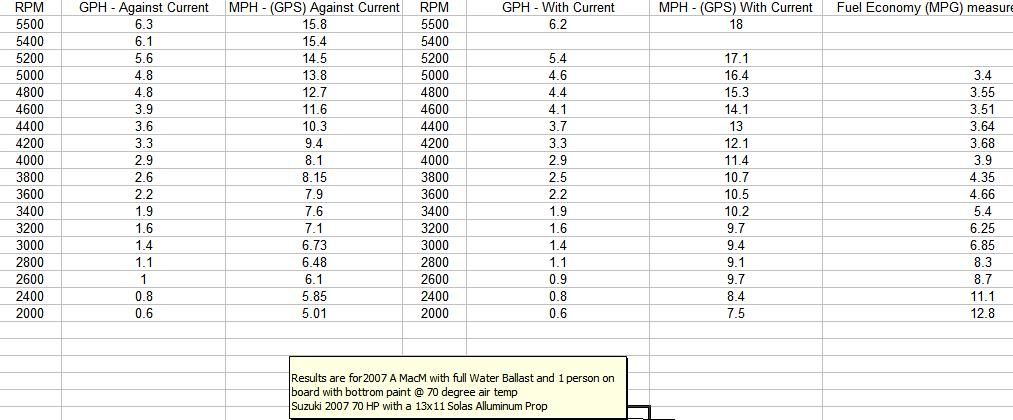
I have posted before but this may help some who have not seen this....


Click on Pic to enlarge...and again to enlarge more...
One day I had time to kill so I went out and recorded the following:
I have A Suzuki 70 with full ballast in My MacM and recorded the following with a Lowrance GPS and wiring harness connected to the module on the motor to measure fuel usage at the injectors...
I wanted to do a chart but I could not figure it out how to work Excel so this will have to do....

Image
Post Reply