

What Speed Is Considered Good Performance?
-
johnnyonspot
- First Officer
- Posts: 441
- Joined: Thu Oct 06, 2005 9:19 pm
- Location: Elk River, MN.
What Speed Is Considered Good Performance?
I had my Mac 25 out yesterday in 20+ mph winds and was getting peak readings on my GPS of 8.8 mph, or a bit better than 7.6 knots while on a broad reach. Where does this sit as far as performance of a trailer sailor goes? I knows it definitely not bad, but how good is it? I had full main and standard hank-on jib deployed.
-
baldbaby2000

- Admiral
- Posts: 1382
- Joined: Sun Mar 28, 2004 8:41 am
- Location: Rapid City, SD, 2005 26M, 40hp Tohatsu
- Contact:


-
beene

- Site Admin
- Posts: 2546
- Joined: Tue Sep 19, 2006 5:31 pm
- Sailboat: MacGregor 26M
- Location: Ontario Canada, '07 26M, Merc 75 4s PEGASUS
I think that is a great speed.
From my experience, I would say the best speed one could attain on these boats is by sailing just off DDW with the asim in moderate winds. I don't think you would need the main up either, but it might add stability. I just don't like using the main with the spin up because it blocks my view of the spin. She's such a beauty sail to look at.
Under those conditions, one should be able to attain greater than 10kts IMHO.
G
From my experience, I would say the best speed one could attain on these boats is by sailing just off DDW with the asim in moderate winds. I don't think you would need the main up either, but it might add stability. I just don't like using the main with the spin up because it blocks my view of the spin. She's such a beauty sail to look at.
Under those conditions, one should be able to attain greater than 10kts IMHO.
G
-
johnnyonspot
- First Officer
- Posts: 441
- Joined: Thu Oct 06, 2005 9:19 pm
- Location: Elk River, MN.
-
baldbaby2000
- Admiral
- Posts: 1382
- Joined: Sun Mar 28, 2004 8:41 am
- Location: Rapid City, SD, 2005 26M, 40hp Tohatsu
- Contact:

-
baldbaby2000
- Admiral
- Posts: 1382
- Joined: Sun Mar 28, 2004 8:41 am
- Location: Rapid City, SD, 2005 26M, 40hp Tohatsu
- Contact:
There have been spirited debates on this forum as to when a boat is planing!
I miss those days when the arguments actually had something to do with boats and sailing. All the political arguments seem to have distracted us from the purpose of this site.spirited
That's one way to put it.
Oops...I'm in the wrong forum, sorry.


-
Frank C
Re: What Speed Is Considered Good Performance?
Jots,johnnyonspot wrote:I had my Mac 25 out yesterday in 20+ mph winds and was getting peak readings on my GPS of 8.8 mph, or a bit better than 7.6 knots while on a broad reach. Where does this sit as far as performance of a trailer sailor goes? I knows it definitely not bad, but how good is it? I had full main and standard hank-on jib deployed.
That's great for a 26X, but I don't know what the 25 should get. My best ever day in the X, I saw 8+ mph for about a half-hour, just peaking at 9 mph a few times (I'm guessing 8 knots is max upwind speed for the X-boat). That was a close reach with reefed main and jib, heeling about 30 degrees. It's great fun when we can keep her from rounding up, but everything was singing that day ... the rigging too! I'd guess winds were 18+ kts, profuse whitecaps and about 18" chop.
-
Lease

- First Officer
- Posts: 290
- Joined: Thu Nov 17, 2005 3:07 pm
- Location: Canberra Oz; 1995 26X "MACMAC" Tohatsu 50
No-one has mentioned the theoretical hull speed of displacement boats in displacement mode, so here it is: 1.3 X Square Root of the Waterline Length (provides speed in knots).
For the Mac, that is around 6.4 knots. There are lots more factors that affect the ability of a boat to achieve this speed, some design related, some environment related, and of course the extreme variable being the nut attached to the end of the wheel.
At the end of last summer, in racing mode, we started to get a consistent 5.8 hard on a work in around 12 knots of breeze. Above that, sail had to be reduced in order to keep the boat balanced and driving (alternative being lots of wheel work, untidy course, and no speed gain). I reckon that with a better main (mine is a ten-year veteran), a bit better tune, and more experience, we could get six knots (7.2 mph) on a work pretty consistently in moderate to fresh winds.
Unfortunately, we haven't done that much work off the wind in racing mode and have nothing to offer in regard to the speed potential other than to note some of the observations (claims?) made by others. Given the Mac's initial tenderness however, and the need when reaching to unload the rudder and fin by keeping the boat under the sails, I do wonder at what technique will be the most effective to achieve this.
As far as comparison to other trailer sailers?
Dishy ultralight sport boats regularly record speeds upwards of 15 knots in strong breezes with their massive assy kites drawing on a broad reach. The best I ever achieved was on my older style Farrier Trailertri (22'6") of 17 knots in 18 knots of southerly on a protected lake on a beam reach with a square kite and the pole just touching the forestay. Beating 10 knots in a mono will be something that you will recognise instantly, because that it the point at which you become very aware of function of your heart.
On edit: This is what 15 knots in a trailer sailer looks like:

For the Mac, that is around 6.4 knots. There are lots more factors that affect the ability of a boat to achieve this speed, some design related, some environment related, and of course the extreme variable being the nut attached to the end of the wheel.
At the end of last summer, in racing mode, we started to get a consistent 5.8 hard on a work in around 12 knots of breeze. Above that, sail had to be reduced in order to keep the boat balanced and driving (alternative being lots of wheel work, untidy course, and no speed gain). I reckon that with a better main (mine is a ten-year veteran), a bit better tune, and more experience, we could get six knots (7.2 mph) on a work pretty consistently in moderate to fresh winds.
Unfortunately, we haven't done that much work off the wind in racing mode and have nothing to offer in regard to the speed potential other than to note some of the observations (claims?) made by others. Given the Mac's initial tenderness however, and the need when reaching to unload the rudder and fin by keeping the boat under the sails, I do wonder at what technique will be the most effective to achieve this.
As far as comparison to other trailer sailers?
Dishy ultralight sport boats regularly record speeds upwards of 15 knots in strong breezes with their massive assy kites drawing on a broad reach. The best I ever achieved was on my older style Farrier Trailertri (22'6") of 17 knots in 18 knots of southerly on a protected lake on a beam reach with a square kite and the pole just touching the forestay. Beating 10 knots in a mono will be something that you will recognise instantly, because that it the point at which you become very aware of function of your heart.
On edit: This is what 15 knots in a trailer sailer looks like:
-
Frank C
There's no magic in that formula, though it does give approximately correct results for traditional displacement hulls. In fact, I believe it was first postulated in the 17th century.Lease wrote:No-one has mentioned the theoretical hull speed of displacement boats in displacement mode, so here it is: 1.3 X Square Root of the Waterline Length (provides speed in knots).
For the Mac, that is around 6.4 knots. There are lots more factors that affect the ability of a boat to achieve this speed, some design related, some environment related, and of course the extreme variable being the nut attached to the end of the wheel.
However, many "full displacement hulls" exceed the dictates of the traditional formula, simply because their designs are non-traditional. US Navy ships are easily driven well beyond the results of that formula. How is it that full-displacement multihulls easily shatter the predictions of that formula?? ... they do so because their beam-to-length factors are significantly altered from traditional monohulls ... usually much, much skinnier hulls. That's also the way that ULDB designs, including Roger's Mac65, shatter the traditional formula .... very skinny hull designs.
Further, Roger's powersailor hull design is a semi-displacement hull, which totally obviates the results of that formula. David Gerr is a contemporary naval architect who has postulated a revised formula that seems to account accurately for the actual speeds experienced by semi-displacing hulls. That formula indicates that the 26X hull speed is 8 knots. Hmmmm.
Both the following quotations as well as an explanatory letter from Gerr appear on this Potter webpage. While Potters are not semi-planing designs like Roger's, they are a semi-displacement design. In both cases, Gerr contends that speed under sail differs markedly from the traditional formula. It provides very interesting reading!
(Coincidentally, KmC just posted photos of a Potter hull design over here.)

Potter website wrote:Like many other small sailboats, Potters are semi-displacement boats. Plus, with their flat panels in the aft hull, they occassionally actually do get up on a plane. They're really fast, if you know how to sail them fast and you don't load them up with too much gear.
A P19 with 700 pounds of crew and gear can theoretically reach sustained speeds of 6.3 knots, comparable to a 25' displacement hull with a 23' LWL. An almost empty P19 theoretically can sustain 7.2 knots, comparable to a 30+' displacement hull with a 29' LWL. Clearly, an empty P19 can't sail because there's no skipper, but there is a point -- the less gear you put in your boat, the closer it can get to the theoretical limit of 7.2 knots, given enough wind.
. . . .
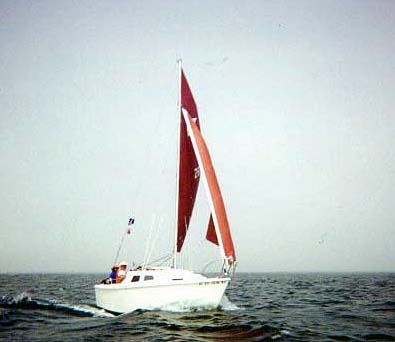
Something funny is going on here. Look at the stern wave. The crest is aft of the transom. Redwing's going faster than the old the hull speed formula predicts. When the crest of the stern wave is aft of the transom, you are going faster than "hull speed." When the stern wave flattens out, you are planing.
Last edited by Frank C on Wed Oct 10, 2007 4:11 pm, edited 3 times in total.
