

I'm really new at this so please be patient with me ... I got a 2004 26M the first week in september and have been out quite a few times since then just getting used to the boat and sailing with just the main.. next year I'm starting the season by taking some lessons so I really know what I'm doing.
My question is .. I'm getting ready to trailer it home for the winter .. so far I've removed the main, boom, vang and traveler.. before I lower the mast I'm guessing I have to remove the genoa from the furler.. I looked at it today and it's just not obvious to me how to do it.. it looks like it slides out of the track on the furler but it just doesn't look like you can do it with the mast up... I can't find anything in the Macgregor manual on how to do this so any help would be greatly appreciated..
I hope by the end of next season I will be asking more challenging questions and able to actually contribute to this forum.
A question about the CDI Furler and then genoa
On the forward side of the foil, there is a halyard that's tied off to a shackle on the drum and it runs up to a metal piece inside a groove in the foil.
Get a line a bit longer than the furler, untie the furler halyard from the drum and tie it to your new line, then pull the sail down while feeding the line up. Wrap the line around the foil a few times once the sail is down.
Given you're going to be taking the mast and furler down, you don't even have to add the line, just let the halyard go to the top of the furler. But you'll need the line to hoist the sail if you put the furler back up next year without the sail on it.
Get a line a bit longer than the furler, untie the furler halyard from the drum and tie it to your new line, then pull the sail down while feeding the line up. Wrap the line around the foil a few times once the sail is down.
Given you're going to be taking the mast and furler down, you don't even have to add the line, just let the halyard go to the top of the furler. But you'll need the line to hoist the sail if you put the furler back up next year without the sail on it.
-
They Theirs

- Captain
- Posts: 790
- Joined: Tue Dec 27, 2005 1:42 pm

-
ALX357

- Admiral
- Posts: 1231
- Joined: Thu Jul 22, 2004 6:09 am
- Location: Nashville TN -- 2000 MacGregor 26X, Mercury two-stroke 50hp
Most of us just leave the Genoa on the furler and strap it flat to the mast, some let if flop around but it is better if it stays flat. The Dacron sail material needs the protection of a sock or UV resistant strip if left on the furler exposed to sunlight, like any sail. Lots of methods have been used to support the furler as it sticks out past the mast at the bow of the boat in the mast-down position.
-
Duane Dunn, Allegro

- Admiral
- Posts: 2459
- Joined: Fri Jan 02, 2004 6:41 pm
- Sailboat: MacGregor 26X
- Location: Bellevue, Wa '96 26x, Tohatsu 90 TLDI and Plug In Hybrid Electric drive
- Contact:
In 7 years I have never removed my genoa from my furler. I do keep it supported so there is no sag in the drum end of the foil when in the down position. I store it well bungee'd to the mast to it is supported over the entire length. I also use a mid mast support to keep the whole thing from bouncing on the road.


I never took the sail off the furler of the Mac, but then I could get the whole sail/furler combo down in my basement for the winter. I wouldn't leave the sail on the furler strapped to the mast over winter. I also supported the furler with a 1 x 4 bungied to it as shown in TT's picture.
I also keep the Capri 18's furler in the basement, but I take the sail off for raising and lowering the mast because I do that by hand and every bit of weight reduction helps, especially lowering.
--
Moe
I also keep the Capri 18's furler in the basement, but I take the sail off for raising and lowering the mast because I do that by hand and every bit of weight reduction helps, especially lowering.
--
Moe
-
They Theirs
- Captain
- Posts: 790
- Joined: Tue Dec 27, 2005 1:42 pm
Leaving the headsail up makes things easy, and many do just that. The truth is the sail adds to the weight aloft and increases windage when slipped or left in mast up storage. A CDI furler (known for “Set it and forget it use”) can be convenient to leave factory Generic Sails without a UV protective foot-and-leech cover (Adds weight aloft) because of they are relatively inexpensive to replace. Quality Loft Sails can be very costly and need UV protection if left up after sailing. Many neglect to relieve the static luff tension on their furled headsail after sailing, something that helps maintain sail shape and increase the life of the sail. The standing rig tension should be maintained when left standing, to reduce buffeting in the wind with the bulked up furled sail on the headstay, possibly reducing fatigue of the forestay wire aloft.
Many sails fail from overtensioning the luff, and detiorate from the suns Ultra Violate rays. (From Moe’s post above) Removing the headsail from the CDI furler requires a messenger line, attached to the CDI self contained small halyard, to retain the halyard. As you pull the sail down, the halyard will rise out of your reach without a messenger attached. After removing the sail, secure the sails-head end of the CDI halyard line to the small sail-tack line at the base of the furler housing. Sails last much longer when flaked, bagged and properly stored, over those suffed, wadded and wrinkled as it breaks down the resins in the warp-and-weave of the sail cloth.
Many sails fail from overtensioning the luff, and detiorate from the suns Ultra Violate rays. (From Moe’s post above) Removing the headsail from the CDI furler requires a messenger line, attached to the CDI self contained small halyard, to retain the halyard. As you pull the sail down, the halyard will rise out of your reach without a messenger attached. After removing the sail, secure the sails-head end of the CDI halyard line to the small sail-tack line at the base of the furler housing. Sails last much longer when flaked, bagged and properly stored, over those suffed, wadded and wrinkled as it breaks down the resins in the warp-and-weave of the sail cloth.
-
baldbaby2000

- Admiral
- Posts: 1382
- Joined: Sun Mar 28, 2004 8:41 am
- Location: Rapid City, SD, 2005 26M, 40hp Tohatsu
- Contact:
True. The tensions should be relieved after sailing. Even when sailing the tension doesn't need to be that tight; maybe 50 lbs or so.Many neglect to relieve the static luff tension on their furled headsail after sailing,
The problem I have with my CDI extrusion is that it gets distorted a little from being strapped to the mast unevenly. It used to be worse before I started removing the spreaders. They say it can be straightened by putting in a pipe and leaving in the sun but I haven't tried it.
Daniel
-
Richard O'Brien
- Captain
- Posts: 653
- Joined: Fri May 14, 2004 8:20 am
- Location: Lakewood, CO. Mercury 60hp bigfoot M0427B404
My foil has developed a semi-permanent "dogleg" where it lays across the spreaders. has anyone tried attaching a flexible rod or plastic pipe to the furler to smooth it out across this bump? I was thinking 1" plastic pipe or ?? something to act as a spine to support it?baldbaby2000 wrote:The problem I have with my CDI extrusion is that it gets distorted a little from being strapped to the mast unevenly.Many neglect to relieve the static luff tension on their furled headsail after sailing,
Daniel
-
ALX357
- Admiral
- Posts: 1231
- Joined: Thu Jul 22, 2004 6:09 am
- Location: Nashville TN -- 2000 MacGregor 26X, Mercury two-stroke 50hp
Suggested somewhere on this forum, I copied the idea, and made four of these PVC furler supports, which clamp to the mast and provide cradles to hold the furler on top of the lowered mast.
The front support extends out far enough to keep the furler supported all the way to the drum, and the others hold it in several places along the mast. The two that are on either side of the spreaders are offset to one side to keep the furler from resting on the steaming light, where it might otherwise develop a kink, or damage the light.
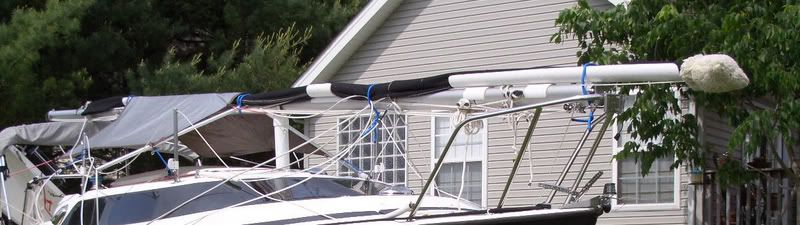
The supports are made from PVC tubes, 3", cut and screwed back to back. The joint between the back-to-back pipe sections was reinforced by a gusset of 3M 5200 marine sealant. Edges were smoothed with a belt sander, sandpaper would do the same. The trickiest part of cutting the PVC pipe sections that clamp to the mast, was finding the point where the PVC was open wide enough to be able to snap over the mast, but still have a tight hold, and not slip off unless pulled off with a hard tug.
 This arrangement keeps the furler foil almost straight, with just a slight bit of sag between the cradles, and being almost exactly on top of the mast, makes it easier to keep the mast from twisting to one side when moving it from the pulpit mount to the step on top of the cabin.
 While I was at it, I made a stovepipe mast support, with a cut-open T fitting, to support the center of the mast, the bottom of the PVC 4" pipe resting in the mast step, the top with the cut-open T fitting cradling the mast. The PVC pipe just fits tight enough to stay in place between the mast and step, and stabilizes the mast from swinging or bouncing too much.
The front support extends out far enough to keep the furler supported all the way to the drum, and the others hold it in several places along the mast. The two that are on either side of the spreaders are offset to one side to keep the furler from resting on the steaming light, where it might otherwise develop a kink, or damage the light.
The supports are made from PVC tubes, 3", cut and screwed back to back. The joint between the back-to-back pipe sections was reinforced by a gusset of 3M 5200 marine sealant. Edges were smoothed with a belt sander, sandpaper would do the same. The trickiest part of cutting the PVC pipe sections that clamp to the mast, was finding the point where the PVC was open wide enough to be able to snap over the mast, but still have a tight hold, and not slip off unless pulled off with a hard tug.
This arrangement keeps the furler foil almost straight, with just a slight bit of sag between the cradles, and being almost exactly on top of the mast, makes it easier to keep the mast from twisting to one side when moving it from the pulpit mount to the step on top of the cabin. While I was at it, I made a stovepipe mast support, with a cut-open T fitting, to support the center of the mast, the bottom of the PVC 4" pipe resting in the mast step, the top with the cut-open T fitting cradling the mast. The PVC pipe just fits tight enough to stay in place between the mast and step, and stabilizes the mast from swinging or bouncing too much.-
Bawgy

- First Officer
- Posts: 410
- Joined: Wed Jan 11, 2006 7:26 am
- Location: M 26 "Pepe le Bleu" Lake Gaston NC
- Contact:
Just for conversation as I do not have a furler . After unstepping the mast could you not undo the connection at the top of the forestay and slide the whole assembly to hang in a pipe suspended under the mast . I have not looked at the connection on my boat with this in mind but I do believe it would be an option . This would eliminate the sag and forward extension support needed for transport
-
KayakDan
- Captain
- Posts: 507
- Joined: Wed Jun 21, 2006 1:10 pm
- Sailboat: MacGregor 26M
- Location: Apple Valley,Ohio, ........... 2006 26M "Spice" Honda 50
Problem would be getting the furler past the spreaders,and the shrouds. It's not a big deal,but it would be a nuisance. If it was just a short tube on the lower part of the mast,you would still be putting a twist into the furlerBawgy wrote:Just for conversation as I do not have a furler . After unstepping the mast could you not undo the connection at the top of the forestay and slide the whole assembly to hang in a pipe suspended under the mast . I have not looked at the connection on my boat with this in mind but I do believe it would be an option . This would eliminate the sag and forward extension support needed for transport
Also,I'm not keen on detaching the forestay every time I take the rig down. Mine is cranked up and secured with ss wire.
The PVC support tube works pretty well,and it's an inexpensive mod.

Bawgy wrote:
"Just for conversation as I do not have a furler . After unstepping the mast could you not undo the connection at the top of the forestay and slide the whole assembly to hang in a pipe suspended under the mast . I have not looked at the connection on my boat with this in mind but I do believe it would be an option . This would eliminate the sag and forward extension support needed for transport "
I've been undoing the top bolt then sliding back the furler successfully these past 4 yrs. with no kink problems that I can see. I do keep the furler on top of the mast. Plus it does give you a chance to scrutinize what's going on up there too. Don't think I ever incurred any problems around the spars either, just one gentle bend around the steaming light. I bungee perhaps every 3-4 ft. Now the CDI drum is the only thing projecting beyond the pulpit.
R
"Just for conversation as I do not have a furler . After unstepping the mast could you not undo the connection at the top of the forestay and slide the whole assembly to hang in a pipe suspended under the mast . I have not looked at the connection on my boat with this in mind but I do believe it would be an option . This would eliminate the sag and forward extension support needed for transport "
I've been undoing the top bolt then sliding back the furler successfully these past 4 yrs. with no kink problems that I can see. I do keep the furler on top of the mast. Plus it does give you a chance to scrutinize what's going on up there too. Don't think I ever incurred any problems around the spars either, just one gentle bend around the steaming light. I bungee perhaps every 3-4 ft. Now the CDI drum is the only thing projecting beyond the pulpit.
R
-
Duane Dunn, Allegro
- Admiral
- Posts: 2459
- Joined: Fri Jan 02, 2004 6:41 pm
- Sailboat: MacGregor 26X
- Location: Bellevue, Wa '96 26x, Tohatsu 90 TLDI and Plug In Hybrid Electric drive
- Contact:
You certainly can do that, but why have yet another thing to connect and reconnect as part of the setup process. My focus is on reducing what needs to be done, not adding to it. I feel it would be too much trouble dealing with sliding the furler along the mast everytime in and out. Minutes count, and I want to spend as few of them as possible in the parking lot. The furler support takes seconds to put on and off each way.
I leave as much as possible in place at tear down so the setup next time is faster. All my raising gear, pole and lines stay in place pre-run when the mast is down. Baby stays stay attached with the mast up or down. The jib halyard stays set at the length required to clip right on the pole tip. I've looked at every step of the process and if there is a way to secure something in place rather than remove it that's what I do. Adding my aft arch this past summer took over 10 steps off my setup list alone as I can leave things in place that used to be removed and stored below or in the truck.
I leave as much as possible in place at tear down so the setup next time is faster. All my raising gear, pole and lines stay in place pre-run when the mast is down. Baby stays stay attached with the mast up or down. The jib halyard stays set at the length required to clip right on the pole tip. I've looked at every step of the process and if there is a way to secure something in place rather than remove it that's what I do. Adding my aft arch this past summer took over 10 steps off my setup list alone as I can leave things in place that used to be removed and stored below or in the truck.