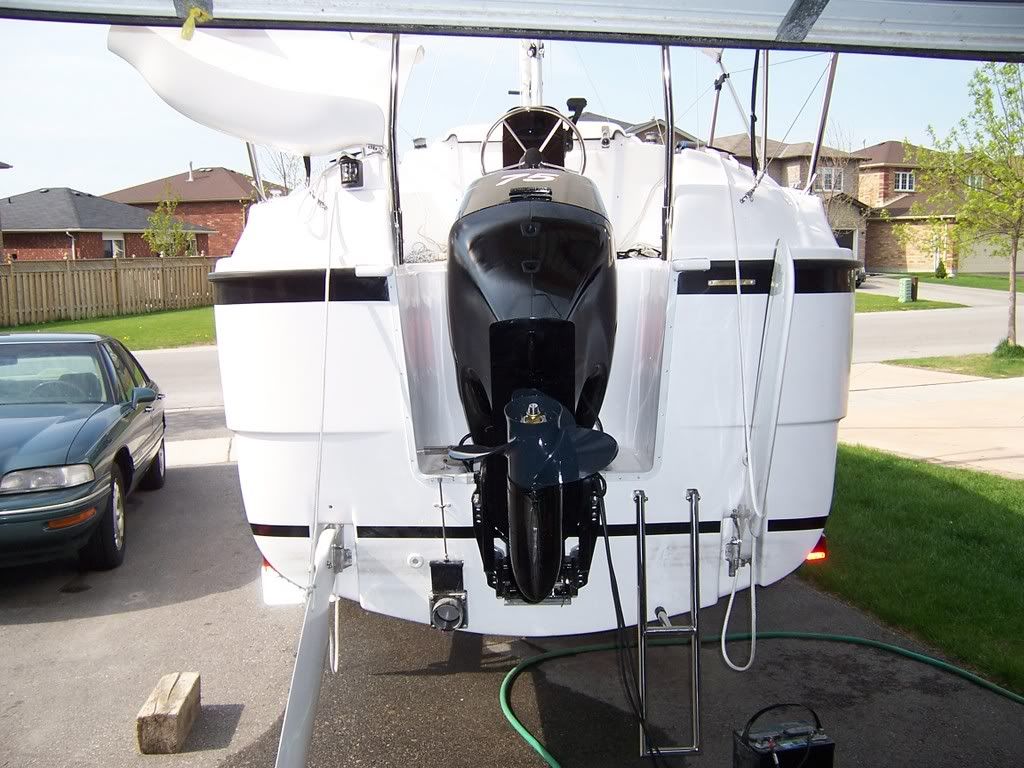
I love going into the shallows, but my problem that most of you don't have to worry about is the size of my outboard. When I tilt it up as many of you have mentioned while going into shallow waters, I can no longer steer. Due to the length of the cylinder head, just take your standard Honda 50 with 800cc and think what twice that, my motor at 1600cc, would look like tilted up. The weight of the thing makes it impossible with the stock steering system to handle tilting it from side to side while on a significant angle. She will just flop over to one side and smash the cowl into the bolt heads that hold the mast crutch, at least if you have an M.
Leon Could you disconnect the engine and put it on the mount and put the rudders out trailing the boat at an angle . Limit yourself to 2-3 mph in the shallow and continue on that way
delevi wrote:Add 3" to the draft if you have ballast in.
Removing that 3" of draft might get you unstuck. Didn't I see a mod that forced air into the vent hole to force the ballast out while the boat was at rest? Might be a good reason to do that mod.
I have been stuck in the mud in about 2 feet. Tilted the engine about half way up and slowly got out. Prop kicked up tons of mud, making a mess of things, but we did get out.
There isn't much mud where we boat. Most of what we'd kick up are rocks and sand. I've bent a coupla props that way.
Leon Could you disconnect the engine and put it on the mount and put the rudders out trailing the boat at an angle . Limit yourself to 2-3 mph in the shallow and continue on that way
Never tried, but the motor may not get enough water intake for cooling and a parallel rudder puts huge loads on the steering system. Anyhow, the incident I described was unplanned. Personally, I try to avoid the shallows.
Removing that 3" of draft might get you unstuck. Didn't I see a mod that forced air into the vent hole to force the ballast out while the boat was at rest? Might be a good reason to do that mod.
I've done that on mine. I have the vent hole as a feed through on the liner above the floor. Normally I close it with the drain plug but I can hook a standard 12V pump like you'd use for an air mattress. It definitely blows a lot of the ballast out but I'm not really sure how much. I've always meant to do that before I pull the boat and see how much water is left.
Another thing thats useful is turning on the pump while the ballast valve in the back is closed. Let the pressure get to say 100 psi or so and then open the valve. The rush of air out the back will accerlerate the boat quickly!
Gentlemen. . . Minimum draft is not about water skiing or sailing its about floating. Floating in shallow water. Its about when is YOUR boat stuck or grounded versus when is it not. When does your boat cease to move across the water due to a lack of water buoyancy. Not how much water does it draws under full power?? I have seen as have most of you fellows. . . boats that need only about 6 to 10 inches of water when doing 100 mph or more. Not relative to any of us.
Our Bottom line is , your in trouble because you were not watching what can you do to get going again and how much water do you need above the obstacle to float off . . . in our cases in or about 12 "
Need less Tap a zuric fitting into a screw cap in the ballast vent and hook up a air pump of any sort to force the water out . . . .
eric3a wrote:Hey now!
I run aground on purpose! Not because I'm not watching!
So many places around here are so shallow, I keep exploring. The trick is not to explore at the highest tide (duh!) and go upwind so I can always get out. (I did once on another boat end up spending an extra day aground as the tide didn't come back as expected!)
Eric
Eric allow me to let you in on a secret. . . .
If its grounded at high tide make sure its your buddies boat hahahaha