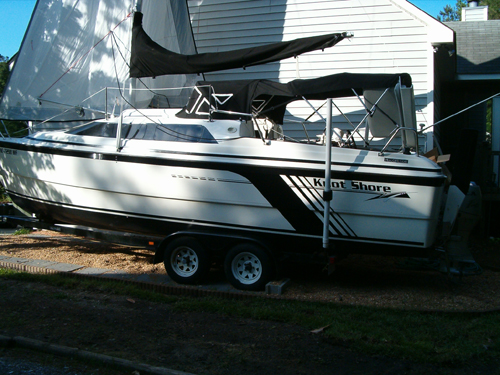
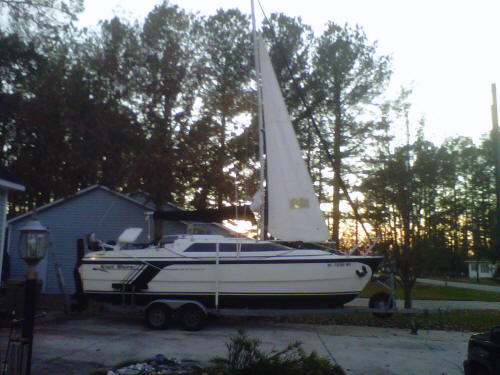
so I'm looking at pics of the single axle trailers and the tandem axle trailers for the X. It appears that the trailer I have had the second axle added without moving the first axle forward to compensate. What kind of extra load can I expect that to put on the tongue?
Whats the best way to measure it? I don't think our little digital bathroom scale can handle it..
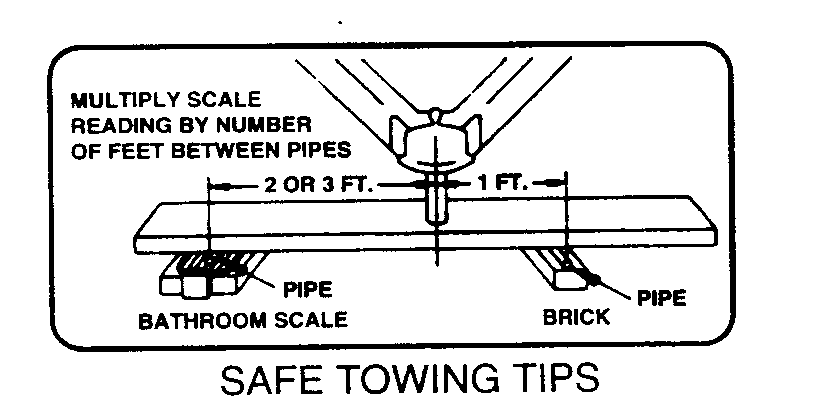
You can use your bathroom scale and a 3:1 lever with a 2x4 to measure.
To. Swag the change, the tongue will go up by roughly a factor of...
Distance from front bunk to the mid point of the two axles
--------------------------------------------------------------------------
Distance from the front bunk to the front axle centerline
It's not possible to calculate the tongue load without making some assumptions, so assuming the trailer with a single axle is loaded such that the total (gross) weight of the boat and trailer combo is 3500 lb (the nameplate GTW) with a 10% tongue load of 350 lb, the original single axle would have been carrying 3150 lb. That puts the center of mass of the entire trailer/boat combo 22.4" forward of the axle center.
Adding a second axle 34" behind the original would make it the equivalent of a single axle 17" further back, assuming equalized leaf springs, which are visible in your pic, or balanced independent suspension. The center of mass would stay in the same place (almost), but would now be 39.4" forward of the axle pair center, making the tongue load 572 lb, with all other things being equal.
Obviously, there are many variables involved, many of which are under your control, like where you carry supplies, spare tires, fuel in the stern lockers or empty, etc. That napkin analysis also doesn't take into account the weight of the axles themselves (hence the 'almost' in the previous paragraph, but taking that into account doesn't change the math much). But it should give you an idea of how much of an increase there is by not moving that original axle forward halfway.
Do measure with a scale, plank, and pipes, and do strive for ~10% of the trailer gross weight on the tongue. I have a dual axle OEM trailer (axle pair centered on original axle location, though), and with a light tongue load (~200 lb), it tows just fine. Keeping tire pressure up in the trailer tires helps, even though the tires are lightly loaded (for their capacity). I usually have two full 6 gallon tanks in the back, and most boat components in the stern berth. It's a little tail heavy, but it seems fine on the highway nonetheless. When I add the dual spare tire carrier I'm fabbing to the tongue, it'll increase the tongue load a little.
I don't think you'll have any problem keeping the tongue load high enough to prevent trailer sway - in fact, it looks from the pic (and the math) that it's sitting pretty heavy on the ball.
I should also add that I softened up the leaf springs on my trailer, which was comprised of one original set (gotta be a 5000 lb or so pair of springs from the leaf thickness) and one set of 3500 lb springs, for a total of 8500 lb or more of suspension. For a 3500 lb (rated) boat/trailer combo!
It rides nice and soft now. I used to feel the jarring through the hitch when going over any kind of rough ground or surface imperfection. Now, I feel nothing. It's easy to forget it's even back there, in fact.
When I added the second axle to my trailer we mounted the springs/axle assy on angle sliders so we could find the best balance for the load which located the walking beam 4" forward of the original center line of the single axle. We also reduced the old spring assy from 5 leafs to 3 for a better ride. My max travel speed = 65 mph level, 45 on steep down grades.
My Axels are about 18 inches forward of your Picture with a tough weight of 450 lbs. I do have double batteries at Vberth so that would deduct aprox. 80 lbs from Toung due to batteries location.
You probably have 700-900 lbs of tough weight looking at picture.(to much)
I would recommend moving both axels 18-24 inches forward.
10% of total trailer weight is needed for the hitch.
This is asuming you have a motor that weighs around 240 lbs.
Dave
Kevgrn114 wrote:so I'm looking at pics of the single axle trailers and the tandem axle trailers for the X. It appears that the trailer I have had the second axle added without moving the first axle forward to compensate. What kind of extra load can I expect that to put on the tongue?
Whats the best way to measure it? I don't think our little digital bathroom scale can handle it..
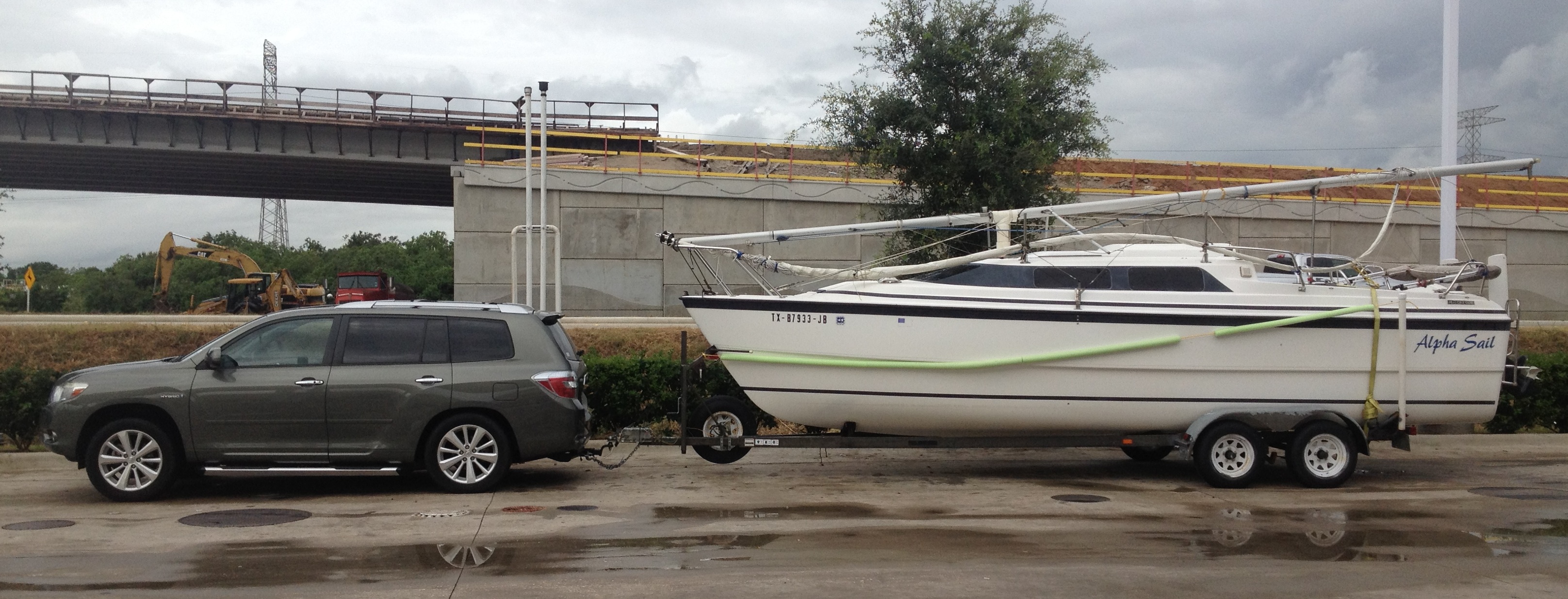
I used the brochue and saw that the orginal trailer wheels were centered on the jib winch... so I went with that when I added a second axle to my original trailer:
and did it again when I got my new galvanized trailer:
What are the dimensions of that inside jib you have in your second photo? I'd been thining ofo adding a sail like that for a little Highlanderish action
Have you sialed with it Cutter style? How have you found it?
Thanks
P.S.
Hey Kev,
What is your concern is it your level of towing comfort? Tail wagging the dog? That's a lot of boat back there behind that car; Pound vs pound it's probably close
It's probably not practical to have a tow beast just for towing & such. The other issue is the wheelbase length of our tow vehicles...
Like our boats, sometimes life is in the compromise. Without a proper tow beast [ suburban, tahoe, diesel monster, Pickup truck etc.] I'd drop my boat in a local marina for the season; and offer a 4x4 tow beast buddy a case of beer to pull it out at seasons end
Just imagine how much more fun haul out is with a capable bud & Budweiser
The tongue weight is my main concern. It actually tows and tracks fine. In the highlander and my wrangler 4dr. Just wondering if I should have the axles moved forward. The rating on both vehicles is 350 at the tongue. Need to find a welding place and get a quote...
The other thing is I back it in to a tight spot and the last bit of rotating makes one of the tires on each side drag sideways.. Wondering how quick that will screw up the hubs? Maybe I should just restore it to a single axle for my purposes.





 trailer we mounted the springs/axle assy on angle sliders so we could find the best balance for the load which located the walking beam 4" forward of the original center line of the single axle. We also reduced the old spring assy from 5 leafs to 3 for a better ride. My max travel speed = 65 mph level, 45 on steep down grades.