Tomfoolery wrote:I have a RAM mic that I've never installed, for an older style Standard Horizon (the one I mentioned above), and it uses a cable with plug. Maybe that would be a good solution for your needs, hardwired with an umbilical, if they still make that style. Puts the mic at the helm, but the radio down below, out of the weather and away from prying eyes.
I figured you had your reasons for not wanting it on the mast. I just had to ask, though.
FWIW, mine is at the top of the mast, and a PO installed it with an adjustable mount, so I fold it back along the mast when I need it to be shorter. The plug connection is a potential problem area, of course, but they used gold-plated connections, and so far I haven't had a problem, though I'm sure the mere presence of another connection attenuates the signal a little. But it's what I have, so it's what I use. Well, that, and a hand-held, which is my main radio, as I don't ever seem to be far enough away from anyone I need to talk to, including the USCG. So far . . .
Ignore below, poster off his medication
The handheld unit isn't generating RF , it is just feeding signal into the VHF amplifier...thus no-loss like a coax connector on the antenna.
HaminX can confirm that, being the resident expert on radios.
Tomfoolery wrote:I have a RAM mic that I've never installed, for an older style Standard Horizon (the one I mentioned above), and it uses a cable with plug. Maybe that would be a good solution for your needs, hardwired with an umbilical, if they still make that style. Puts the mic at the helm, but the radio down below, out of the weather and away from prying eyes.
I figured you had your reasons for not wanting it on the mast. I just had to ask, though.
FWIW, mine is at the top of the mast, and a PO installed it with an adjustable mount, so I fold it back along the mast when I need it to be shorter. The plug connection is a potential problem area, of course, but they used gold-plated connections, and so far I haven't had a problem, though I'm sure the mere presence of another connection attenuates the signal a little. But it's what I have, so it's what I use. Well, that, and a hand-held, which is my main radio, as I don't ever seem to be far enough away from anyone I need to talk to, including the USCG. So far . . .
The handheld unit isn't generating RF , it is just feeding signal into the VHF amplifier...thus no-loss like a coax connector on the antenna.
HaminX can confirm that, being the resident expert on radios.
The signal loss I was referring to was on my boat, at the coax connector to the mast (to the antenna), as powered by the 25W fixed-in-place Raymarine VHF. The handheld I referred to is a 6W handheld Standard Horizon 2-way VHF marine radio. My Standard Horizon RAM mic is still in the box, never opened. I don't even have the radio that it would connect to any more.
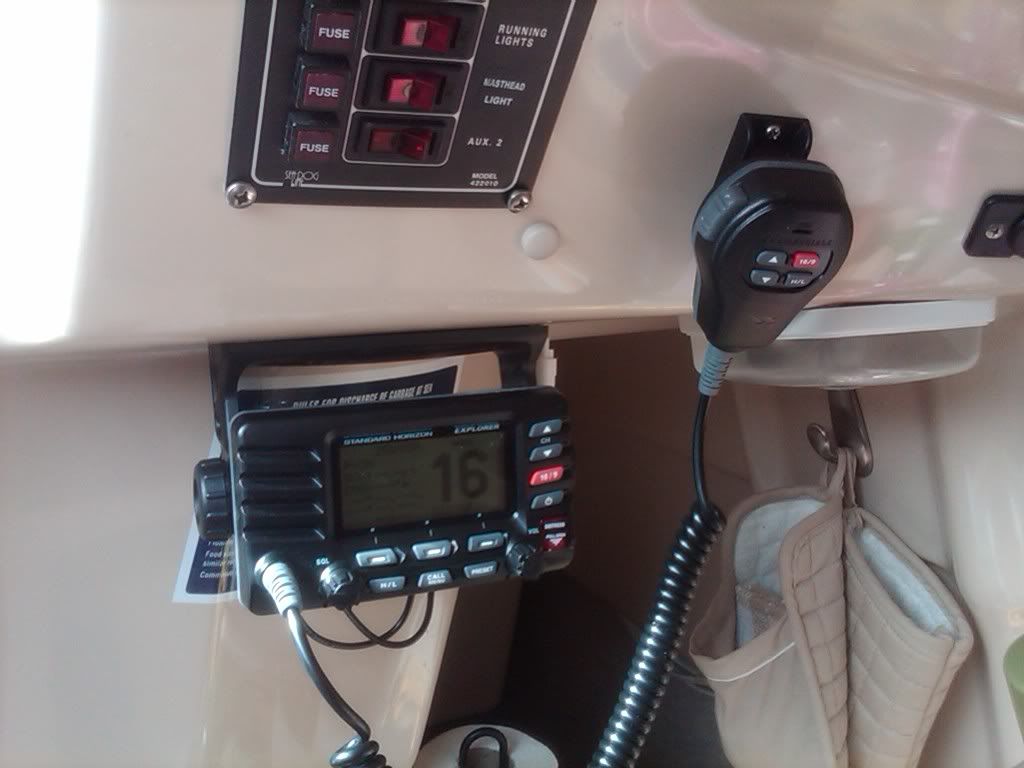
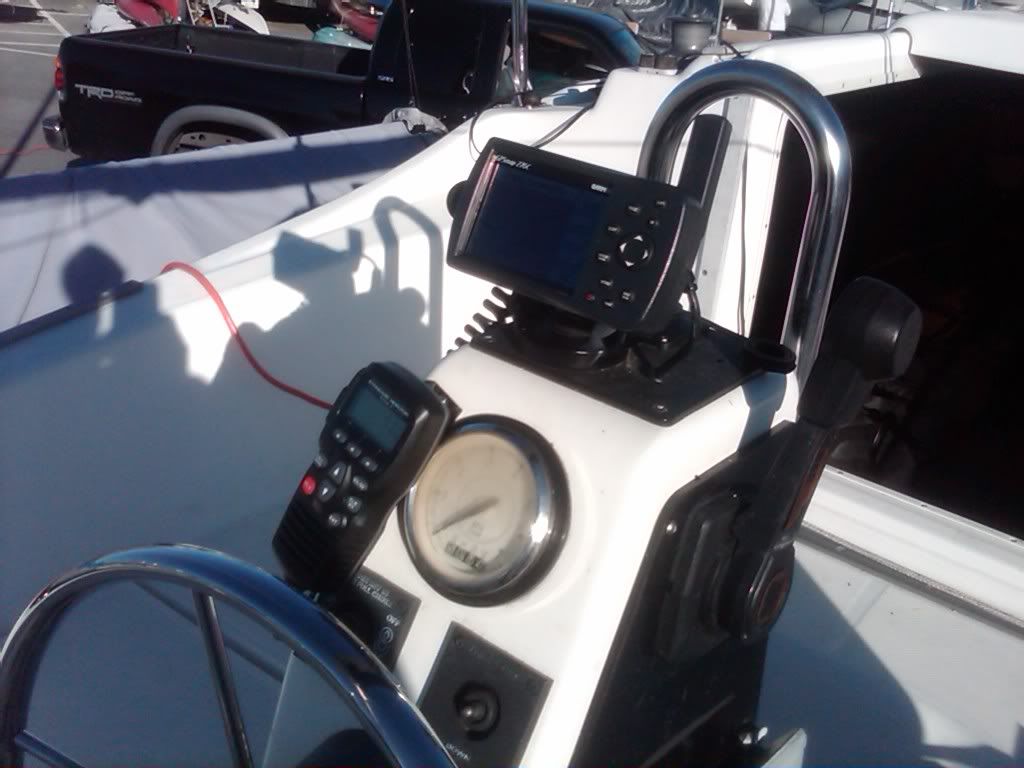
I have the Standard Horizon GX1600, with RAM mic, and I love it. Having the remote mic readily available at the helm is very convenient. The radio is mounted near the fuse panel of the 26M.
Antenna is a 6 dB gain mounted on the stern rail.
I'm not sure what you were referring to, Cat. If you mean the RAM is not generating RF, correct. But, that is not what Tom was talking about.
~Rich
Catigale wrote:
Tomfoolery wrote:I have a RAM mic that I've never installed, for an older style Standard Horizon (the one I mentioned above), and it uses a cable with plug. Maybe that would be a good solution for your needs, hardwired with an umbilical, if they still make that style. Puts the mic at the helm, but the radio down below, out of the weather and away from prying eyes.
I figured you had your reasons for not wanting it on the mast. I just had to ask, though.
FWIW, mine is at the top of the mast, and a PO installed it with an adjustable mount, so I fold it back along the mast when I need it to be shorter. The plug connection is a potential problem area, of course, but they used gold-plated connections, and so far I haven't had a problem, though I'm sure the mere presence of another connection attenuates the signal a little. But it's what I have, so it's what I use. Well, that, and a hand-held, which is my main radio, as I don't ever seem to be far enough away from anyone I need to talk to, including the USCG. So far . . .
The handheld unit isn't generating RF , it is just feeding signal into the VHF amplifier...thus no-loss like a coax connector on the antenna.
HaminX can confirm that, being the resident expert on radios.
I've just realized I can use my handheld VHF for anchoring ops, and it floats. So I'll helm mount the remote mic and put the VHF inside.
As for antenna height, while it's obviously important it is a root function, which means that difference between the 14 feet I'm getting off the deck has a predicted full power range of:
sqrt(14)*1.42 = 5.3nm (0db gain mast-top antenna)
sqrt(35)*1.42 = 8.4nm (6db gain FG antenna)
Given the 4X power gain from the bigger antenna, I'm estimating similar real-world performance.
mastreb wrote:As for antenna height, while it's obviously important it is a root function, which means that difference between the 14 feet I'm getting off the deck has a predicted full power range of:
sqrt(14)*1.42 = 5.3nm (0db gain mast-top antenna)
sqrt(35)*1.42 = 8.4nm (6db gain FG antenna)
Given the 4X power gain from the bigger antenna, I'm estimating similar real-world performance.
Matt
Not sure what the 1.42 represents. Mast top antennas are usually 3db gain.
West Marine wrote:
http://www.westmarine.com/webapp/wcs/st ... kSCltLbNsI
Selection criteria:
dB Rating
An antenna’s dB rating (or antenna gain) indicates the apparent increase in transmitting power due to its ability to focus energy. Antennas with a high dB rating concentrate energy perpendicular to the antenna shaft in a field that is shaped like a disk. This makes your radio signal appear stronger to receiving stations around you.
It also reduces the amount of energy transmitted above or below the antenna, which can be a problem if your boat is pitching or rolling in seas. A concentrated signal can actually fade in and fade out as the boat rolls and pitches. As the dB rating of the antenna increases, so does the height of the antenna, but the horizontal angle diminishes. The broad radiation pattern from a low dB antenna allows a sailboat to heel over and still send signals toward the horizon. Sailboats should use a 3dB antenna mounted at the top of the mast whenever possible.
If I mounted my antenna on the deck, I would have a tendency to try to grab for it or it would get in my way all the time. Up top out of the way for me.
VHF radio distance is basically line of sight. I have talked to the ISS (International Space Station) with a handheld and 5 Watts. The higher your antenna, assuming minimal losses in your coax, the farther you will communicate. The ISS antenna height is somewhere in the neighborhood of 250 miles. The points about using a high gain antenna are also valid. On a sailboat, use a 1/2 wave antenna at the mast top. The 1/2 wave does not require a ground plane like a 1/4 wave, or 5/8's wave does. A higher gain antenna up there is detrimental due to wave action and heeling.
The high gain antenna down low is not as bad, because it swings in a shorter arc. However, it does not talk through water worth a hoot and that is what is required to go the same distance as a mast top antenna.
I understand the need to simplify rigging when trailering a lot, but the lower antenna is a compromise and must be accepted as such.
Hamin' X wrote:I have talked to the ISS (International Space Station) with a handheld and 5 Watts.
Forgive the tangent, but how do you talk to the ISS? We have watched it fly over countless times. It's quite fascinating, but I didn't realize it was at all possible to communicate with them.
I am very surprised to hear you could talk to the ISS with HAM, I thought the frequencies it worked at reflected off the ionosphere, and so the iss would not be able to hear you. In fact, it was my understanding that this is the way the ham can "curve" around the earth, because it uses the ionosphere as a helmhertz resonator, and "bounces" about the curve of the earth. I know there are some "holes" where RF can get through (very very valuable holes) .. GPS uses them. I am also pretty surprised that a 5 watt radio was able to do that distance, maybe they had a directional array or something.
I think that the concerns about directional antennas/wave action are exaggerated. if you compare the polar patterns of the arrays, you will see even in significant rolling , the radiated power at the horizon is almost the same a non-directional antenna, and it only gets better the flatter you are.
As for the "height" and the arc it swings through .... that doesn't matter .. it is not the distance it swings, but the angle through which it swings though. 20 degrees off horizontal , is 20 degrees, weather it is at deck height, or top of mast.