

26s bilge pump
-
chadwiseman
- Chief Steward
- Posts: 82
- Joined: Wed Sep 15, 2021 4:50 pm
- Sailboat: MacGregor 26X
- Location: St. John's
26s bilge pump
Hoping to add a bilge pump just in case this spring. Wondering what opening you pipe it to? Do you connected to the existing one for the sink , toilet, etc? Do you add a check valve so your not pushing the water back inside?
-
Jimmyt

- Admiral
- Posts: 3402
- Joined: Sat Jul 18, 2015 9:52 am
- Sailboat: MacGregor 26M
- Location: Mobile AL 2013 26M, 60 Etec
Re: 26s bilge pump
While waiting for an "S" owner to reply, I'll give you the following to check out on the topic.
viewtopic.php?t=26735
viewtopic.php?p=354943&hilit=Bilge+pump#p354943
viewtopic.php?p=350280#p350280
The discharge from the bilge pump must be above the waterline at max angle of heel (and all other times), unless you have a vented high loop and sea cock. No check valve should be installed in the discharge piping (per the rules). However, certain pump types contain internal check valves, which is ok. Your install should not depend on pump check valves to prevent ingresss of sea water. Having said that, several forum members have installed valves in the discharge. While this may function for them, it is not technically correct.
I would not combine the bilge pump discharge with any other function.
Discharge piping from centrifugal pumps should rise continually toward the discharge point, or high loop (as appplicable). No loops, traps, sags, etc, other than a high point just before discharge. Positive displacement pumps (including diaphragm pumps) are more forgiving regarding discharge piping arrangement.
Once you get your pump and discharge piping installed, you should test it through several on/off cycles to insure proper operation.
Good luck and post pics of your install.
viewtopic.php?t=26735
viewtopic.php?p=354943&hilit=Bilge+pump#p354943
viewtopic.php?p=350280#p350280
The discharge from the bilge pump must be above the waterline at max angle of heel (and all other times), unless you have a vented high loop and sea cock. No check valve should be installed in the discharge piping (per the rules). However, certain pump types contain internal check valves, which is ok. Your install should not depend on pump check valves to prevent ingresss of sea water. Having said that, several forum members have installed valves in the discharge. While this may function for them, it is not technically correct.
I would not combine the bilge pump discharge with any other function.
Discharge piping from centrifugal pumps should rise continually toward the discharge point, or high loop (as appplicable). No loops, traps, sags, etc, other than a high point just before discharge. Positive displacement pumps (including diaphragm pumps) are more forgiving regarding discharge piping arrangement.
Once you get your pump and discharge piping installed, you should test it through several on/off cycles to insure proper operation.
Good luck and post pics of your install.
Jimmyt
P-Cub-Boo
2013 26M, Etec 60, roller Genoa, roller main
Cruising Waters: Mobile Bay, Western Shore, Fowl River
P-Cub-Boo
2013 26M, Etec 60, roller Genoa, roller main
Cruising Waters: Mobile Bay, Western Shore, Fowl River
-
OverEasy
- Admiral
- Posts: 3019
- Joined: Mon Sep 28, 2020 11:16 am
- Sailboat: MacGregor 26X
- Location: NH & SC
Re: 26s bilge pump
Hi ChadWiseMan!
IMHO adding a bilge pump is one of the Best pre-emptive things you can do!
It buys you time in an event and generally pumps out water faster and better than by hand.
A bilge pump while not a cure-all a bilge pump can definitely help when/if things go awry……
Time: Allows you to navigate/operate your vessel to a place of safety while it pumps water up and out of your vessel
Automatic: Starts pumping when it senses water not when you happen to notice it
Faster/Better: > Doesn’t require you to find and use a hand pump or bucket
> Pumps the water from the bilge areas that you generally can’t reach readily
> Can actually move more water out in less time than manually
While a bilge pump can take care of occasional water collection such as rain and splash if properly sized can help with potential cracks and punctures.
What we’ve done on our was to start with the use of the BoatUS recommendations.
https://www.boatus.com/expert-advice/ex ... o-the-math
So for our Mac26X that would be:
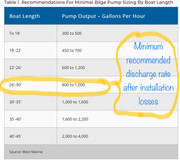
AFTER factoring in the head and line losses.
Head loss is the pumping capacity lost when raising the pumped water up from the bilge and out of the vessel. This is the highest height the water is to be raised, not just the bilge to discharge height. This would be to the highest top of any loops that might be incorporated.
Line loss is the effective friction/turbulence incurred when moving water through the piping or hoses or fittings from the pump to the end of the discharge outlet. These line losses are minimized by using SMOOTH interior surface hoses with as large a diameter as you can with the least amount of fittings and least run length. Avoid using the cheap corrugated tubing if at all possible. It my be flexible but all those corrogations add up to a significant amount of friction/turbulence vs. smooth interior surface tubing. Use of proper discharge tubing should also help avoid any potential for kinks to form. A larger diameter dramatically improves flow rate. Try and avoid using elbows and check valves if possible as these also have high flow obstruction factors.
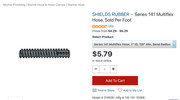
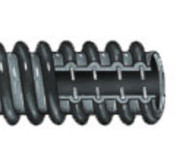
We chose the 1” ID smooth ID bilge discharge hose from West Marine for our installations. We liked that it was a smooth bore and had the reinforcement on the exterior that not only prevents kinking but also protects the tubing from chaffing. There are others that are also good choices as well.
For our initial installation we chose to place our discharge thru-hulls above the side chines and installed an 800 gph automatic pump in each of the three midship bilge zones of our Mac26X. Each pump has its own discharge line, thru-hull and pump control switch with alarm. That way if water shows up in the areas to either side of the water ballast transfer tubes or in the center it can be immediately pumped overboard. This gives us, after accounting for line and head losses, about roughly 560 gph effective discharge capacity per pump for a combined discharge capacity of roughly 1680 gph or greater (I tend to underestimate rather than overestimate final numbers to provide margin ).
).
Later we will be adding an additional 2 bilge pumps in the stern corners to provide additional capacity as we’ve noticed that while the pumps amidship are at the lowest static resting locations when operating under way with the engine the stern is lower. The 2 additional stern pumps will help address this and increase our overall discharge capacity to roughly 1880 gph (or more) for a reasonable cost and effort.
Over Easy has been and continues to be a very dry boat. Our bilge pump system is a choice to help mitigate a potentially incurrent of a hazardous condition. It is there to buy us time to continue to operate and navigate our vessel to a safe location and/or implement a corrective mitigation (plug the leak) while the pumps are getting the water out.
Bilge pumps aren’t a cure for a wet boat or one with a leak.
It is always best to find and fix to source of a persistent leak whether it be from fittings, windows or other sources.
No, bilge pumps are not a cure-all for every potential situation, but they do provide a means to help mitigate many potentially bad situations from getting worse by providing one with the time (a precious commodity in a crisis) to help to properly respond to a situation.
Best Regards
Over Easy


We posted our initial system on the forum and in the Mods section if you’re interested.
viewtopic.php?p=349185#p349185
https://macgregorsailors.com/mods/index ... em&id=2159
https://macgregorsailors.com/mods/index ... em&id=2161
IMHO adding a bilge pump is one of the Best pre-emptive things you can do!
It buys you time in an event and generally pumps out water faster and better than by hand.
A bilge pump while not a cure-all a bilge pump can definitely help when/if things go awry……
Time: Allows you to navigate/operate your vessel to a place of safety while it pumps water up and out of your vessel
Automatic: Starts pumping when it senses water not when you happen to notice it
Faster/Better: > Doesn’t require you to find and use a hand pump or bucket
> Pumps the water from the bilge areas that you generally can’t reach readily
> Can actually move more water out in less time than manually
While a bilge pump can take care of occasional water collection such as rain and splash if properly sized can help with potential cracks and punctures.
What we’ve done on our was to start with the use of the BoatUS recommendations.
https://www.boatus.com/expert-advice/ex ... o-the-math
So for our Mac26X that would be:
AFTER factoring in the head and line losses.
Head loss is the pumping capacity lost when raising the pumped water up from the bilge and out of the vessel. This is the highest height the water is to be raised, not just the bilge to discharge height. This would be to the highest top of any loops that might be incorporated.
Line loss is the effective friction/turbulence incurred when moving water through the piping or hoses or fittings from the pump to the end of the discharge outlet. These line losses are minimized by using SMOOTH interior surface hoses with as large a diameter as you can with the least amount of fittings and least run length. Avoid using the cheap corrugated tubing if at all possible. It my be flexible but all those corrogations add up to a significant amount of friction/turbulence vs. smooth interior surface tubing. Use of proper discharge tubing should also help avoid any potential for kinks to form. A larger diameter dramatically improves flow rate. Try and avoid using elbows and check valves if possible as these also have high flow obstruction factors.
We chose the 1” ID smooth ID bilge discharge hose from West Marine for our installations. We liked that it was a smooth bore and had the reinforcement on the exterior that not only prevents kinking but also protects the tubing from chaffing. There are others that are also good choices as well.
For our initial installation we chose to place our discharge thru-hulls above the side chines and installed an 800 gph automatic pump in each of the three midship bilge zones of our Mac26X. Each pump has its own discharge line, thru-hull and pump control switch with alarm. That way if water shows up in the areas to either side of the water ballast transfer tubes or in the center it can be immediately pumped overboard. This gives us, after accounting for line and head losses, about roughly 560 gph effective discharge capacity per pump for a combined discharge capacity of roughly 1680 gph or greater (I tend to underestimate rather than overestimate final numbers to provide margin
). Later we will be adding an additional 2 bilge pumps in the stern corners to provide additional capacity as we’ve noticed that while the pumps amidship are at the lowest static resting locations when operating under way with the engine the stern is lower. The 2 additional stern pumps will help address this and increase our overall discharge capacity to roughly 1880 gph (or more) for a reasonable cost and effort.
Over Easy has been and continues to be a very dry boat. Our bilge pump system is a choice to help mitigate a potentially incurrent of a hazardous condition. It is there to buy us time to continue to operate and navigate our vessel to a safe location and/or implement a corrective mitigation (plug the leak) while the pumps are getting the water out.
Bilge pumps aren’t a cure for a wet boat or one with a leak.
It is always best to find and fix to source of a persistent leak whether it be from fittings, windows or other sources.
No, bilge pumps are not a cure-all for every potential situation, but they do provide a means to help mitigate many potentially bad situations from getting worse by providing one with the time (a precious commodity in a crisis) to help to properly respond to a situation.
Best Regards
Over Easy


We posted our initial system on the forum and in the Mods section if you’re interested.
viewtopic.php?p=349185#p349185
https://macgregorsailors.com/mods/index ... em&id=2159
https://macgregorsailors.com/mods/index ... em&id=2161