Boat wiring really shouldn’t involve soldering at all.
First: Marine-grade wiring is a specialized, stranded, highly flexible cable with tinned copper conductors (to prevent corrosion) and durable insulation (like PVC or XLPE) to resist moisture, heat, oil, and chafing, designed for boats' harsh, vibrating, wet environments, often meeting specific standards like UL 1426, unlike less robust auto or house wiring. Never use solid core wire.
Second: Crimp connectors are the preferred and recommended means of making splices or terminal ends like eye or fork type ends.
Eyes while more secure as they are captured by a screw or nutted post/stud are a bit more time consuming to attach as the screw or nut must be fully removed and reinstalled. Fork type ends are a little less secure in the the screw or nut is loosened sufficiently to allow the fork to be slipped under it and then tightened. Done properly either will work. The higher the vibration area and the greater the importance of the particular circuit one tends to use eye type terminations.
The crimp connectors for boats are now generally insulated with heat activated heat shrink tubing nowadays. After the crimp connection is made the insulating collar is heated to shrink the collar and activate the adhesive which seals the insulated wire/connector interface from moisture intrusion. As the connector insulating collars are generally a bit short many professionals prefer to add an additional length of separate adhesive heat shrink tubing generally at least 3/4 of an inch or more beyond the crimp connection. (One just has to remember to slip the extra heat shrink tubing onto the wire before making the crimp connection.) A electricians heat gun is the the preferred means to apply heat rather than an open flame.
A marine grade terminal strip is the general go to when routing wires that need junctions. Say when one lead is divided into multiple sub circuits such as for lighting circuits.
A marine grade buss bar is the preferred means to take a primary lead, such as the positive output from the battery and then distribute it to a host multiple circuits.
As a rule one should maintain one to two connections to a given terminal/bus screw/stud. Avoid multiple connections to a stud or screw as multiples will tend to lead to self loosening connections.
If a wire line requires a mid run disconnect there are shielded male/female crimp connectors for that purpose. A general rule is to have the side that can supply positive electrical power be the shielded female connector. That way one can avoid potential shorts by inadvertent contact with other grounded items. The negative side should be the less shielded male connector.
Operation of a crimp plier is pretty basic and there are different sizes for the different wire gauge connectors.
NEVER attempt to make a crimp connection to a solid wire. It will not hold properly.
The reason Soldering is avoided as it makes stiff and fatigue susceptible areas that can break over time.
LABLE and color code each end of a wire run. It will save a lot of headaches now and later.
Make a schematic diagram and keep it readily available as well as updated.
For all but the highest amperage circuits the use of modern marine grade manually resetting circuit breakers are recommended over fuses.
The slight increase in cost over fuses will provide huge benefits. Circuit breakers are as, if not more, reliable than fuses. If tripped they can be reset without wandering around looking for a spare fuse of the right amp rating that you may or may not have available when you need it most. Barrel type fuse ratings are hard to read even under the best of circumstances. Blade type fuses are difficult to remove/replace without an appropriate tool. It is often difficult to visually see if either a barrel type or blade type fuse has actually blown.
Most all resetting circuit breakers have an obvious visual and tactile indicator to show it has popped so identifying the errant circuit is straight froward, even in the dark.
The exception is when dealing with high amperage circuits such as positive battery post current limiting applications. Given that most primary battery terminal locations are not readily accessible and space limited terminal fuses are a valid option from a cost and space perspective. One should have a current limiting device, fuse or circuit breaker within 7 inches of the battery terminal. Mounting it to the battery terminal meets that requirement. If space and access allows a properly rated resettable circuit breaker will often be a better and more reliable choice in that you won’t be looking for a spare fuse, nor will you be needing the time/tools/spare/access to remove/replace the blown fuse. It’s a choice one needs to make and provide for (as in having the appropriate replacement fuses on board along with any tools/knowledge required).
Hope this helps some.
Best Regards,
Over Easy

PS: When I redid the wiring system on Over Easy we went with an all indicating resettable circuit breakers approach. That way just about anyone, even in less than optimal conditions, can immediately identify and reset the affected circuit both now and in the future. We posted our electrical system in the Mods section.


 , the running lights run along the port side between the hull and the cabin liner. Most of the time it will be in the lip formed at the bottom of the cabin top. I never found it running anywhere higher than the bottom of the windows.


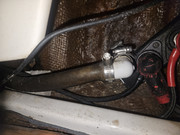
 I did inspect the fittings on the tubing that drains the transom "pond" out the stern. All FIVE connections sound. Probably good to check every time we do some major maintenance (what we would call a yard period in the Navy). Scenes from my "man cave."