Hi Pitchpolehobie!
In Engineering Reliability Analysis there are several methodologies or approaches utilized.
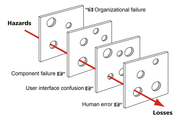
In the Swiss Cheese graphical approach the "first contact plate" has all the potential things (components/operations) that could possibly go wrong for a device or system.
these are termed the potential Failure Modes (FM)
Within those potential things that could go wrong are specific singular aspects that would lead to a catastrophic failure of the device or system.
Those are termed Single Point Failure Modes (SPFM) and are generally clustered to a central region or 'bullseye' that are carried through all the remaining plates.
Then each of the remaining holes on the first plate are evaluated to determine if any of the other no-SPFM FM could in conjunction with any other FM would lead to a catastrophic failure of the device or system. Those are termed Secondary Combined Point Failure Modes (SCPFM). These are graphically arranged around the SPFM aspects.
Then if the device or system is valuable or critical enough the second process is again repeated for the non-SPFM or Non-SCPFM to determine if any three of the remaining FMs could potentially lead to a catastrophic failure of the device or system. These are termed Triple Combined Point Failure Modes (TCPFM).
Generally by that time one would have enough to start applying probability statistical valuations to each of the SPFM, SCPFM (& TCPFM if one has taken it that far).
Then starting with the FM items having the highest likelihood of occurring one would look into means to mitigate the issue by design, re-design, secondary system/device actuation, pending issue alarm, etc... One can also reduce the probability of occurrence by rigorous process control and device/component/system testing. Making sure that a device/component/system has sufficient margin to handle more than what it's intended operational requirements also minimizes the probability of occurrence. Its a rebalancing act to identify, evaluate and mitigate a device or system and Failure Mode mitigations within performance, cost and manufacturability constraints. one sees this every day in aviation, aerospace and other industries.
Where it comes to our boating community its generally not very rigorous unfortunately... especially when it comes to owner modifications.
Here it depends on the common sense of the individual making the modifications and the current/future operators of the vessel.
This is where design features like having a vessel with sufficient built-in flotation and the wearing of life jackets comes into play to mitigate the myriad of things that could potentially go wrong for a variety of reasons.
Best Regards,
Over Easy




 .
.