Page 2 of 3
Re: Newbie question. Need your advice.
Posted: Tue Mar 23, 2010 7:12 pm
by Love MACs
So the "common" is the third or lower mounting bolt on the switch, is what I think you are saying. And that is where the Merc engine red wire is connected. And you are saying that all positive leads from all electrical equipment should be connected there also? (instead of being connected to the positive terminal of, in my case, battery #2? )
Allan
Re: Newbie question. Need your advice.
Posted: Tue Mar 23, 2010 7:38 pm
by Hamin' X
Yep, that way you can have one battery in reserve for starting. The way you are wired now, sounds like everything but the starter is wired direct to both batteries. If both batteries go flat, it won't do much good to be able to switch the starter to one, or the other. As stated earlier, use position #1 on odd days and #2 on even days. This will keep one in reserve for starting. If you run one flat, just switch to the other battery and start your engine. As long as you have a true marine switch, you can then switch to the flat battery for charging, as long as you don't go through the off position. Marine switches are designed to make the next circuit before breaking the circuit that is currently in use. If you switch through the off position while the engine is running, you can damage the alternator. DON'T DO IT.
~Rich
Re: Newbie question. Need your advice.
Posted: Sat Feb 19, 2011 8:48 pm
by vizwhiz
"old post resurrection" - it's such a newbie thing...

Okay, went through and ripped out the battery portion of my boat's wiring today - wow! the laz is big without anything in it! I actually crawled down inside to clean some stuff out of it! (I'm 6-1 and 225...that was interesting)
The PO's (I'm sure there were several) had a 1-2-Both switch in there, there were obviously at some point several batteries down in the laz, but essentially, I am planning to put a house battery in there and a motor starting battery in there. This post had a lot of good suggestions in it, and I'm planning to implement a lot of the details...everything attached to the common post on the switch, everything negative to a common bus (in my case might be a big bolt...), odd/even days...great stuff.
You're saying you CAN switch between batteries with the motor running as long as you don't go through the OFF position - good to know, important to remember. However, can you switch from one battery to the "both" position while the motor is running?
Along that line, if you've used one battery, and it's low, and you switch to the "both" position, does the charged battery attempt to charge the low battery? Not that I want it to, just wondering if it truly combines the positive terminals such that the low battery would drain the high battery?
One more question I have - I don't have a boat-mounted charger - I wasn't planning to drop the $$$ for one at this point - I have a handy-dandy ol' Exide battery charger that has clip-on alligator clips and automatic 2A-10A settings so it backs down when the battery is done charging. I was planning to use it to trickle charge the batteries up on-and-off while the boat is on the trailer in the backyard. Would it be a bad idea to clip that kind of charger to the "both" terminal and trickle charge both batteries at the same time?
Re: Newbie question. Need your advice.
Posted: Sun Feb 20, 2011 4:16 am
by Catigale
You're saying you CAN switch between batteries with the motor running as long as you don't go through the OFF position - good to know, important to remember. However, can you switch from one battery to the "both" position while the motor is running?
I dont think this is right, Viz - and the cost of the error is a new alternator (not cheap)
Along that line, if you've used one battery, and it's low, and you switch to the "both" position, does the charged battery attempt to charge the low battery? Not that I want it to, just wondering if it truly combines the positive terminals such that the low battery would drain the high battery?
Exactly what will happen. If the two batteries are identical and in similar condition, no problem. Different types will inevitably lead to problems.
From some of the other threads, the correct approach for day sailors and short term (<1 week) cruisers is two identical batteries of deep cycle type. Ignore the 'starting battery' type and cold cranking amps crap - our outboards are like lawn tractors compared to real marine engines.
Re: Newbie question. Need your advice.
Posted: Sun Feb 20, 2011 5:48 am
by raycarlson
the only wires going to your battery's should be battery cables, and the leads from your charger, positive batt cables go to perko switch 1 and 2 positions and then your positive cable from perko switch to your distribution panel or circut breaker panel where all your accessories will go to get powered.if you have accessories wired directly to a battery terminal there's no way to switch it to another batt. and it's also not real safe.you should consider starting from scratch and build it to a minimum safe level where you have everything protected by at least in-line fuses
Re: Newbie question. Need your advice.
Posted: Sun Feb 20, 2011 7:55 am
by Divecoz
Yes...... IMHO ..... Start Over......I agree what you have is wrong...Don't be IMHO flipping the 4 way switch with the motor running. Yes you could blow the alternator ..
Basically. That switch operates everything. HOWEVER IIRC the charger doesnt run through the switch it is direct to the batteries and it senses when and which battery needs what ..Its best ( real best) to have matched batteries of the same size and the same type for these and any boat.. can..... there be exceptions to this rule? Aren't there always?
raycarlson wrote:the only wires going to your battery's should be battery cables, and the leads from your charger, positive batt cables go to perko switch 1 and 2 positions and then your positive cable from perko switch to your distribution panel or circut breaker panel where all your accessories will go to get powered.if you have accessories wired directly to a battery terminal there's no way to switch it to another batt. and it's also not real safe.you should consider starting from scratch and build it to a minimum safe level where you have everything protected by at least in-line fuses
Re: Newbie question. Need your advice.
Posted: Sun Feb 20, 2011 10:05 am
by yukonbob
We have a Pro Sport 20 plus battery bank charger (about $200) Comes with great wiring diagrams:
Distributed-On-Demand.
Automatically charge and maintain engine crank battery(s) while sensing and distributing 100% of the available charging amps to trolling motor or house bank battery(s).
Automatic Multi-Stage Charging
Fully charge and extend the life of your batteries with ProSport’s multi-stage performance charge profiles.
Automatically charges and conditions your batteries with a built-in safe maintenance mode for long or short term storage.
Digital Battery Type Selector
3 Charge Profiles - User selectable performance charge profiles for: Flooded(lead-acid)/STD AGM, GEL & High Performance(HP) AGM.
Expanded LED Status Center
High Visibility LED Status Center provides at-a-glance status of: AC Power, Charge Mode, Battery Type, and Ready/Maintenance Mode.
Controls charging amps while maintaining the recommended charger temperature.
Compact and rugged design, 100% waterproof and shockproof, dual inline DC safety fuses for trolling motor / accessory battery banks, dynamic thermal output control, over voltage, overload, overtemperature, reverse polarity, and ignition protection.
Re: Newbie question. Need your advice.
Posted: Sun Feb 20, 2011 11:15 am
by Sumner
Here is a partial wiring diagram...
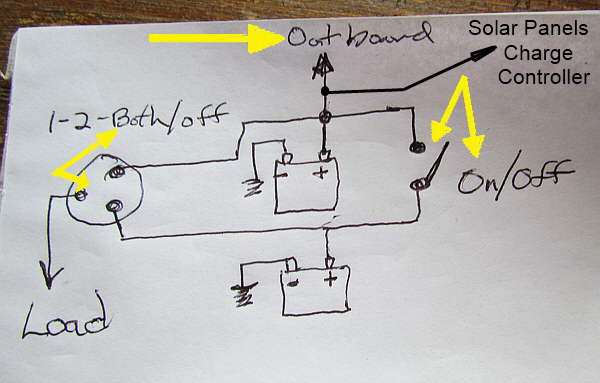
...of how the boat is wired now. I wanted the outboard to always be connected to a battery regardless of switch position for the reasons mentioned above.
Changing to an electric start outboard with the batteries in the cabin along with a new overhead console and also a computer/nav. station resulted in a complete new wiring system.
I got rid of the factory distribution panel and that mess of wires. Here is the...
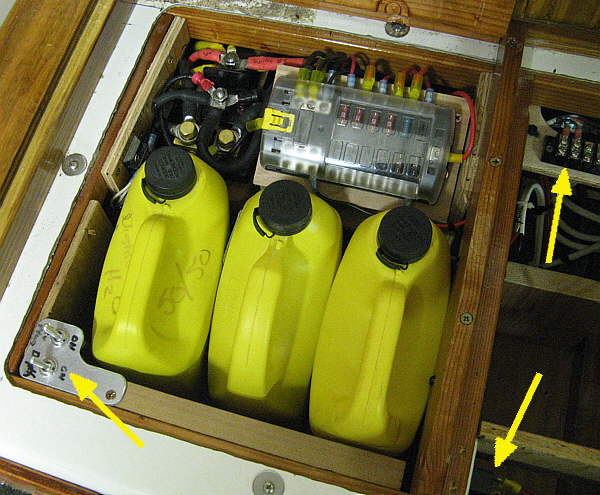
...new one along with some other wiring upgrades.
This is....
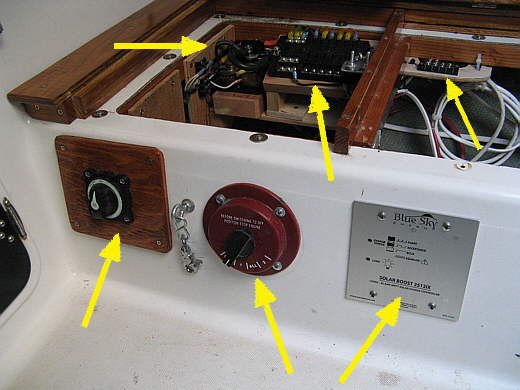
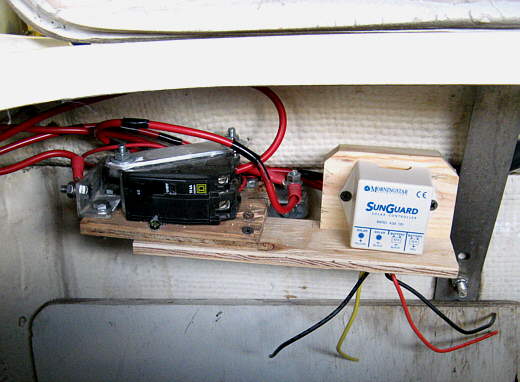
a picture of the main switches and the MPPT charge controller.
All of this is working great and the wiring is much better than before, but we did sail a lot for a year with the orginal mess, so don't think you have to do all of this before you get the boat wet. Get out there and work on this stuff as time permits.
You can find more pictures and more detailed info on the re-wire here....
http://purplesagetradingpost.com/sumner ... de-30.html
Sum
Our Trips to Utah, Idaho, Canada, Florida
Our MacGregor S Pages
Mac-Venture Links
Re: Newbie question. Need your advice.
Posted: Mon Feb 21, 2011 7:34 pm
by vizwhiz
Thanks Sumner... I'm going to go ahead and re-wire the major stuff with the batteries in the laz so they're easy to get to, but there are still a couple unknowns (motor type, etc.). I'll probably keep the motor wired into "both" so I can start it off of either battery without having to consider a separate switch (simplicity's sake only - there's just one switch for everything then). Your info helps though - lots of good ideas. The boat had one 4-switch panel and I just bought a second one, so I'll have a total of 8 fused switches I can use to separate the various loads onto...going to try to keep it simple.
Catigale - Rich says you can switch the switch, you say you can't...hmmmm...
Seriously though, I'm not really trying to push anything, I'll usually go the safer route...which is obvious here. But would still be good to know so I don't have a fit out on the water if someone does it "wrong"...

BTW, the only battery that works right now is a big starting battery, not a deep cycle...but it was free (just had to buy a boat!
) so at least I have a battery... The other one was a small starting battery (again, not a deep cycle) but it's on the charger, and might be just a core...will replace with a deep cycle if it's dead, then do the same with the other when it goes...
Thanks again for the help...if I understood everyone right, one battery positive to "1", other battery positive to "2" and all loads on "both" terminal of main switch.
Now what did everyone do with your negative battery terminal connections? A big negative bus bar? I read through Sumner's, but my boat just had all the negative wires tied together with a big bolt, hanging in the laz from a little wire hanger...
Re: Newbie question. Need your advice.
Posted: Mon Feb 21, 2011 7:58 pm
by Sumner
vizwhiz wrote:...
Cat - Rich says you can, you say you can't...hmmmm...
Seriously though, I'm not really trying to push anything, I'll usually go the safer route...which is obvious here. But would still be good to know so I don't have a fit out on the water if someone does it "wrong"...
...
Rich is qualifying his answer with....
Marine switches are designed to make the next circuit before breaking the circuit that is currently in use. If you switch through the off position while the engine is running, you can damage the alternator. DON'T DO IT
You could check to see if your switch is a true "marine type" with a Volt-Ohm meter. With the batteries disconnected from the switch attach a jumper wire between the '1' and '2' posts that you are attaching the batteries to. Then attach your ohm meter to one of those posts and to the 'load' post. Next the ohm meter should show no resistance or very little. With the ohm meter on and still connected switch the switch and see if the needle on the ohm meter jumps at all during the switch. If it does don't switch with the outboard running.
Do you have an outboard? If so does it have an alternator? Personally I wouldn't use both of those batteries in parallel (hooked together) since they are so different. Just use one good one for what you are doing. Our Tohatsu 9.8 HP has electric start, but will still start with a pull cord. Can yours? If so don't sweat the battery if you can start it.
I ran two batteries that were semi-deep cycle RV types the first year that weren't of the same manufacture and it worked. One was brand new and the other was older. I did charge them separately with the gen-set on the boat. Then we bought a second battery just like the other new one. So one has about 3-4 more weeks use on it.
Now I have them both hooked to the load and the charging system together all of the time. I can charge 2 batteries with the gen-set faster than charging one at a time on the gen-set.
Take the boat out and have some fun
,
Sum
Our Trips to Lake Powell, UT - Kootenay Lake, Canada - Priest Lake, ID
Our Mac Pages
Mac Links
Re: Newbie question. Need your advice.
Posted: Tue Feb 22, 2011 8:38 am
by Catigale
The correct solution for this is not just make-before-break but the switch should actually switch off the Alternator Field wire when turned to off
Marine electrical stuff is awfully expensive to fix..be careful out there...
From the GUEST website (mfg of marine battery switches)
Model 2100. 2300A.3100 and 3200 switches feature an alternator field disconnect which interrupts the alternator field when the switch is turned to the "off" position, thus preventing electrical surges in the armature circuit which might burn out the alternator diodes or ancillary equipment. Models 2101. 3101 and 3201 do not include this feature and should never be turned to the "off' position with engine running.
Re: Newbie question. Need your advice.
Posted: Tue Feb 22, 2011 9:25 am
by Sumner
Catigale wrote:The correct solution for this is not just make-before-break but the switch should actually switch off the Alternator Field wire when turned to off
Marine electrical stuff is awfully expensive to fix..be careful out there...
From the GUEST website (mfg of marine battery switches)
Model 2100. 2300A.3100 and 3200 switches feature an alternator field disconnect which interrupts the alternator field when the switch is turned to the "off" position, thus preventing electrical surges in the armature circuit which might burn out the alternator diodes or ancillary equipment. Models 2101. 3101 and 3201 do not include this feature and should never be turned to the "off' position with engine running.
Is there a way to switch off the 'field' on a smaller outboard. My 9.8 HP Tohatsu doesn't have it and neither did the Honda 8 HP. I'm thinking that feature is for boats with inboards with a car like alternator on them. On my gen-set that uses....
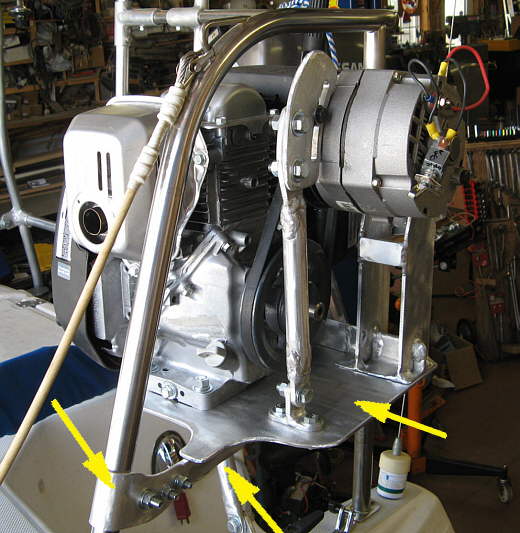 http://purplesagetradingpost.com/sumner ... de-13.html
... a car alternator I put in a circuit like that using....
....... the circuit breaker I'm using on that circuit. If the breaker trips it does what you are describing above.
With our smaller outboards, don't know about you guys with larger outboards on X and M's, I think the only thing you have to do is don't run the outboard without it being connected to a battery. That is the reason in our boat now it is always connected to a battery and the main switch only controls the 'load' side and the other switch acts as a manual 'combiner'.
c ya,
Sum
Our Trips to Lake Powell, UT - Kootenay Lake, Canada - Priest Lake, ID
Our Mac Pages
Mac Links
Re: Newbie question. Need your advice.
Posted: Tue Feb 22, 2011 2:42 pm
by Catigale
Sum - I think you would have to find the wiring diagram and implement a field switch on your own. Looks easy enough to do on my Merc 50 ...my Nissan kicker doesnt have the ALT kit so I dont know about that
Re: Newbie question. Need your advice.
Posted: Tue Feb 22, 2011 6:34 pm
by vizwhiz
To answer some of your questions Sum...I have a motor - actually, the same motor you have except the Nissan version, and, unfortunately, short shaft (don't ask - I didn't either). I know that I need the long or extra long shaft... I looked over your motor mount mod posts last night in some detail - after seeing how tight this motor will be on the standard motor mount, I'm thinking that the best thing for me to do is sell this one (it's a 2010 and should sell for a good price) and buy a physically smaller (7.5 is what I'm thinking) motor with the extra-long shaft, and not waste a lot of time or $$ trying to get the motor shaft extension, etc. I'd rather sell it and buy down, saving a few $$ rather than spending more $$ right now to try to get a long shaft on a motor that will barely fit in the space. Beautiful motor, however... So I don't know the exact motor situation I'm going to be in - electric start or not, etc. I'm assuming I'll find one that has an alternator on it.
As for the 1-2-Both-off selector switch, mine is a Sea Dog and I have no idea how old...looks pretty simple, but it's in good shape. Will use it, just need to re-wire it.
I appreciate all the help - everything is making sense and coming together (in my head first of course).
Thanks and happy sailing!
Re: Newbie question. Need your advice.
Posted: Wed Feb 23, 2011 2:28 pm
by Sumner
vizwhiz wrote:........ I'm thinking that the best thing for me to do is sell this one (it's a 2010 and should sell for a good price) and buy a physically smaller (7.5 is what I'm thinking) motor with the extra-long shaft, and not waste a lot of time or $$ trying to get the motor shaft extension, etc. I'd rather sell it and buy down, saving a few $$ rather than spending more $$ right now to try to get a long shaft on a motor that will barely fit in the space.......!
I'd think about going down a good bit before doing it. In the Tohatsu line you can get the 6 Hp and the 8.8 HP in the extra long shaft only. Where you live with the possibilities of being out in the ocean with the swells I would really want an extra long shaft if that is where I lived.
Now can your wife start the 6 hp with the hand pull. You have to get to an 8 hp and up to get electric start. I've probably preached this too much, but I feel very strongly that both parties on the boat should be able to start the outboard. When I fractured my shoulder and screwed up the rotator cuff it was 3 days before I could really pull start our Honda. What if you fell overboard can she get the outboard started to come back and get you?
If you have the electric start now think hard and long before you give it up. One option might be to lower the present outboard down with a mount a ways and keep it until you could extend the lower end or look for other options. I'll bet you take a pretty big hit on selling it even though it is a 2010.
Good luck,
Sum
Our Trips to Lake Powell, UT - Kootenay Lake, Canada - Priest Lake, ID
Our Mac Pages
Mac Links