Page 2 of 3
Re: Ultra-light air performance
Posted: Fri Dec 06, 2013 8:05 am
by Jeff L
Seapup wrote:If you can fill the jib, you can move the boat
Sometimes you just have to pop the ol motor in reverse to fill the spinnaker up on the dead days, the steering gets tricky though...

Now THAT I would pay a dollar to watch...

Re: Ultra-light air performance
Posted: Fri Dec 06, 2013 10:59 am
by Steve K
When I had the X boat I became pretty good at keeping her moving in the lightest of air.
Some of the best improvements were.........
As Newell said, flatten the main:
In very light air one might think a very baggy main will help, but the breeze in these conditions doesn't have enough energy to curve around a baggy sail and keep moving. A flatter surface will slow what breeze there is less.
Rudder alignment:
This is critical. If the rudders are not aligned perfectly, you end up with one doing the steering and one just causing a certain amount of drag. Particularly at very slow speeds (but it effects boat speed in all cases) you really need them both to function at their best potential.
Ultra light sheets:
The type of rope that MacGregor includes for sheet lines is way too heavy for very light air sailing. They end up dragging the head sail down by their weight. When I really started being able to get something out of the boat in ultra light air, was after I got enough New England Ropes "Flight Line" on sale for new head sail sheets. This small (although expensive for me at the time) change made a huge difference. I have used this rope for my head sheets since. There is no need to change to heavy air sheets either, as this rope is plenty strong enough for the heavy stuff.
Another plus is "Flight line does not soak up water and get heavier in bad conditions, so if you do happen to get hit in the face by a flogging sheet, the light weight line hurts a lot less (really another story).
I'll say it again, though there is much mixed opinion on this:
Many of you (if you have read some of my recent posts) know that I have stripped and either re-finished, or highly polished the hulls of three boats now. This makes a measurable difference in light air performance, in particular, by my experience. Bearing in mind that what was stripped from these boats was ablative, antifouling paint that looked like it was applied by paint roller. But I have to say, all three boats performed better, particularly in light air..
The Catalina was completely re-finished, wet sanded to #2000, polished like a mirror and waxed with Aurora VS-721.
The X boat was just stripped. It had been prepped by a boat yard with a "no-sand" epoxy primer, before getting the bottom paint and the factory gelcoat was perfect underneath. A quick polish and ,again, the VS-721 is all it took.
The D boat, although now stripped of bottom paint, is only wet sanded (to # 600) and nothing else. The gel-coat was too thin to do anything else at the time and there are some small blisters that need repair. I hope to re-finish the hull sometime this coming year. Even in this state (and I don't really know if it's the hull, or the recent adjustment to my mast.... or a little of both) the boat performs incredibly better. I know I run quite a bit heavier than Newell's D boat and I figured that was the reason I could never catch him (and the fact that he is a better sailor than I'll ever be). But the difference between the two boats was too big in my mind to just be the load and the guy at the helm. Well, the last time I was out and he was there too, I found I could keep up. I even caught and passed him once or twice. He can get the better of me most of the time though.
So, to re-cap and this is only IMHO:
1. Rudder alignment
2. a flat main
3. light head sheets
4. clean, smooth hull
I'm sure there are other factors, like rig adjustment and so on, but I'm no expert on any of this and this offering is just what I've found has worked on the boats I've sailed the most and had the opportunity to experiment with.
Best Breezes,
Steve K.
Re: Ultra-light air performance
Posted: Fri Dec 06, 2013 8:05 pm
by Catigale
I would like to think I could have helmed Matts boat with a tiller rather than a wheel but since we can't do that experiment it is a safe claim to make.
Underscoring this is the fact that the weight in board was impressive..matt has a body designed to hold his big heart and I'm just a plain fat oinker
Re: Ultra-light air performance
Posted: Sat Dec 07, 2013 6:08 pm
by seahouse
So the heeling tenderness of the Mac (the result of a water ballast) turns out to be an advantage over other boats (keel boats with weighted keels) in light airs. The hull shape of a sailboat is designed so as to presents less drag in the water when heeled.
Contrary to what you would do in higher wind speeds, you can take advantage of the Mac's “Achilles heel” by moving your weight to the leeward side of the boat, causing it to heel (call it the “Achilles heel” when you're doing it
). The induced lean also allows gravity to help keep the sail shape and position. I assume this is what you are also referring to, Ix and Bscott.
I haven't done much sailing in light air, there's usually some wind here, but I have found that it helps if you let the boat do what it wants to do within bounds, and not be too particular about your exact heading. But still be allowed to pretend that you have some semblance of control.

- B.

Re: Ultra-light air performance
Posted: Sat Dec 07, 2013 9:21 pm
by bscott
Anothe method of getting the sails too fill is to "roll tack" the Mac,moving the crew quickly to leeward with the main centered and medium flat, and not changing the rudder position. The induced wind on the sails will move the boat. You can beat down the fairway picking up .5 to 1.0 kts.
Also, lift one rudder. 1/2 way on the board, and try for 10* heel--note-- do not dump ballast, but it is sure tempting
Bob
Re: Ultra-light air performance
Posted: Sun Dec 08, 2013 5:31 am
by Catigale
In light air, in predictable venues with local knowledge, it's fine to drop ballast. Chip and I use to sail the Hudson this way..he once knocked down up ballasted and had to bail for 40 minutes, though.
Re: Ultra-light air performance
Posted: Sun Dec 08, 2013 7:33 am
by Johnacuda
Catigale wrote:In light air, in predictable venues with local knowledge, it's fine to drop ballast. Chip and I use to sail the Hudson this way..he once knocked down up ballasted and had to bail for 40 minutes, though.
Oof, that is a lot of bailing. I have had light ait situations on the hudson where I have been fighting a 1-2 knot current and just holting steady. Sails full with control, it was like sailing on a treadmill.
Re: Ultra-light air performance
Posted: Sun Dec 08, 2013 3:47 pm
by Boblee
Johnacuda wrote:Catigale wrote:In light air, in predictable venues with local knowledge, it's fine to drop ballast. Chip and I use to sail the Hudson this way..he once knocked down up ballasted and had to bail for 40 minutes, though.
Oof, that is a lot of bailing. I have had light ait situations on the hudson where I have been fighting a 1-2 knot current and just holting steady. Sails full with control, it was like sailing on a treadmill.
Know the feeling but one that comes to mind was without the admiral on board with good winds and 4-5knot tides, I spent all afternoon playing and making almost zero progress but it is rare as usually just drop the motor.
No way would I drop the ballast there is just too much good stuff that I don't want wet even without the missus on board.
Re: Ultra-light air performance
Posted: Mon Dec 09, 2013 9:55 am
by arknoah
Ixneigh wrote:I dont know about windspeed, but if there is enough wind to fill the jib, I can keep a course. If I cant keep the jib filled, even by sitting on the leeward rail, I hang it up, in any sailing craft.
Ix
I'm with you. I read an article about "ghosting" somewhere which recommended staying on the leeward side so all of the boat's momentum is focused on moving forward (to whatever heading you're on) rather than having to use all of its oomph to induce a nice heel. Forcing the heel by sitting to leeward helped me on several occasions salvage some slow and nice movement out of an otherwise almost breezeless day.
Re: Ultra-light air performance
Posted: Mon Dec 09, 2013 4:04 pm
by bartmac
Inducing a heel works in small dinghy sailing....no reason it would not help a Mac
Re: Ultra-light air performance
Posted: Tue Dec 10, 2013 8:12 am
by Newell
Another control, not mentioned as affecting light air performance is the topping lift. I had a great discussion with John Acton, a long time 26D racer, last year on the use of the topping lift to induce twist in the mainsail. I haven't done this, but others have. The reasoning goes something like this. There is more air movement the further up the mast in most wind conditions. When the wind is very light, removing the weight of the boom from the mainsail allowing the top of the sail to twist off establish's a better attachment with the wind further up the mast. I have ajustable topping lifts but never think of trying it or usually just let the boat do it's best without going to too much work, since not racing. Many macs don't have adjustable topping lifts or use pigtails off the backstay.
Re: Ultra-light air performance
Posted: Tue Dec 10, 2013 9:46 am
by Wind Chime
A Boomkicker does basically the same as a shortened toppinglift, and is one of it's selling points.
It holds the boom up and does not flatten (or close) the leech too much so there is still good sailshape in light wind.
We have one an just love it!
... and they are sold on this website
http://macgregorsailors.com/catalog/pages/boomkicker/
by Newell » Tue Dec 10, 2013 9:12 am
Another control, not mentioned as affecting light air performance is the topping lift. I had a great discussion with John Acton, a long time 26D racer, last year on the use of the topping lift to induce twist in the mainsail. I haven't done this, but others have. The reasoning goes something like this. There is more air movement the further up the mast in most wind conditions. When the wind is very light, removing the weight of the boom from the mainsail allowing the top of the sail to twist off establish's a better attachment with the wind further up the mast. I have ajustable topping lifts but never think of trying it or usually just let the boat do it's best without going to too much work, since not racing. Many macs don't have adjustable topping lifts or use pigtails off the backstay.
Re: Ultra-light air performance
Posted: Tue Dec 10, 2013 10:49 am
by BOAT
Newell wrote:Another control, not mentioned as affecting light air performance is the topping lift. I had a great discussion with John Acton, a long time 26D racer, last year on the use of the topping lift to induce twist in the mainsail. I haven't done this, but others have. The reasoning goes something like this. There is more air movement the further up the mast in most wind conditions. When the wind is very light, removing the weight of the boom from the mainsail allowing the top of the sail to twist off establish's a better attachment with the wind further up the mast. I have ajustable topping lifts but never think of trying it or usually just let the boat do it's best without going to too much work, since not racing. Many macs don't have adjustable topping lifts or use pigtails off the backstay.
Yes, this is the same as a "muscle head" the idea is to get the pocket to move up to the top of the main - many times we do it by just standing up and lifting the boom, then when the boat gains a little speed you can let go because the apparent wind takes over for you. It's great for accelerating out of the hole after a tack too.
I would not use the topping lift much to do it because it only works if the boat is standing straight up - if there is any heel at all it does not work. (IMO)
Re: Ultra-light air performance
Posted: Tue Dec 10, 2013 11:11 am
by Wind Chime
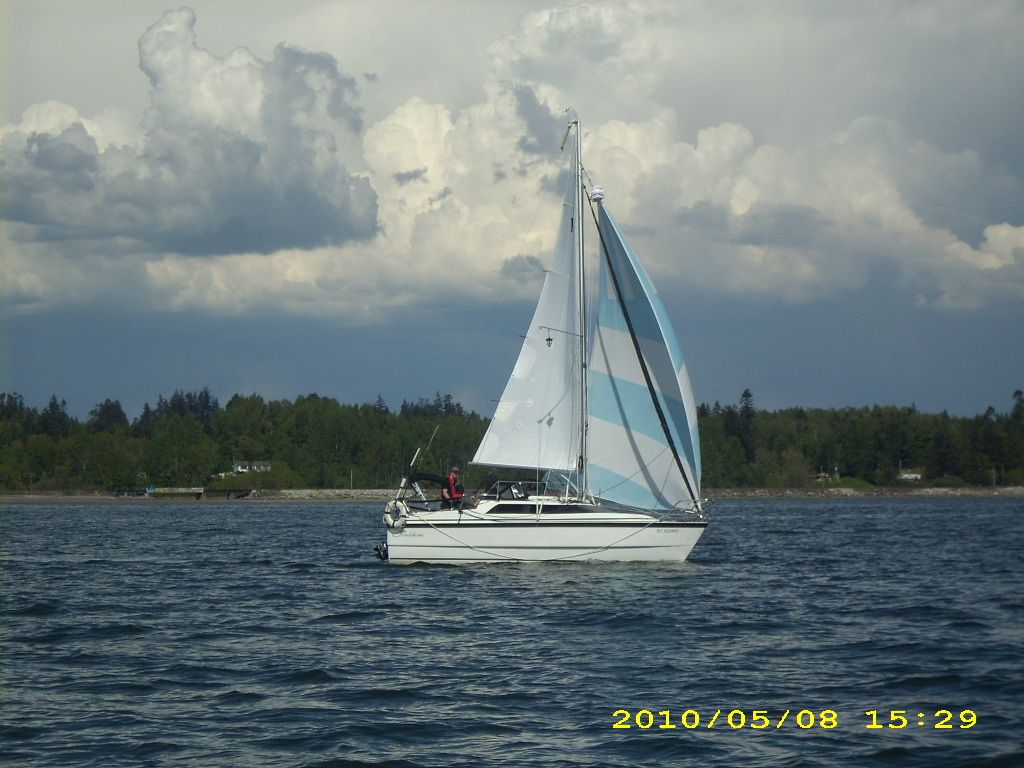
Another tool we have for "Light-Air" sailing is a Gennaker sail.
For those not familiar with a Gennaker, it’s kind of a cross between a genoa and a spinnaker. Similar shape as a standard headsail but made of nylon like a spinnaker. The sail has a flatter cut (similar to a genoa or jib) so it allows you to sail closer to the wind than an asymmetrical spinnaker, and because it is made of light nylon it takes less wind to fill the sail compared to a standard jib or genoa that is made of mylar or dacron. The size is the same as our 150 genoa.
We run it with an adjustable tack-line, so the tack can be raised and lowered to max out any puff or point of sail. When the tack line is hardened in (tack down low against the foredeck) it tightens the luff so it runs parallel with the forestay. We sheet it the same as our asymmetrical spinnaker with turning blocks aft in the cockpit (or sometimes the standard coaming t-tracks blocks), and gybe and tack forward of the headstay. The gybes are easy, but we need to be quick on the tack into the wind, but remember this is in light air.
If you zoom in on this photo, you can see by the windex on the top of the mast that we were sailing almost on a close reach. And we could have sailed even closer to the wind if we tightened the luff more with the adjustable tack-line and/or halyard.
Re: Ultra-light air performance
Posted: Tue Dec 10, 2013 11:41 am
by BOAT
Wow, that's a cool head-sail you got there.
