What's useful to keep in mind is that the water ballast, or permanent ballast, or a weighted (bulb or fin) keel, doesn't act alone, as a separate component. It's just a part of the boat. The center of mass is a theoretical point in the boat that represents the total mass and the location where, if you passed a pivot (or axle) through it and supported it, in any of the three axes, the boat would not rotate about it under gravity.
Ballast and keels and masts and such are independent components of the boat, with forces and moments that are reacted internally to the overall vessel, but the complete vessel doesn't know or care about the bits - just the total mass and center of mass location and, of course, the center of buoyancy, where the vertical force the water exerts on the hull can be mathematically 'concentrated' as a simple force reacting against the hull for stability purposes.
Having said that, adding fixed ballast on the keel, and removing some water ballast to keep the total mass the same, will invariably cause the hull to sail flatter, all other things being equal. The center of mass is moved downward when heavy ballast is added low (or lower than the CG of the ballast water) and water is removed to keep the weight the same. Or even if the water isn't removed, but that would make the boat heavier for no gain, which isn't a good idea.
First sketch is a cartoon of the vessel with high center of mass, and center of buoyancy lined up with the CoM, sitting level. Heel the boat, and the center of mass remains the same as the boat heels, but the center of buoyancy moves as the hull shape in the water changes (form stability), and the horizontal distance between them is the restoring moment arm while the two forces (boat gravity force and countering buoyant force) is the righting moment. Dimensions shown are illustrative only, of course.

Adding heavy ballast low in the hull, like the keel, and removing the equivalent weight in water (and reducing the size of the water tank so it doesn't move around) lowers the vessel's center of mass. The righting moment arm for a given heel angle is greater, so the balance between the wind force on the sails and the water force on the keel against the righting moment results in less heel for the same conditions.

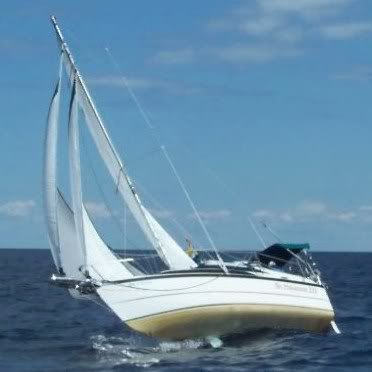
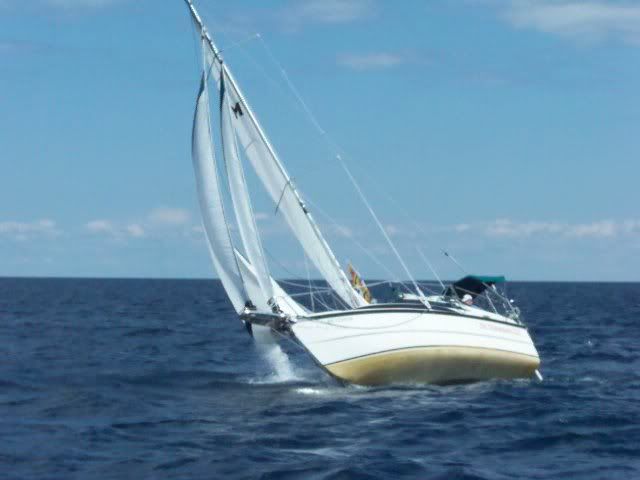
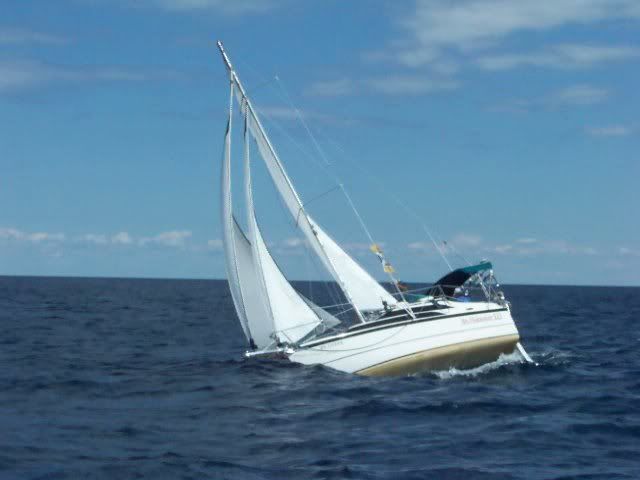
Water ballasted boats are going to be more tender than heavy keel boats with the same hull and rig size, shape, and total weight simply because their center of mass is higher, all other things being equal. But you can't treat the water ballast or keel as a separate entity except in calculating the center of mass of the boat, as it's all part of the same lump.
Just sayin'.


 what you are trying to achieve is akin to sticking mag wheels on a lawnmower and expecting it to mow better


 ), spilling air is actually reducing the heeling moment, which allows the boat to stand up higher, thereby reducing the righting moment. The two are exactly balanced when the boat is traveling steady-state (holding steady heel angle). Increase the wind force (which also increases the opposing water force) and the boat heels more, which reduces the projected sail area a bit, and also increases the righting moment from increased heel angle and weight vs buoyancy (see previous sketch), until they balance again.
 the guy wants to add ballast to the boat! That means more beef in the rigging.