Page 2 of 3
Re: Charge controller
Posted: Fri Apr 07, 2017 4:47 pm
by Highlander
grady wrote:Sumner wrote:grady wrote:.... Are you going to run the panels in series? With that controller it will be more efficient....
The 'series' vs. 'parallel' debate comes up often on sailboat boards. If there is any shading on any panel and they are in series you will kill the output of the other panels that are in series. If the current is cut down in one panel in series the other panel, even if in full sun, will be reduced to the current that is passing through the shaded one. Hard to avoid this on a sailboat. I've tried to get the panels behind the boom on both boats but still there are times they become shaded to some degree by something. On the Mac 200 watts are behind the boom and the rest can be shaded by it. On a fixed house install if shading isn't a problem then I'd look into series.
Here is a good video showing the effects of minor shading on one panel and the impact if they are in series...
https://www.youtube.com/watch?v=ofo1HQy ... u.be&t=561
I'd stay with parallel on a boat.
I have all my panels in parallel and Blue Sky MPPT controllers on both boats except for a Morning Star MPPT controller on some of the panels on the Mac where I do run two sets of two sixty watt panels in series (240 watts) to charge 2 12 volt batteries in series for the 24 volt trolling motor. I have two other ...
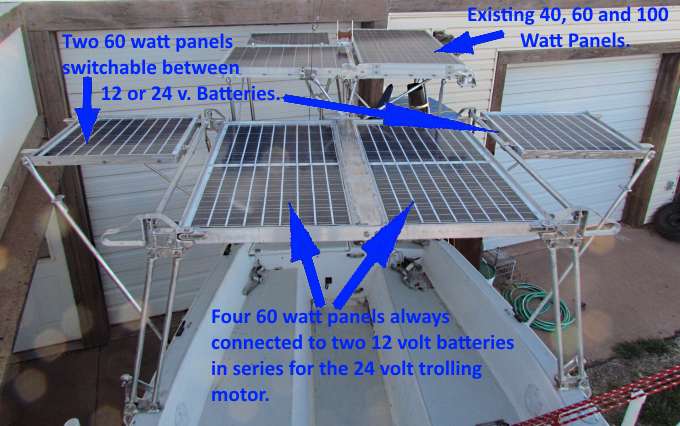
... 60 watt panels that can be switched from running in series and going to the Morning Star controller or running in parallel and going to the Blue Sky controller that is charging 2 Trojan T-105 6 volt batteries in series for the main house bank.
The 2 12 volt batteries can be switched from the 24 volt bank to a 12 volt bank at night and added to the house bank if needed. In 3 months on the Bahama trip with the 560 watts total of solar I never once had to run the outboard or the gen-set for power and the batteries never went below about 60%. I'm purely a cruiser and not a racer so having 12v power is essential to me so I can use the 63 quart fridge, CPAP machine, computer, lights and so forth,
Sumner
============================
1300 miles to the Bahamas and back -- 2015
The MacGregor 26-S
The Endeavour 37
Trips to Utah, Wyoming, Idaho, Canada, Florida
Mac-Venture Links
That is why I state if the panels do not have pass thru diodes you need to add them. With those the issue of shading of one panel is eliminated.
Grady
is this what ur talkin about ?
Advanced Maximum Power Point Detection in case of partial shading conditions
Re: Charge controller
Posted: Sat Apr 08, 2017 8:40 am
by Highlander
according to this info if "Load output"
Over-discharge of the battery can be prevented by connecting all loads to the load output. The load output
will disconnect the load when the battery has been discharged to a pre-set voltage.
https://www.victronenergy.com/upload/do ... -15-EN.pdf
So as long as I follow these instruction,s I should b good to go

J

Re: Charge controller
Posted: Sat Apr 08, 2017 10:03 am
by Highlander
Look,s like the panels have their own biult-in diodes
Coleman
FEATURES
Ideal for use with RVs, homes, cabins, remote and back-up power, 12V battery charging and more
Panel features high efficiency crystalline solar cells and durable metal frame for extended outdoor use
Includes fold-out stand for easy installation
Features fully weatherproof design shatterproof tempered glass for superior durability
Includes 7 amp charge controller to protect the 12 Volt battery from overcharging
Built-in blocking diode prevents reverse discharge in battery
Maximum power output: 40 Watts and 2.3 Amps under ideal conditions
J
Re: Charge controller
Posted: Sun Apr 09, 2017 6:36 am
by Sumner
Highlander wrote:Look,s like the panels have their own built-in diodes
...
Almost all panels now have built-in diodes for passing of current, within the panel, when there is shading on that panel, but they only work for that panel. If you decide to run panels in series then you need...

... by-pass diodes external to the panel and the associated wiring as shown in the diagram above. This helps with the large problem you have with panels in series and shading but shading is shading and regardless of the wiring it is going to kill panel output.
If you haven't already take the time to watch this video and see the effects of shading on just one small part of a panel....
https://www.youtube.com/watch?v=ofo1HQy ... u.be&t=561.
You would also need to make sure the controller can handle the resulting voltage of having panels wired in series. Looks like the one you are looking at is good for up to either 75 volts or 100 volts (not sure which you are looking at), so you would be fine. Others have limits of around 40 volts, so I just mention this for someone else looking to go that route. I still don't see any significant gains to be had in series and like the simpler wiring running them all in parallel and also like the fact that if I loose a panel, did damage one on a piling once

, that the remaining panels will all still be doing their job. Parallel vs. series can be debated till the end of time and it has been, so do what you think works best for you.
As far as hooking the loads to the charge controller without seeing the wiring instructions for the controller I probably wouldn't do that for all the loads you might have on the boat. If, say you left the boat with a fridge running in it or night lighting that comes on, then having those items on the load circuit might be a good idea. If you are using the boat there might be a time you might say I'll take the consequences of running the batteries down further than what is good for them and would want to by-pass having the controller turning those loads off.
Good to see you adding solar but 120 watts is still not a tremendous amount of solar. If you don't plan on running refrigeration or taking longer trips it might do the job fine, especially if you have a backup planned for charging the batteries.
Looks like you have some good mods going on
,
Sumner
============================
1300 miles to the Bahamas and back -- 2015
The MacGregor 26-S
The Endeavour 37
Trips to Utah, Wyoming, Idaho, Canada, Florida
Mac-Venture Links
Re: Charge controller
Posted: Sun Apr 09, 2017 7:08 am
by Tomfoolery
Sumner wrote:. . . I still don't see any significant gains to be had in series and like the simpler wiring running them all in parallel . . .
. . . Parallel vs. series can be debated till the end of time and it has been, so do what you think works best for you.
I was wondering about that, just from reading here about people wiring panels in series with bypass diodes, but never bothered to follow up and educate myself. Assuming you can take full advantage of the excess voltage from series connection, which is a big assumption since it's not AC and you can't use a transformer to increase current/decrease voltage*, you still lose output from partial shading. But being that I don't now have, and never have had, solar panels bigger than what's built into some calculators, I was never that interested. Until now. <groan> Another thing to put my diminishing gray matter to.

I'm putting the boat on a mooring for a week this summer in Cape Cod, so I've been thinking about a small 'maintainer' type PV panel and controller, maybe strapped to the cabin roof when the boat's not in use. Especially since the electric output of my BF50 is so anemic, even by outboard standards. But that won't require ganging units, so this is just interesting to me for its own sake.

*Edit: A little research turns up switch-mode DC-DC voltage conversion, utilizing energy stored in either capacitors or inductors (probably a tiny transformer of sorts) to reconvert to a lower voltage but higher current by tapping the stored energy. So between that, and the video Sumner linked to (series connection of two panels, and roughly doubling output current at double input voltage but same regulated output voltage), I can see the current increasing as the voltage is regulated downward.
Re: Charge controller
Posted: Sun Apr 09, 2017 8:09 am
by Mac26S-95
Tom, You'll have to stop by and see what I'm doing for solar - simple and inexpensive. It's a 50W flexible panel I got off Amazon and a charge controller that I've had for years - I don't remember where I got that. It does the job keeping my battery maintained, but that's about it. I don't use much power.
https://www.amazon.com/gp/product/B013D ... UTF8&psc=1
Oh, and by the way, the State launch at the north end of the bay is awesome. I use that in the fall when the water level drops.

Re: Charge controller
Posted: Sun Apr 09, 2017 9:57 am
by grady
As i under stand it the the biggest benefit for going with series is that even in indirect sunlight (right after sun up and till sun down) a 18v panel is going to make around 5v or so. If yo have 3 panels in series you are already at a voltage that will start to charge your battery bank. It will be low but it will start.
We all know one thing is that anytime you convert energy from one form to another it is never 100% efficient. So i would agree that at Noon with the sun directly above and all your panels in parralell you probably will have more output than one making a lot of voltage then converting to current. But from what I understand this does not make up for the 2 to 4 more hours of charging per day a series setup gives you.
I am considering adding one more 50W panel on the sliding hatch. This will make 3 50W panels total. And Yes they are in PARALELL. Different from what I think would be best as stated above. This is because I have this charge controller at this time.
http://www.batteryminders.com/12-volt-s ... er-SCC-180
I am happy happy with it. It has kept my batteries healthy for years. If it ever breaks I will go with the Victron Energy and convert to series. The other benefit of series is you do not have to use as large of wire.
One more bit of info. Be careful of cheep controllers with expensive batteries. Most cheep controllers with smoke a AGM battery. AGM batteries need a specific float voltage and need to be temperature compensated. I have turned my float voltage down to 13.3 at normal temperatures. When it get hot it back down from there. A cheep controller that runs up to 14.4V and then turns off then turns back on at 13.2 will boil you batteries. Not an issue when you have large flooded batteries.
Re: Charge controller
Posted: Sun Apr 09, 2017 5:06 pm
by Highlander
Sumner
I think I,ll run my panel,s in parallel as that,s the reason for going with 3 panels if one fail,s u still have a workin system , also my under standing is that this controller according to the manual it doe,s not matter what way u go it automatically adjust,s & compensates for best charging results regardless
J
Re: Charge controller
Posted: Mon Apr 10, 2017 9:17 am
by Tomfoolery
Mac26S-95 wrote:Tom, You'll have to stop by and see what I'm doing for solar - simple and inexpensive.
I'll check it out this summer. Thanks.
Re: Charge controller
Posted: Mon Apr 24, 2017 10:29 am
by Bilgemaster
Just as an update to my
earlier posting in this thread, I should mention that
Renogy is now selling an MC4 to SAE type adapter for $24.99. A tad pricey for what it is, but there you have it.
Such adaptors, formerly appearing to have been fashioned from Inobtanium annealed in Essence of Unicorn Belch when I was cobbling together my own cheapo solar setup, might be handy for folks like me linking together gear from different companies using these two most commonly found connector types,
MC4 and
SAE. Sure, you can still make your own adaptors like I had to out of
these things and cannibalized
Harbor Freight Solar Connector Kit parts--maybe even save, say, almost $20 a pop that way, but seriously: that's a lot of bother for a Jackson. In Winter--OK, maybe that'd be a swell time-killer--But it's Spring
! Go sailing
!

So, just to sum up it all up (and since I just got an IM from another Forum member asking me about a current online source for that flexible 50 watt panel and all the other needful bits), to add 50 watts of cheap and super-easy-to-install solar to your boat for just $170.94 (or less), and which is quicker to install than you can hoist the mainsail and say, "Let's spend this weekend on the hook
!", here's all you need:
 "Semi-Flexible Bendable 18V 50 Watt Lightweight Solar Panel 12v Battery Off Grid"
 -- Cost: $95.99 (free shipping)
RENOGY MC4 to SAE Adaptor -- Cost: $24.99 (Free shipping on orders over $35.
Get a book maybe.)
Solar Power Connection Cable Kit -- Cost: $9.99 (U.S. Shipping $6.99 [see next two items below], or free pickup in store)
100 Watt Solar Charge Regulator -- Cost: $25.99 (U.S. Shipping free if you get the Cable Kit and/or Bungees at the same time, or free pickup in store)
12 Pc Assorted Length Elastic Stretch Cords (you'll only need four of the tiny black ones for the hatchtop "installation", but bungees are always handy, right?) -- Cost $6.99 (U.S. Shipping free if you get the Cable Kit and/or Regulator at the same time, or free pickup in store)
That's it. That's all you need. Just slap the Panel onto the sliding hatch, secure its four handy grommets to the corners of the hatch with the little Bungees, plug the MC4 to SAE Adaptor into the panel, plug the Adaptor into the long SAE cable in the Cable Kit, plug that cable into the Regulator, attach its alligator clips to your battery or batteries, and you've got some decent juice, my friend. All for just $170.94 on your boat delivered...even less if you use a coupon or three on that Harbor Freight gear.
Re: Charge controller
Posted: Tue Apr 25, 2017 12:10 pm
by Starscream
Do any of these controllers (Harbor Freight or Victron or ?) differentiate between the type of battery being charged? How do they handle the different needs of Lead vs. AGM?
I just replaced my lead-acid batteries last fall with Optima blue-top group 27 AGM's, and would really like to add solar charge capability for those times when we use the boat as a camper and won't run the engine for days.
Re: Charge controller
Posted: Tue Apr 25, 2017 2:45 pm
by sailboatmike
I would hope they have different options for batteries, even my chinese $20 controller is programmable for battery type.
IM very happy with my MPPT20 unit, its supposed to be MPPT and PWM but for $20 I dont really think it is, most of the time i says its running at around 66% which I make out to be PWM
Re: Charge controller
Posted: Tue Apr 25, 2017 4:59 pm
by grady
You need to look at the battery recommended charge profile. Bulk voltage, equalization voltage, float voltage. Then make sure the charge controller falls within those specifications.
https://www.optimabatteries.com/en-us/s ... rging-tips
Also temperature compensation is important. If you overcharge a AGM battery it will destroy it quick. That is usually how they get a bad rap. A flooded battery you can overcharge and boil. Then you just have to put electrolight back in. When you boil an AGM the electrolight is lost and you can not replace.
Re: Charge controller
Posted: Wed Apr 26, 2017 10:53 am
by Bilgemaster
Starscream wrote:Do any of these controllers (Harbor Freight or Victron or ?) differentiate between the type of battery being charged? How do they handle the different needs of Lead vs. AGM?
I just replaced my lead-acid batteries last fall with Optima blue-top group 27 AGM's, and would really like to add solar charge capability for those times when we use the boat as a camper and won't run the engine for days.
I don't know about the Victron unit you mention, but
the Harbor Freight one is pretty simply either on or off. There are no means to program it--There's not even a display screen as such nor any buttons nor controls, just little red, yellow and green lights to display charging status: Yellow means it's charging, Green means it's fully charged (current to the battery cut), while Red indicates low voltage discharge protection (current from the battery cut). According to its
User Manual, the specs look like this:
Power Input: Solar Panel / 22 VDC, 7 AMP, 100 Watt Maximum
Power Output: 12 VDC
Automatic Over-Charge Protection: 14V (+0.5V) [
i.e., Green light on]
Automatic Discharge Protection: 10.5V (+0.5V) [
i.e., Red light on]
Operating Temperature: 14º Fahrenheit to 108º Fahrenheit
LED Indicators: Green = High Voltage / Yellow = Charging / Red = Low Voltage
Connectors: 2-Way Plug (+/--) = Solar 2-Way Plug (+/--) = Battery 3” Pigtail = Load [
i.e., live current]
I don't know how well such rather humble and binary "off or on" specs might play with your fancy and fussy AGM batteries, but it's been working just superbly with my old lead acid lumps. They couldn't be happier. One thing I like about the Harbor Freight unit it that it hangs rather handily from a little velcro lanyard from that hand rail at the aft end of the 26X's galley, right over that storage area where I keep my pair of batteries, a sturdy old Exide Group 27 and a dual purpose marine-starting Group 34 that came with the boat. Of course, you may end up needing to get some sort of specialized or programmable controller that'll pamper your AGMs...Or then again: maybe not. I really don't know.
Re: Charge controller
Posted: Wed Apr 26, 2017 11:19 am
by Seapup
Do any of these controllers (Harbor Freight or Victron or ?) differentiate between the type of battery being charged? How do they handle the different needs of Lead vs. AGM?
Also temperature compensation is important. If you overcharge a AGM battery it will destroy it quick.
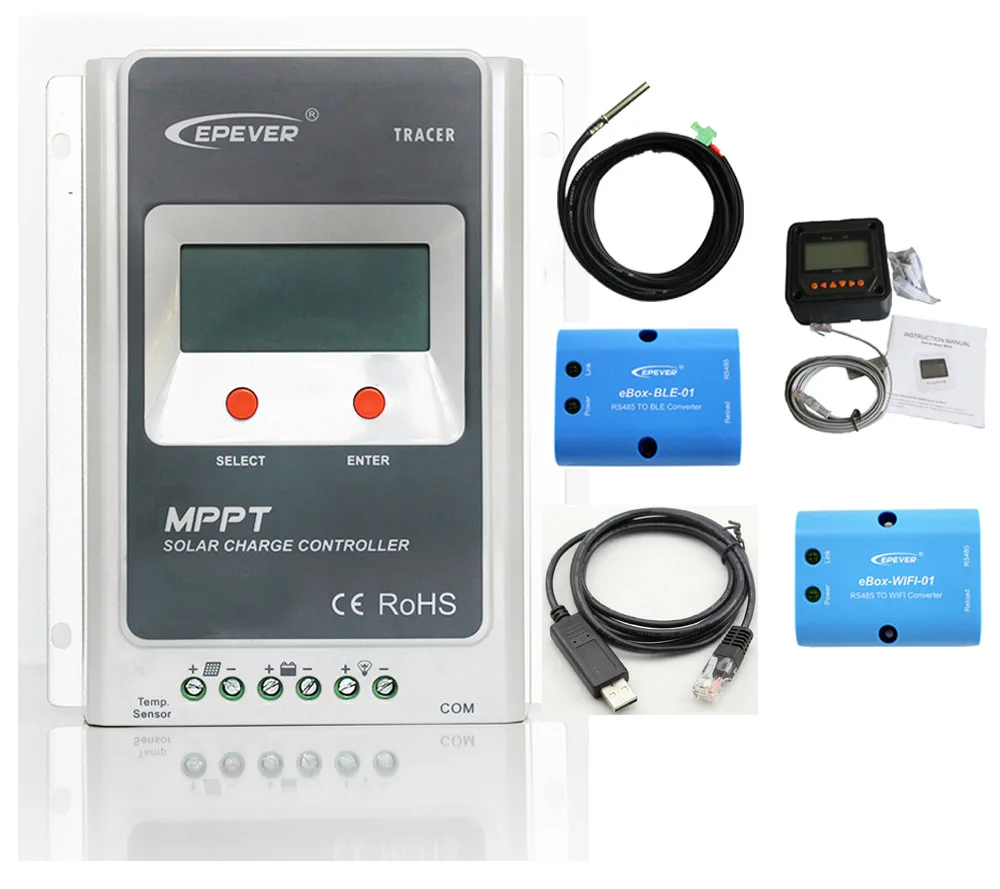
The epever MPPTs are one of the few reasonable priced (under $100) true MPPTs with external temp sensors ($5) . You can program it using a wired remote/display, bluetooth dongle & app, wifi dongle ($25 each) or regular usb. There are several preset temperature and charge profiles and a blank user variable profile for 12-17v. Examples for user set profiles are to equalize batteries at 15.5v, lock out of float charging when cruising, or boost voltage at your programmed intervals for storage.