Hi All!
Just an Engineering perspective on what may have led to this issue….
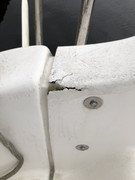
Looking at the helm seat and the cracking of the seat back opposite the hinge I can see that it is a kind of part-to-part tolerance issue between the seat and the cockpit. The parts are a “it just fits” where the attempt was made to have the seat bottom contact would match with the seat back contact at nearly the same moment. Kind of a tough thing to do with precision machined parts never mind with molded fiberglass and gel coated layup parts!

Some times the seat back is gonna contact first and sometimes the seat bottom is due to the real world aspects of manufacturing. Add in the aspect that the seat bottom is a post molding machine cut surface Contact face and the seat back is an as molded surface it’s most likely that the seat back is gonna have the greater dimensional variability and generally contact first.
(In Design Engineering we generally cover this as Product Interface Geometric Dimension & Tolerancing…. Where unless there is an over riding concern one would avoid trying to have two contact regions from mating at the same time..just make the one actually carrying the most functional loads of the ‘Rumpus Maximus’ the point of contact which would be the seat bottom-to-cockpit bench….)
So inevitably there are gonna be cases where the back rest contact is gonna contact before the seat bottom first… this seems to generally occur on the side opposite the hinge for the examples I’ve seen for the Mac26X and suspect this is also the case for the Mac26M. It can also happen on the hinge side as well where the seat back contacts before the seat bottom but without the impact loading aspect. When, under static conditions (I.e. not slamming closed), the seat back contacts first all the loads imposed bumpy someone sitting in the helm seat are imposed at the thinner seat back first before the seat structure deflects to allow contact with the seat bottom. This imposes a strain that it isn’t as capable of handling. Eventually adversely strained areas tend to fatigue. Now add in a couple dynamic momentum slamming shuts to the equation and it only exacerbates the problem. The thinner seat back is gonna take the brunt of the abuse.
So I figure that when I get around to fixing the helm seat on our Mac26X I can fix a couple aspects at the same time.
A) The first is to repair the damaged fiberglass of the seat back.
B) The second is build up and reinforce the contact lip of the seat bottom so it will always contact first on both sides but particularly on the side opposite the seat hinge.
C) The third is to add some compliant cushioning material to the seat bottom contact surfaces to moderate and distribute the potential momentum impact kinetic forces that will inevitably occur if/when the seat falls shut. UV resistant Nitrile or VITON foam padding should help with this.
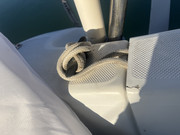
D) The fourth would be to make sure at reassembly that the hinge is adjusted such that the seat bottom is what contacts and Carrie’s the vertical loads and not the seat back.
I don’t doubt that somewhere along the line this probably was the original design intent but just as probably that intent was either not continually communicated or was circumvented during the production and/or assembly processing. It’s not an uncommon thing to occur, especially when there are low tech processing and multiple personnel turn overs as was most likely the case when the boats were in volume production at the MacGregor facility. Expecially when the consequences only showed up as the boats were being used by owners in diverse locations.
Now it’s time to get back to being productive and see if I can convince the Admiral to go out on the boat for a couple hours…..


Best Regards,
Over Easy