

Rudder depth

Re: Rudder depth
Thanks Jimmyt. That's very helpful. I tried motoring around with the rudder half raised but it was difficult to turn the rudder. The motor has limited swing on the 26D.
-
Jimmyt

- Admiral
- Posts: 3402
- Joined: Sat Jul 18, 2015 9:52 am
- Sailboat: MacGregor 26M
- Location: Mobile AL 2013 26M, 60 Etec
Re: Rudder depth
I'll bet it was difficult. The way your rudder is made, you went from 90% area at a moment arm of about 6" (fully down) to 100% area on a moment arm of (likely over) 30". So, I'd expect the effort to be well over 5 times higher.
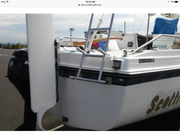
Jimmyt
P-Cub-Boo
2013 26M, Etec 60, roller Genoa, roller main
Cruising Waters: Mobile Bay, Western Shore, Fowl River
P-Cub-Boo
2013 26M, Etec 60, roller Genoa, roller main
Cruising Waters: Mobile Bay, Western Shore, Fowl River
-
OverEasy
- Admiral
- Posts: 2895
- Joined: Mon Sep 28, 2020 11:16 am
- Sailboat: MacGregor 26X
- Location: NH & SC
Re: Rudder depth
Hi!
I think JimmyT has the right idea in making a couple simple slab prototypes.
The distribution of rudder fore/aft of the pivot axis shouldn’t be much above 30% fwd (as you won’t have any “feel” to the rudder with more).
The more aft of pivot axis the rudder panel goes the more leverage force is applied but too much and all you get is a sore arm.
The leverage also applies forces to the hinge pivot and transom. Generally I wouldn’t suspect that to be a problem unles taken to the extremes.
Thick marine grade plywood with a coat of epoxy resin as varnish and equal beveled edges and or radius should be fine for the leading and trailing.
Don’t think there is much to be gained with making an airfoil shape given the increased chord (length of rudder along waterline).
Bevel can be done with a guide bar and canted over skill saw, a jig saw, a band saw or a table saw. You could also use a router with the desired cutter like a raised panel type is desired.
If yo get started it might be best to start with a long chord then progressively shorten it until it feels and operates like you want.
Then you can sand /scuff the epoxy and apply a couple layer epoxy resin fiberglass shell. (Minimize the material waste…)
You might want to also incorporate a #10 gauge thickness SST or Aluminum trim tab to the trailing edge of the rudder to help balance the forces to help compensate for any offsets or imperfections.
Given the shallow water nature of the endeavor you might also want to beef up the bottom and lower leading edges with a SST or Aluminum skin to absorb the inevitable abuse ground strikes will impose (to protect the epoxy fiberglass seal cover).
The keel board is another item you may want to make out of marine ply and fiberglass with a protective SST or Aluminum bottom and leading edge for similar reasons. That way you can have it designed to only go down as far as desired and not worry of it slipping or getting set too deep. That way you still have your deeper performance keel board and rudders to retrofit back on if/when you get the opportunity to move back to deeper water sailing options.
Good luck and have fun!
Best Regards
Over Easy


I think JimmyT has the right idea in making a couple simple slab prototypes.
The distribution of rudder fore/aft of the pivot axis shouldn’t be much above 30% fwd (as you won’t have any “feel” to the rudder with more).
The more aft of pivot axis the rudder panel goes the more leverage force is applied but too much and all you get is a sore arm.
The leverage also applies forces to the hinge pivot and transom. Generally I wouldn’t suspect that to be a problem unles taken to the extremes.
Thick marine grade plywood with a coat of epoxy resin as varnish and equal beveled edges and or radius should be fine for the leading and trailing.
Don’t think there is much to be gained with making an airfoil shape given the increased chord (length of rudder along waterline).
Bevel can be done with a guide bar and canted over skill saw, a jig saw, a band saw or a table saw. You could also use a router with the desired cutter like a raised panel type is desired.
If yo get started it might be best to start with a long chord then progressively shorten it until it feels and operates like you want.
Then you can sand /scuff the epoxy and apply a couple layer epoxy resin fiberglass shell. (Minimize the material waste…)
You might want to also incorporate a #10 gauge thickness SST or Aluminum trim tab to the trailing edge of the rudder to help balance the forces to help compensate for any offsets or imperfections.
Given the shallow water nature of the endeavor you might also want to beef up the bottom and lower leading edges with a SST or Aluminum skin to absorb the inevitable abuse ground strikes will impose (to protect the epoxy fiberglass seal cover).
The keel board is another item you may want to make out of marine ply and fiberglass with a protective SST or Aluminum bottom and leading edge for similar reasons. That way you can have it designed to only go down as far as desired and not worry of it slipping or getting set too deep. That way you still have your deeper performance keel board and rudders to retrofit back on if/when you get the opportunity to move back to deeper water sailing options.
Good luck and have fun!
Best Regards
Over Easy


Re: Rudder depth
I made my replacement rudder out of 1/2" HDPE after the original fiberglass over softwood frame rudder rotted out. Same size as original with 3" added to the leading edge as recommended somewhere. I just want to go fishing and crabbing around the bay. No big regattas yet.
Re: Rudder depth
I think I'll cut 12" off it and round off the front and see how it does. "Close enough for government work".
Re: Rudder depth
HDPE (High Density Polyethylene) Sheet, Opaque White, Standard Tolerance, UL 94HB, 1/2" Thickness, 24" Width, 48" Length. $108 from Amazon. Triple thick (1-1/2") at the top held together with 1" SS countersunk screws on both sides to strengthen the pivot area. See photos:
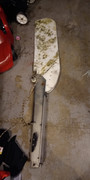
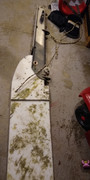
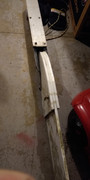
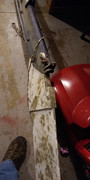
I notice that the leading edge is in line with the pivot points so I don't have any balance. I'll have to move the rudder forward so I have 3" of balance.
I notice that the leading edge is in line with the pivot points so I don't have any balance. I'll have to move the rudder forward so I have 3" of balance.
-
OverEasy
- Admiral
- Posts: 2895
- Joined: Mon Sep 28, 2020 11:16 am
- Sailboat: MacGregor 26X
- Location: NH & SC
Re: Rudder depth
Hi Warren631!
Interesting idea to make a rudder!
I’m sure it works but nut having played with 1/2 HDPE I wonder about flexure and/or twist under load.
As you have the experience with it in real-time I’m hoping you can tell us first hand.
Maybe a bench test of static lateral bend with a hand pressure or a static weight.
Nothing too serious but to just give an idea of how stiff it is.
Thanks!
Best Regards
Over Easy
Interesting idea to make a rudder!

I’m sure it works but nut having played with 1/2 HDPE I wonder about flexure and/or twist under load.
As you have the experience with it in real-time I’m hoping you can tell us first hand.
Maybe a bench test of static lateral bend with a hand pressure or a static weight.
Nothing too serious but to just give an idea of how stiff it is.
Thanks!
Best Regards
Over Easy
-
chadwiseman
- Chief Steward
- Posts: 82
- Joined: Wed Sep 15, 2021 4:50 pm
- Sailboat: MacGregor 26X
- Location: St. John's
-
Jimmyt
- Admiral
- Posts: 3402
- Joined: Sat Jul 18, 2015 9:52 am
- Sailboat: MacGregor 26M
- Location: Mobile AL 2013 26M, 60 Etec
Re: Rudder depth
HDPE is somewhat commonly used for rudders...OverEasy wrote: ↑Sat Jan 08, 2022 4:01 pm Hi Warren631!
Interesting idea to make a rudder!
I’m sure it works but nut having played with 1/2 HDPE I wonder about flexure and/or twist under load.
As you have the experience with it in real-time I’m hoping you can tell us first hand.
Maybe a bench test of static lateral bend with a hand pressure or a static weight.
Nothing too serious but to just give an idea of how stiff it is.
Thanks!
Best Regards
Over Easy
https://store.ruddercraft.com/index.php ... uct_id=110
Jimmyt
P-Cub-Boo
2013 26M, Etec 60, roller Genoa, roller main
Cruising Waters: Mobile Bay, Western Shore, Fowl River
P-Cub-Boo
2013 26M, Etec 60, roller Genoa, roller main
Cruising Waters: Mobile Bay, Western Shore, Fowl River
-
chadwiseman
- Chief Steward
- Posts: 82
- Joined: Wed Sep 15, 2021 4:50 pm
- Sailboat: MacGregor 26X
- Location: St. John's
Re: Rudder depth
Thanks, I was equally curious about the thickness, as it seems the manufactured one is 1.5 “ vs 0.5”..
-
Jimmyt
- Admiral
- Posts: 3402
- Joined: Sat Jul 18, 2015 9:52 am
- Sailboat: MacGregor 26M
- Location: Mobile AL 2013 26M, 60 Etec
Re: Rudder depth
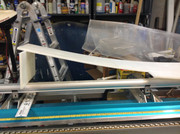
You are spot on. I've got a 10' piece of 3/8" thick, that's about 12" wide. It is quite flexible. While a half inch piece would be stiffer, I think it would be too flexible for a rudder of significant length. I assumed he laminated a thicker section to make a usable rudder (but see from the pics that he only did it at the top bracket). So, my thinking is, it probably isn't very good in sporty weather. Now, when he shortens it, it may work ok.chadwiseman wrote: ↑Sun Jan 09, 2022 11:09 am Thanks, I was equally curious about the thickness, as it seems the manufactured one is 1.5 “ vs 0.5”..
Jimmyt
P-Cub-Boo
2013 26M, Etec 60, roller Genoa, roller main
Cruising Waters: Mobile Bay, Western Shore, Fowl River
P-Cub-Boo
2013 26M, Etec 60, roller Genoa, roller main
Cruising Waters: Mobile Bay, Western Shore, Fowl River
-
OverEasy
- Admiral
- Posts: 2895
- Joined: Mon Sep 28, 2020 11:16 am
- Sailboat: MacGregor 26X
- Location: NH & SC
Re: Rudder depth
I wonder with that amount of deflection, and not having a foil shape, if the existing rudder was experiencing flutter when more heavily loaded?
Maybe even twist in a fast tack?
Just wondering…..
Best Regards
Over Easy
Maybe even twist in a fast tack?
Just wondering…..
Best Regards
Over Easy
Re: Rudder depth
The rudder is stiff. I can't bend it more than an inch. The only reason I made it thicker at the top was so it fitted the 1-1/2" opening the same as the original rudder. I'd say this solid rudder is a lot stronger than the rotted original which was just a very thin skin of fiberglass over a SOFT wood frame. I could have extended the laminations further down but it's not needed and would make the rudder very heavy.
-
OverEasy
- Admiral
- Posts: 2895
- Joined: Mon Sep 28, 2020 11:16 am
- Sailboat: MacGregor 26X
- Location: NH & SC
Re: Rudder depth
Hi Warren631
That’s great!
Stronger than I thought!
This could be a great DIY replacement for a variety of MacGregors!
Maybe you could make a post in the MacGregor Mod section?
That way when others come to a point where they need a replacement rudder(s) they can have an alternative option.
Make mention about its real world stiffness too!
Nice!
Best Regards
Over Easy
That’s great!
Stronger than I thought!
This could be a great DIY replacement for a variety of MacGregors!
Maybe you could make a post in the MacGregor Mod section?
That way when others come to a point where they need a replacement rudder(s) they can have an alternative option.
Make mention about its real world stiffness too!
Nice!
Best Regards
Over Easy
Last edited by OverEasy on Fri Feb 25, 2022 8:23 am, edited 1 time in total.
Re: Rudder depth
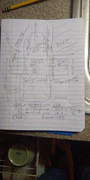
I'm thinking of shortening my HDPE custom rudder by cutting 26" off the bottom and attaching this 26" x 12" piece across the bottom using HDPE epoxy and SS screws as indicated in attached sketch so 20" is behind and 6" is in front of the pivot axis giving a balance of 30%. The square inches in the water would be the same but the depth would be 26" less.
Any comments?
Any comments?