


Electric trolling motor mounted on the engine cover.
The controls removed and mounted on the console. Power for motor from starter wires.
I’ll do this eventually if I don’t end up getting a smaller boat.
Ix
Auxiliary outboard for 26M
-
dustoff

- Engineer
- Posts: 108
- Joined: Sat Jul 31, 2010 6:25 am
- Sailboat: MacGregor 26M
- Location: Stevensville, MD
Re: Auxiliary outboard for 26M
Rather than going to the trouble of mounting a backup motor to the transom of a 26M (not a lot of good options), for those that have dinghies w/ motors and rear davits why not just set up a tender aux power system that you can rig as a contingency in a pinch. This is how the Maryland Skipjacks power their historical boats without altering the original designs with installed engines.

-
OverEasy
- Admiral
- Posts: 2977
- Joined: Mon Sep 28, 2020 11:16 am
- Sailboat: MacGregor 26X
- Location: NH & SC
Re: Auxiliary outboard for 26M
Hi Kurz!
You bring up a good point!
If done properly one could possibly use a stand off type mounting, if done properly.
The key is to understand all the forces involved with an operational kicker or auxiliary engine being transferred to the boat hull.
If one can design it and implement it to provide sufficient rigidity and surface are reinforcement to handle the force loads then that good!
The challenge is the stern hull wall thickness isn’t all that thick… so one will need to disaster those forces with sufficiently sized load washers or plates. On the aft face of the stern for forward travel and in the interior aft stern face for reverse.
The bolts woul need sufficient rigidity and stability to take lateral forces due to turning forces imposed.
There are also the moment arm magnifying load forces generated by the distance from the prop line up to the motor mount.
( a 1 lb force at 3 feet generates 3 ft-lb of force. 5 hp of thrust at prop line would generate 15 hp of moment at the mount.
Then there are the vibratory load transmissions which can shake things up a bit.
This is why the aspect of creating a contour fitting load plate come into play.
The one piece plate will generally take up a sufficient area to distribute the forward thrust & moment loads and at the same time should take up the lateral loads as well with the least amount of stand-off distance from the hull. One would still need to make a backing plate to distribute the loads rearward.
It’s really a preference call for simplicity vs complexity based on your perspectives
Best Regards,
Over Easy
You bring up a good point!
If done properly one could possibly use a stand off type mounting, if done properly.
The key is to understand all the forces involved with an operational kicker or auxiliary engine being transferred to the boat hull.
If one can design it and implement it to provide sufficient rigidity and surface are reinforcement to handle the force loads then that good!
The challenge is the stern hull wall thickness isn’t all that thick… so one will need to disaster those forces with sufficiently sized load washers or plates. On the aft face of the stern for forward travel and in the interior aft stern face for reverse.
The bolts woul need sufficient rigidity and stability to take lateral forces due to turning forces imposed.
There are also the moment arm magnifying load forces generated by the distance from the prop line up to the motor mount.
( a 1 lb force at 3 feet generates 3 ft-lb of force. 5 hp of thrust at prop line would generate 15 hp of moment at the mount.
Then there are the vibratory load transmissions which can shake things up a bit.
This is why the aspect of creating a contour fitting load plate come into play.
The one piece plate will generally take up a sufficient area to distribute the forward thrust & moment loads and at the same time should take up the lateral loads as well with the least amount of stand-off distance from the hull. One would still need to make a backing plate to distribute the loads rearward.
It’s really a preference call for simplicity vs complexity based on your perspectives
Best Regards,
Over Easy
-
dustoff
- Engineer
- Posts: 108
- Joined: Sat Jul 31, 2010 6:25 am
- Sailboat: MacGregor 26M
- Location: Stevensville, MD
Re: Auxiliary outboard for 26M
Wow, that’s a lot of engineering. I was thinking quite a bit simpler. Every boat already has the thrust forces distributed across the transom with the existing outboard mount. So just configure a way to lock the dinghy bow to the lower unit of the (presumably non-functional) outboard and two steering lines (3:1 blocks) on the stern cleats of the dinghy. A throttle control from the dinghy outboard to the boat would be pretty useful. Probably a boat hook could be jury rigged for that.
-
OverEasy
- Admiral
- Posts: 2977
- Joined: Mon Sep 28, 2020 11:16 am
- Sailboat: MacGregor 26X
- Location: NH & SC
Re: Auxiliary outboard for 26M
Hi Dustoff!
The transom on the Max26X and Mac26M is reinforced in the center section with a integrated backing plate to help distribute the engine forces over a broader area that rather quickly tapers down to about 3/16” at the side corners (at least on our Mac26X) as the hull wraps around.
The imbedded factory mount plate really isn’t all that big… just slightly larger than a standard engine mount.
It’s why when going to larger than originally spec’d engines it is advisable to increase the mount area with a larger plate to better distribute the main engine forces over a larger area.
Simply making holes and inserting bolts for a kicker/auxiliary engine in this thinner material will make stressors and will probably eventually lead to cracking due to the kicker/auxiliary motor forces and vibration (which is dependent upon how it is operated).
Making a conforming backing plate isn’t all that difficult or complex yet will provide a huge benefit in load distribution at least when providing forward thrust. This thicker section would also stabilize the bolts to keep the lateral forces in check. An interior/internal conformal backing plate of similar size would provide the force distribution when operating the kicker/auxiliary engine in reverse.
If attempting to do this with just bolts instead of plates one would need to add some type of internal and external conformal washers of sufficient size to disapate the forces over area and allow for alignment of the penetrating bolts. There is then the lateral forces which will be attempting to lean the bolts sideways but with a limited contact footprint to adequately resolve the forces.
Either method can work reliably and robustly if the details are adequately addressed.
One could also wing it and hope it miraculously works out… Generally the results don’t meet expectations.
Best Regards,
Over Easy
The transom on the Max26X and Mac26M is reinforced in the center section with a integrated backing plate to help distribute the engine forces over a broader area that rather quickly tapers down to about 3/16” at the side corners (at least on our Mac26X) as the hull wraps around.
The imbedded factory mount plate really isn’t all that big… just slightly larger than a standard engine mount.
It’s why when going to larger than originally spec’d engines it is advisable to increase the mount area with a larger plate to better distribute the main engine forces over a larger area.
Simply making holes and inserting bolts for a kicker/auxiliary engine in this thinner material will make stressors and will probably eventually lead to cracking due to the kicker/auxiliary motor forces and vibration (which is dependent upon how it is operated).
Making a conforming backing plate isn’t all that difficult or complex yet will provide a huge benefit in load distribution at least when providing forward thrust. This thicker section would also stabilize the bolts to keep the lateral forces in check. An interior/internal conformal backing plate of similar size would provide the force distribution when operating the kicker/auxiliary engine in reverse.
If attempting to do this with just bolts instead of plates one would need to add some type of internal and external conformal washers of sufficient size to disapate the forces over area and allow for alignment of the penetrating bolts. There is then the lateral forces which will be attempting to lean the bolts sideways but with a limited contact footprint to adequately resolve the forces.
Either method can work reliably and robustly if the details are adequately addressed.
One could also wing it and hope it miraculously works out… Generally the results don’t meet expectations.
Best Regards,
Over Easy
-
Jimmyt
- Admiral
- Posts: 3402
- Joined: Sat Jul 18, 2015 9:52 am
- Sailboat: MacGregor 26M
- Location: Mobile AL 2013 26M, 60 Etec
Re: Auxiliary outboard for 26M
Although it’s not in the exact spot for a kicker mount, you can see that the transom on the M is about 3/8” thick; once you’re away from the main outboard mount.
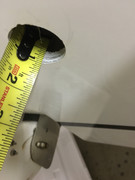
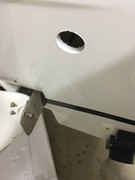
Kicker minimum size depends on what the weather conditions are. If it’s calm, a small kicker will get it done. If it’s a good blow, and you’re trying to beat into it, you’re going to need something bigger.
Starting, steering, and throttle control are other issues you’ll have to work out.
For the mount, I’d make a wooden block (something dense and reasonably rot resistant) conforming to the hull shape, for the outside; and use some aluminum or stainless plate on the inside. I’d coat the wood in epoxy and bed it to the hull with 5200.
But, I don’t intend to install a kicker.
Kicker minimum size depends on what the weather conditions are. If it’s calm, a small kicker will get it done. If it’s a good blow, and you’re trying to beat into it, you’re going to need something bigger.
Starting, steering, and throttle control are other issues you’ll have to work out.
For the mount, I’d make a wooden block (something dense and reasonably rot resistant) conforming to the hull shape, for the outside; and use some aluminum or stainless plate on the inside. I’d coat the wood in epoxy and bed it to the hull with 5200.
But, I don’t intend to install a kicker.
Jimmyt
P-Cub-Boo
2013 26M, Etec 60, roller Genoa, roller main
Cruising Waters: Mobile Bay, Western Shore, Fowl River
P-Cub-Boo
2013 26M, Etec 60, roller Genoa, roller main
Cruising Waters: Mobile Bay, Western Shore, Fowl River