


I use a 13 lb Danforth with 15' chain. Never drifted. The key is to let out a lot of rode.. 5 x depth or 7 x depth if there is wind or heavy current. The bottoms of places I've sailed are mud or sand. Perhaps rocks would merit a different type anchor but I'm very happy with mine. Looks like the one on kmclemore's picture.
Cheers,
Type and Size of Anchor
-
Duane Dunn, Allegro

- Admiral
- Posts: 2459
- Joined: Fri Jan 02, 2004 6:41 pm
- Sailboat: MacGregor 26X
- Location: Bellevue, Wa '96 26x, Tohatsu 90 TLDI and Plug In Hybrid Electric drive
- Contact:
I often use my Guardian G-16 as a land anchor. (The Guardian is the cheaper cousin to the Fortress. Both are Aluminum Danforth style anchors.) IT's light weight makes it easy to handle in the dingy.
The year before last when we made our 3 week trip up into Canada we discovered how great shore ties can be. Most of their anchorages up there have rings mounted on shore around the anchorages. You drop your anchor out toward the middle, then back in toward shore when setting. Then you take a shore tie attached to one stern cleat in to the ring and bring it back to the other stern cleat. This eliminates all swinging and lets many more boats fit in a small harbor. We carried a 400' spool of 3/8 poly for this and it worked great. When you depart you just let loose from the cleat and line can be pulled in without going to shore. We have also used this around trees when rings were not available.
Last year I used a variant of this a few times with the Guardian. I'd set the Claw and back in to shore. Then I'd put the Guardian in the dingy and take it to the beach. Just push it into the beach with your feet. The rode for the Guardian would run from the bow along the side of the boat and make a stop at a stern cleat on it's way to the beach. Once cleated there you can even power forward on it to set the anchor on the beach. When possible I try to set the anchor below the high tide line. This way at high tide on the day you are departing you can fall back on the bow anchor and pull up the shore anchor without going to the beach.
I also use this approach in what I guess you could call a submerged shore tie. I'll set the Claw off the bow, then fall back toward the beach to the max end of the rode. There I'll drop the Guardian and then pull back in to the center point setting it . Keep the rodes fairly snug and the bow of the boat will be parked in one spot but still swing with the wind. For even a more stable parking spot, you can let out a little slack in the aft anchor rode and cleat it on a stern cleat to eliminate all swinging. Often I'll do this to keep the bow pointed into any waves or wakes when the wind would point me at a different angle to the rollers.
The year before last when we made our 3 week trip up into Canada we discovered how great shore ties can be. Most of their anchorages up there have rings mounted on shore around the anchorages. You drop your anchor out toward the middle, then back in toward shore when setting. Then you take a shore tie attached to one stern cleat in to the ring and bring it back to the other stern cleat. This eliminates all swinging and lets many more boats fit in a small harbor. We carried a 400' spool of 3/8 poly for this and it worked great. When you depart you just let loose from the cleat and line can be pulled in without going to shore. We have also used this around trees when rings were not available.
Last year I used a variant of this a few times with the Guardian. I'd set the Claw and back in to shore. Then I'd put the Guardian in the dingy and take it to the beach. Just push it into the beach with your feet. The rode for the Guardian would run from the bow along the side of the boat and make a stop at a stern cleat on it's way to the beach. Once cleated there you can even power forward on it to set the anchor on the beach. When possible I try to set the anchor below the high tide line. This way at high tide on the day you are departing you can fall back on the bow anchor and pull up the shore anchor without going to the beach.
I also use this approach in what I guess you could call a submerged shore tie. I'll set the Claw off the bow, then fall back toward the beach to the max end of the rode. There I'll drop the Guardian and then pull back in to the center point setting it . Keep the rodes fairly snug and the bow of the boat will be parked in one spot but still swing with the wind. For even a more stable parking spot, you can let out a little slack in the aft anchor rode and cleat it on a stern cleat to eliminate all swinging. Often I'll do this to keep the bow pointed into any waves or wakes when the wind would point me at a different angle to the rollers.
-
Chinook

- Admiral
- Posts: 1730
- Joined: Sun Feb 26, 2006 7:20 pm
- Location: LeavenworthWA 2002 26x, Suzuki DF60A
Hi Duane,Duane Dunn, Allegro wrote:I often use my Guardian G-16 as a land anchor. (The Guardian is the cheaper cousin to the Fortress. Both are Aluminum Danforth style anchors.) IT's light weight makes it easy to handle in the dingy.
The year before last when we made our 3 week trip up into Canada we discovered how great shore ties can be. Most of their anchorages up there have rings mounted on shore around the anchorages. You drop your anchor out toward the middle, then back in toward shore when setting. Then you take a shore tie attached to one stern cleat in to the ring and bring it back to the other stern cleat. This eliminates all swinging and lets many more boats fit in a small harbor. We carried a 400' spool of 3/8 poly for this and it worked great. When you depart you just let loose from the cleat and line can be pulled in without going to shore. We have also used this around trees when rings were not available.
Last year I used a variant of this a few times with the Guardian. I'd set the Claw and back in to shore. Then I'd put the Guardian in the dingy and take it to the beach. Just push it into the beach with your feet. The rode for the Guardian would run from the bow along the side of the boat and make a stop at a stern cleat on it's way to the beach. Once cleated there you can even power forward on it to set the anchor on the beach. When possible I try to set the anchor below the high tide line. This way at high tide on the day you are departing you can fall back on the bow anchor and pull up the shore anchor without going to the beach.
I also use this approach in what I guess you could call a submerged shore tie. I'll set the Claw off the bow, then fall back toward the beach to the max end of the rode. There I'll drop the Guardian and then pull back in to the center point setting it . Keep the rodes fairly snug and the bow of the boat will be parked in one spot but still swing with the wind. For even a more stable parking spot, you can let out a little slack in the aft anchor rode and cleat it on a stern cleat to eliminate all swinging. Often I'll do this to keep the bow pointed into any waves or wakes when the wind would point me at a different angle to the rollers.
This sounds like what's described as the Bahamian moor, which is frequently used down there, where winds and currents often reverse. With both the bow and stern anchor lines cleated at the bow, the boat does indeed stay put in one small patch of water, regardless of a wind or current shift. One thing about this anchoring style though. If other boats are anchored nearby, all have to use the same method, otherwise a boat swinging conventionally on a single anchor could easily tangle with the boat using the Bahamian style of anchoring.
-
James V
- Admiral
- Posts: 1705
- Joined: Sat Jan 22, 2005 9:33 am
- Sailboat: MacGregor 26M
- Location: Key West, Fl USA, 26M 06, Merc 50hp BF "LYNX"
I have a 13 pound Fluke. I went from a 6 foot plastic covered chain to a 25 foot 5/16" chain. The boat rode a lot better with the 25' of chain and it cleaned off better and set better.
I did find that it draged 3 time on me. 1 time because of grass, another becuase of a shell in the fluke, another because I did not let out enough line.
I did find that it draged 3 time on me. 1 time because of grass, another becuase of a shell in the fluke, another because I did not let out enough line.
-
craigsmith

- Just Enlisted
- Posts: 15
- Joined: Wed May 31, 2006 3:35 am
- Location: Auckland, New Zealand
- Contact:
Re: Type and Size of Anchor
Hi all. Sorry for dragging up an old thread but I wanted to pick up on the broad encouragement to use Danforths, or Danforth-types (Fortress etc).Lovekamp wrote:My family has always done daysailing or overnighting in a marina in our prior boat. This year, we are planning to do some true cruising. What type and weight of anchors have readers had good luck with? I'm used to Danforths, but would a plow on a roller work better?
Danforths were designed during the war for temporary use on seaplanes. They are not good anchors to use as primaries, unless you are willing and able to deal with your pick dragging even once set. They offer good holding power for their weight, but better alternatives exist, and such a measure is not the be-all and end-all of anchors.
A Danforth-type will give very unpredictable setting performance on weed or hard seabeds (very hard sand etc). Once they start moving, they will "plane" across the bottom and not bite, and you must stop and try again.
Once set, they do not like the load on them being veered. If your boat swings around, it will most likely pull a Danforth out, and then you left with an anchor that doesn't set reliably as described above.
In straight line terms, Danforths are not roll-stable. This means that once they start to move, they pull out completely and are unlikely to re-set as the boat gathers speed. A good anchor will remain buried even as it drags, so even if a strong gust moves it, the boat will remain secure.
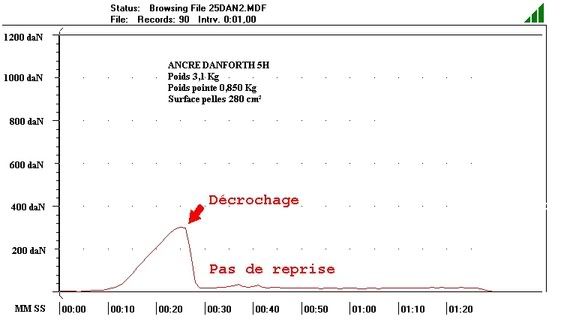
Courtesy M Poiraud of SPADE
A good anchor will remain embedded and the resistance will increase, not drop to zero!
Lastly, Danforths are rather fragile anchors, and while that might not overly concern you guys with your MacGregors, it means they're not to be used around rock or coral, where the flukes will easily get caught and bend under shock loads.
Just a brief overview.
A good modern anchor that addresses some of the issues of the Danforth, while remaining fairly similar in concept, is the Bulwagga. See here: http://www.noteco.com/bulwagga/
That's not necessarily true, if you considering boats of a similar size (it is true that what applies to a MacGregor does not apply to an aircraft carrier) and you want a "general purpose anchor". Traditionally there is no such thing, so you need to carry half a dozen different types to meet all the possible scenarios.Lovekamp wrote:Everything I have read says "it depends on the boat, the weather and the anchorage", but obviously in a Mac, it's not possible to carry twenty different anchors, so I'm hoping to find which two types and weights of those types would be the most useful.
However the argument of carrying a claw, articulating plow, Danforth, and fisherman's, each to address the problems of the others, is nonsense nowadays, because it is possible to consolidate the weight into perhaps two anchors that will more reliably and safely meet all requirements. More may be carried as required, but are not needed to compensate for the poor aspects of the others.
 Research: WASI, Bulwagga, Spade, Rocna.
Last comment: a lot of you guys don't seem to be using much chain. A general rule of thumb is to have a chain leader the length of which should be at least that of the boat. More is better. Applies to any anchor.James V wrote:I have a 13 pound Fluke. I went from a 6 foot plastic covered chain to a 25 foot 5/16" chain. The boat rode a lot better with the 25' of chain and it cleaned off better and set better.
---------------------------------------
Craig Smith
Rocna Anchors
www.rocna.com
-
ssichler

- First Officer
- Posts: 342
- Joined: Thu May 04, 2006 9:22 am
- Location: Redondo Beach, CA 06 M 60hp E-Tec
Charles Kanter's book "Cruising on Multihulls" has an excellent chapter on anchoring where he discusses old school approach of "weight is great" lots of chain vs. high-tech school of modern three-strand nylon and new anchors. According to him mulithulls and modern light displacement boats have the most to gain from high-tech anchoring. He leans towards the Delta anchor and Brian Fagan in "Cruising guide to Central and Southern California" also recommended the Delta for Catalina due to holding in rocky areas. I scuba dive from my boat in rocky areas of PV and Catalina during lobster season because that's where the bugs are so I picked up a 15# Delta. If anyone is interested PM with your email and I can forward a pdf on anchoring.
-
Frank C
Craig Smith,
Nice to see your info contribution, and welcome aboard. I have watched your video a couple of times, most recently from Blanton's link, and found it very convincing. If I didn't already have a Bulwagga 17, I'd sign up with Rocna.
My Bull serves well and fits on my Bruce bow roller ... but yours would "look" better up there!
I understand your cautions about the fluke (Guardian-6 is my #2). It held our 2-boat raft marvelously in a storm one night - but with an aft line to a beach stake.
Our Macs are about 3,000# loaded, 4,500 loaded & ballasted.
If you care to opine, how would you contrast these two anchors:
- Would Rocna-13 serve like the Bul-17 (w/ great price advantage)?
- Do they serve in complementary mode as a 1-2 combo?
- Or rather, do they pretty much serve for identical conditions?
BTW, I was using 15' of small chain with the Bull, but I found it a hassle, and quite punishing across the roller & foredeck. I'm much happier with just 6 feet of 3/8" chain - weighs even more than the smaller chain, but less chain length to clean and manage. I found a catenary spreadsheet that reveals that the weight of chain is the function bearing on catenary and holding power, not the length. The same algorithm reveals that a 12-pound kellet (for our Mac hulls), hanging about 1x depth along our 5x or 7x rode, will triple the holding benefit of our chain leader and rode!
Edit-to-add links:
This previous thread discussed anchoring catenary & advantages of kellet, and this post
showed the calcs ... shorter lengths of bigger, beefier, heavier chain - you might like it!
Nice to see your info contribution, and welcome aboard. I have watched your video a couple of times, most recently from Blanton's link, and found it very convincing. If I didn't already have a Bulwagga 17, I'd sign up with Rocna.
My Bull serves well and fits on my Bruce bow roller ... but yours would "look" better up there!
I understand your cautions about the fluke (Guardian-6 is my #2). It held our 2-boat raft marvelously in a storm one night - but with an aft line to a beach stake.
Our Macs are about 3,000# loaded, 4,500 loaded & ballasted.
If you care to opine, how would you contrast these two anchors:
- Would Rocna-13 serve like the Bul-17 (w/ great price advantage)?
- Do they serve in complementary mode as a 1-2 combo?
- Or rather, do they pretty much serve for identical conditions?
BTW, I was using 15' of small chain with the Bull, but I found it a hassle, and quite punishing across the roller & foredeck. I'm much happier with just 6 feet of 3/8" chain - weighs even more than the smaller chain, but less chain length to clean and manage. I found a catenary spreadsheet that reveals that the weight of chain is the function bearing on catenary and holding power, not the length. The same algorithm reveals that a 12-pound kellet (for our Mac hulls), hanging about 1x depth along our 5x or 7x rode, will triple the holding benefit of our chain leader and rode!
Edit-to-add links:
This previous thread discussed anchoring catenary & advantages of kellet, and this post
showed the calcs ... shorter lengths of bigger, beefier, heavier chain - you might like it!
Last edited by Frank C on Wed May 31, 2006 2:24 pm, edited 3 times in total.
-
Harrison

- First Officer
- Posts: 307
- Joined: Tue Jan 04, 2005 12:57 pm
- Location: Frederick, CO. '05 M, Merc 60 Bigfoot
Seeing this thread reminds me of this past Memorial day weekend at Lake McConaughy in Nebraska. The wife & I take a short (3 hour) trip to this unfamiliar lake for good ole fun and quiet. Weather report calls for a nice weekend. (Warning warning!)
Saturday night we anchor on the north side. Wind comes up and swells are 1-2 feet, all night long. . . wife is not too happy. (Wind decided to come from the south) Sunday late afternoon its calm and peaceful. We anchor in a cove on the south side. (Im going to be smarter this time) We're in 14 feet of water so I toss out my 22lbs Lewmar Delta, with 25 of 5/16 chain, and pay out about 70 of 3/8 nylon rode. After a great dinner and doing dishes, we plug in a DVD. Not 5 seconds after pressing play the boat heels at least 30deg. I think oh S#@%" the anchor dragged and were in the rocks! I open the slider only to duck just in the nick of time, as an 8 footer clears the bow pulpit. I turn on the VHF. The NOAA weather radio was broadcasting a high wind warning for the area. . . Winds at 30-40 mph with gusts to 55 mph. This kept up all night until after we left the lake the following day.
All night while both of us were tossing our dinner over the side, I couldnt keep my mind off the anchor. At any time with constant 6-8+ foot waves pounding us, I just knew that we were going to be in the rocks. If Id have known, Id have paid out much, much more. What seemed like an eternity, by 8:00am we decide to pull up and head out of this Perfect Storm set. Low and behold, she held like there was no tomorrow. (At a time or two, I didnt think there WAS going to be a tomorrow.) I cant say enough good things about the combination of that anchor AND the amount of chain.
Im another believer, a Mac is much tougher than the crew.
---Harrison
Saturday night we anchor on the north side. Wind comes up and swells are 1-2 feet, all night long. . . wife is not too happy. (Wind decided to come from the south) Sunday late afternoon its calm and peaceful. We anchor in a cove on the south side. (Im going to be smarter this time) We're in 14 feet of water so I toss out my 22lbs Lewmar Delta, with 25 of 5/16 chain, and pay out about 70 of 3/8 nylon rode. After a great dinner and doing dishes, we plug in a DVD. Not 5 seconds after pressing play the boat heels at least 30deg. I think oh S#@%" the anchor dragged and were in the rocks! I open the slider only to duck just in the nick of time, as an 8 footer clears the bow pulpit. I turn on the VHF. The NOAA weather radio was broadcasting a high wind warning for the area. . . Winds at 30-40 mph with gusts to 55 mph. This kept up all night until after we left the lake the following day.
All night while both of us were tossing our dinner over the side, I couldnt keep my mind off the anchor. At any time with constant 6-8+ foot waves pounding us, I just knew that we were going to be in the rocks. If Id have known, Id have paid out much, much more. What seemed like an eternity, by 8:00am we decide to pull up and head out of this Perfect Storm set. Low and behold, she held like there was no tomorrow. (At a time or two, I didnt think there WAS going to be a tomorrow.) I cant say enough good things about the combination of that anchor AND the amount of chain.
Im another believer, a Mac is much tougher than the crew.
---Harrison

-
Erik Hardtle

- First Officer
- Posts: 408
- Joined: Sat Jan 03, 2004 4:45 am
- Sailboat: MacGregor 26X
- Location: New Bern, NC
- Contact:
A little different
Always wanting to just be a little different... I have always used a Navy type anchor on all my sailboats... I have a 15 and 20 pound on board... I keep the 20lb up front in the locker and the 15lb next to the gas tank.I have found that they work everywhere and they fit in the anchor locker easily. I have 50 feet of rope on the front and 25 on the back. Heck the weight alone helps in the strong current areas I anchor in.

Here is the Link: http://www.bartswatersports.com/catalog.asp?P=276
... and the workout of lifting it is good exercise for the wife
Erik
"Knot Shore"
Here is the Link: http://www.bartswatersports.com/catalog.asp?P=276
... and the workout of lifting it is good exercise for the wife
Erik
"Knot Shore"
-
Dimitri-2000X-Tampa

- Admiral
- Posts: 2043
- Joined: Fri Jan 02, 2004 5:36 am
- Sailboat: MacGregor 26X
- Location: Tampa, Florida 2000 Mercury BigFoot 50HP 4-Stroke on 26X hull# 3575.B000
Danforths may not be good for rocky or weedy bottoms, but with our pristine sandy West Florida bottoms I think a Danforth works very well. I just have the Guardian G-11 as my primary anchor. It fits in the anchor locker. Like Frank, I use 6 feet of heavier chain. The chain weighs much more than the anchor. I always set a stern anchor or tie to the shore. Can't stand the swinging otherwise.
One evening a year or two ago, we pulled into the Shell key lagoon to spend the night. It was supposed to be a calm and clear evening. Instead, around 10-11 PM, a nasty rain storm squall came through. Didn't put my meter on it, but the way the wind was making the rigging shriek, I figure winds were 35-40 and I had only set out about a 6:1 scope thinking it was gonna be a calm night. I had the stern tied off to some mangrove roots. The boat stayed fast all night long despite the 2-3 foot wind driven surge of water which completely covered the mangroves in the night but was gone in the clear morning. Next day, it seemed I had to pull that anchor out from 1 foot underground ... it was stuck in there so hard. After that experience, I had a lot more respect for my aluminum Danforth.
One evening a year or two ago, we pulled into the Shell key lagoon to spend the night. It was supposed to be a calm and clear evening. Instead, around 10-11 PM, a nasty rain storm squall came through. Didn't put my meter on it, but the way the wind was making the rigging shriek, I figure winds were 35-40 and I had only set out about a 6:1 scope thinking it was gonna be a calm night. I had the stern tied off to some mangrove roots. The boat stayed fast all night long despite the 2-3 foot wind driven surge of water which completely covered the mangroves in the night but was gone in the clear morning. Next day, it seemed I had to pull that anchor out from 1 foot underground ... it was stuck in there so hard. After that experience, I had a lot more respect for my aluminum Danforth.
-
craigsmith
- Just Enlisted
- Posts: 15
- Joined: Wed May 31, 2006 3:35 am
- Location: Auckland, New Zealand
- Contact:
If you check out our sizing chart (website and select "sizing recommendations") you will see that technically we recommend a Rocna 10 (22lb). However we are quite conservative with our sizing, and the 6 (13lb) would be adequate most of the time. Just depends on whether you're the kind of sailor who goes day-sailing and never sees more than 20 knots, or deliberately gets lost and expects his boat and ground tackle to be able to handle the 50 knot gusts when they come.Frank C wrote:Craig Smith,
Nice to see your info contribution, and welcome aboard. I have watched your video a couple of times, most recently from Blanton's link, and found it very convincing. If I didn't already have a Bulwagga 17, I'd sign up with Rocna.
My Bull serves well and fits on my Bruce bow roller ... but yours would "look" better up there!
I understand your cautions about the fluke (Guardian-6 is my #2). It held our 2-boat raft marvelously in a storm one night - but with an aft line to a beach stake.
Our Macs are about 3,000# loaded, 4,500 loaded & ballasted.
If you care to opine, how would you contrast these two anchors:
- Would Rocna-13 serve like the Bul-17 (w/ great price advantage)?
- Do they serve in complementary mode as a 1-2 combo?
- Or rather, do they pretty much serve for identical conditions?
The Rocna and Bulwagga are difficult to compare like-for-like, as the Rocna is designed to be a bullet-proof general purpose anchor, and the Bulwagga is still a "fluke style" such as a Danforth (flat blades with no shape, albeit in a much superior arrangement). The Bulwagga is a great replacement for Danforth styles, but it won't stand up to being knocked around in the way that a more solid anchor will.
Not sure what you mean complementary Frank? Do you mean using both together? Tandem / dual? Or just having both onboard, one as primary one as auxillary / stern anchor? In which case, yes that would have to be ideal.
Yes, you get more benefit from putting weight closer to the anchor. Be careful about your anchoring conditions in that case though, as the chain has other benefits apart from catenary. Using such a short length of chain will see the rope rubbing up against the seabed, and in rock or coral that can be disastrous. A greater length of chain also helps reduce shock-loading on the anchor and boat.Frank C wrote:BTW, I was using 15' of small chain with the Bull, but I found it a hassle, and quite punishing across the roller & foredeck. I'm much happier with just 6 feet of 3/8" chain - weighs even more than the smaller chain, but less chain length to clean and manage. I found a catenary spreadsheet that reveals that the weight of chain is the function bearing on catenary and holding power, not the length. The same algorithm reveals that a 12-pound kellet (for our Mac hulls), hanging about 1x depth along our 5x or 7x rode, will triple the holding benefit of our chain leader and rode!
Kellets do not significantly increase the ultimate holding power of the anchor, although they can be useful in relatively moderate conditions. Frank the calculations on that thread are a little misleading. Rather than go off-topic perhaps you could bump that thread if you want to debate it further. In the meantime take a look at this: http://alain.fraysse.free.fr/sail/rode/ ... forces.htm , and consider the section on kellets plus the conclusions.
As DLT correctly thought, I am a representative of Rocna - I don't have a MacGregor. As far as sizing is concerned, see above.Idle Time wrote:Craigsmith...what size Rocna are you using. The 22# is a bit pricey...of course, if the 13# drags then I didnt spend enough.
But that's not different, it's the same as every other captain during the 19th centuryErik Hardtle wrote:Always wanting to just be a little different... I have always used a Navy type anchor on all my sailboats... I have a 15 and 20 pound on board... I keep the 20lb up front in the locker and the 15lb next to the gas tank.
 and without meaning to offend, that history is the only way such anchors are sold - punters see what they consider an iconic anchor, and buy it without considering why every small boat anchor design for the last 100 years has moved away from this type. The first one was the CQR back in 1933 - it's raison d'etre the realization that scaling down big ships' anchors didn't really work!
Compare the fluke area of a Navy style anchor to a more modern design on a weight for weight basis, and you will see the problem.
The fact that those anchors are painted or plasticized should also provide some hints that the anchors are not intended to be used in anger. Paint will not last when the anchor is used seriously - you will not see any Navy ships with pink anchors!
---------------------------------------
Craig Smith
Rocna Anchors
www.rocna.com
-
Divecoz

- Admiral
- Posts: 3803
- Joined: Sat Oct 16, 2004 2:54 pm
- Sailboat: MacGregor 26M
- Location: PORT CHARLOTTE FLORIDA 05 M Mercury 50 H.P. Big Foot Bill at Boats 4 Sail is my Hero
Most often Chip
Chip Hindes wrote:Not to put you off, but I'd say this horse has been pretty well beaten to death - several times. Try the search feature; a search on "anchor" returns 603 hits.
IMHO the # 603 Is the problem . . . Your search resulted in 2,084,762,541,849,606 post If you get my point . I looked for the multi Fuel Tanks thread a LOT till FrankC and someone else headed me in the right direction .