Lovekamp wrote:My family has always done daysailing or overnighting in a marina in our prior boat. This year, we are planning to do some true cruising. What type and weight of anchors have readers had good luck with? I'm used to Danforths, but would a plow on a roller work better?
Hi all. Sorry for dragging up an old thread but I wanted to pick up on the broad encouragement to use Danforths, or Danforth-types (Fortress etc).
Danforths were designed during the war for temporary use on seaplanes. They are
not good anchors to use as primaries, unless you are willing and able to deal with your pick dragging even once set. They offer good holding power for their weight, but better alternatives exist, and such a measure is not the be-all and end-all of anchors.
A Danforth-type will give very unpredictable setting performance on weed or hard seabeds (very hard sand etc). Once they start moving, they will "plane" across the bottom and not bite, and you must stop and try again.
Once set, they do not like the load on them being veered. If your boat swings around, it will most likely pull a Danforth out, and then you left with an anchor that doesn't set reliably as described above.
In straight line terms, Danforths are not roll-stable. This means that once they start to move, they pull out completely and are unlikely to re-set as the boat gathers speed. A good anchor will remain buried even as it drags, so even if a strong gust moves it, the boat will remain secure.
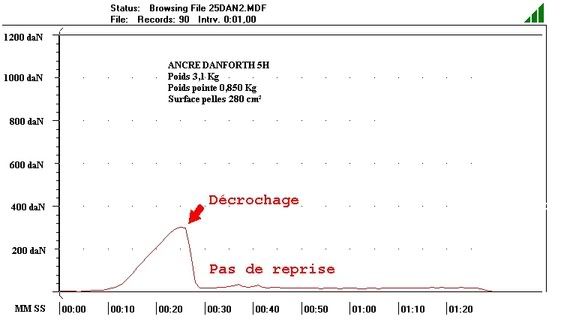 Courtesy M Poiraud of SPADE
A good anchor will remain embedded and the resistance will increase, not drop to zero!
Lastly, Danforths are rather fragile anchors, and while that might not overly concern you guys with your MacGregors, it means they're not to be used around rock or coral, where the flukes will easily get caught and bend under shock loads.
Just a brief overview.
A good modern anchor that addresses some of the issues of the Danforth, while remaining fairly similar in concept, is the Bulwagga. See here:
http://www.noteco.com/bulwagga/
Lovekamp wrote:Everything I have read says "it depends on the boat, the weather and the anchorage", but obviously in a Mac, it's not possible to carry twenty different anchors, so I'm hoping to find which two types and weights of those types would be the most useful.
That's not necessarily true, if you considering boats of a similar size (it is true that what applies to a MacGregor does not apply to an aircraft carrier) and you want a "general purpose anchor". Traditionally there is no such thing, so you need to carry half a dozen different types to meet all the possible scenarios.
However the argument of carrying a claw, articulating plow, Danforth, and fisherman's, each to address the problems of the others, is nonsense nowadays, because it is possible to consolidate the weight into perhaps two anchors that will more reliably and safely meet all requirements. More may be carried as required, but are not needed to compensate for the poor aspects of the others.

Research: WASI, Bulwagga, Spade, Rocna.
James V wrote:I have a 13 pound Fluke. I went from a 6 foot plastic covered chain to a 25 foot 5/16" chain. The boat rode a lot better with the 25' of chain and it cleaned off better and set better.
Last comment: a lot of you guys don't seem to be using much chain. A general rule of thumb is to have a chain leader the length of which should be at least that of the boat. More is better. Applies to any anchor.
---------------------------------------
Craig Smith
Rocna Anchors
www.rocna.com

 and without meaning to offend, that history is the only way such anchors are sold - punters see what they consider an iconic anchor, and buy it without considering why every small boat anchor design for the last 100 years has moved away from this type. The first one was the CQR back in 1933 - it's raison d'etre the realization that scaling down big ships' anchors didn't really work!