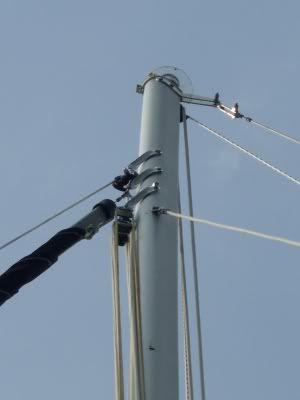
A partially Furled genoa provides somewhat poor shape even with a padded luff , attempting to reduce the unavoidable belly in reducing sail area and flattening as the wind picks up. Sheeting through, between the upper and lower shroud, will allow a better sheeting angle, but only for a limited point of sail. When sheeted between the upper and lower the spreader limits the leach and the lower limits the height of the foot if you can find a genoa track with acceptable sheeting angle that powers up and down the sails poor shape and larger headstay profile. Chafe will be a problem from many points and youll need to barberhaul the clew for position rather than improve your point of sail.
Roller Furlering a sail more than 20% will further degrade an already compromised shape; increase clew height and size of headstay windage presentation, and working with limited track and sheet block position.
From QUANTUM Sail Design Group
The questions to ask yourself are: How long do you plan to own it? How long do you expect your sails to last? What is the typical crew and sailing ability? How concerned are you about sail shape? (i.e.
are you a fiddler who hates to see other boats pass and who loves to sail upwind; or are sails just triangles somewhere up there above the bimini?) How important is ease of handling (hoisting, lowering, flaking, trimming)? Finally, how much do you have to spend? The answers will help focus the search for the appropriate level of technology.
The Inventory
The type of sails needed is a much simpler issue. For headsails, we will accept the convenience and handling safety of a roller furling system, and build as the primary sail a medium to large roller furling genoa. In choosing the size of the overlap for the genoa, we need to balance off several factors:
Size of the Foretriangle versus Mainsail Size The larger the mainsail relative to the headsails, the smaller the genoa needs to be. Check the foot length of the mainsail ("E") versus the base of the foretriangle from mast to stem ("J"). If they are equal, or if E is longer than J, the boat relies more on its mainsail for horsepower, and the jibs can be smaller.
The latest "performance" cruising boats have huge mainsails and use non-overlapping jibs as the primary sail. On the other side of the coin many older, or more traditional, cruising boats have relatively small mainsails and big "J" dimensions. These are genoa dependent, and will need larger headsails.
The length of "J" versus LP LP is the shortest straight-line distance from clew to luff. It is expressed as a percentage of "J" (150% LP = 1.5 x J). It does no relate directly to area, but is a measure of overlap. For a given percentage of overlap, you get a much bigger sail on a boat with a long J dimension.
Crew size, condition, and ability The larger, stronger, and more experienced your normal sailing companions, the better able to manage a bigger sail.
Average Sailing Conditions If you sail in San Francisco or Buzzards Bay, you won't need as much sail as if your home sailing ground is the Chesapeake Bay or Long Island Sound.
Performance Going larger (say from a 135% to a 150%) is usually only a benefit in under eight to ten knots of breeze. Additional LP is a liability in more breeze. It is also of only marginal, if any, benefit reaching and running. With sheets eased, most of the back end of a genoa is turned back into the boat. Specialty reaching genoas for racing are actually usually reduced slightly on the LP.
Ability to Partially Furl Genoas for roller furling are usually sold on the premise that they can be used partly furled. This is true from a structural standpoint, if allowances are made in the initial construction. Shape deteriorates with amount the sail is furled. Most sailmakers will quote reasonably effective reduction of up to 30% of original LP. Beyond this you have a triangle, but not much of an airfoil. When sailing off the wind this probably isn't that important, but is if you want to go upwind. The bottom line is that handling and versatility considerations suggest keeping the genoa as small as possible. Build only enough size to maintain the ability to drive the boat reasonably well in light to moderate conditions. The more easily driven the boat, and the larger the mainsail relative to the headsail, the smaller the LP can be. This is even more valid if you are the type of sailor who turns the engine on when it gets light.
Clew Height The height of the clew off the deck is another issue. The higher the clew, the better the sail will be when used reaching. The sail will twist off less because the angle the sheet makes with the clew will change less. Better tension on the leech will keep the top of the sail from opening up (twisting) and luffing.
Upwind performance is better with a lower clew. A minimum clew height of 36 inches is recommended, simply so that the foot of sail always clears the lifelines, and does not have to be lifted or "skirted" every time the boat is tacked. A higher clew will also minimize the amount of water that is scooped up by the sail in big seas, and will make it a little easier to see under the sail.
Clew height is limited by the amount of genoa track. The higher the clew, the further aft the sail sheets; so size and clew height must be balanced off.