Hello,
Don't forget, the drawings above do not reflect foam flotation.
I posted my drawing of the righting moment in the mod section.
http://www.macgregorsailors.com/modt/in ... ewimg=2228
CB = center of buoyancy
CG = center of gravity
On Edit: My drawing now accounts for form stability of the hull.
My analysis:
1. Very tender upright and low angles of heel because CB and CG are so close to each other.
2 The boat hardens up at 25* heel because the CG is rotating up and the CB moves away to the leeward side. The under water shape is asymmetrical with more buoyancy leeward because of the flat bottom and chine.
3. Righting moment only increases a little as the boat heels to 45* where the under water shape is symmetrical again (chine straight down) moving the CB back to center as the CG rotates around.
4. Beyond 45* the boat begins to loose righting moment as the CG begins to rotate above the CB and the underwater shape becomes asymmetrical again moving CB back to windward. When the wind is pushing it down, it will seem to just roll easier past this point.
Lead ballasted boats tend to get harder (more righting moment) as they heel more and more especially when the ballast is real low like in the keel. But then again, they also tend to sink like a stone when they take on water.
I have never done this analysis before and find it most interesting. I had not considered that our boats may have a "tipping point" at which it will seem to want to just roll over. In my experience, only once did I have the boat over past 45*. We were close hauled on the Columbia river and suddenly found ourselves bearing down on the Washougal shoal. Depth went from 30 ft to 3 ft in short order and the only thing I could think of, to save the centerboard and rudders from the rocks, was to raise them in a hurry. I only managed to get the CB up when the wind turned us around (cuz' It wouldn't steer anymore..... DUH) and knocked us down. We slid over the rocks with only one little ding on a rudder the mast dang near horizontal. I knocked the sheets loose as we cleared it and we righted back up. Fortunately we took on no water and survived to learn the lesson. Since then I have never had it past 30* and have not felt uncomfortable but maybe from now on I will be more wary.


 Still no activity on the latest Mac episode.
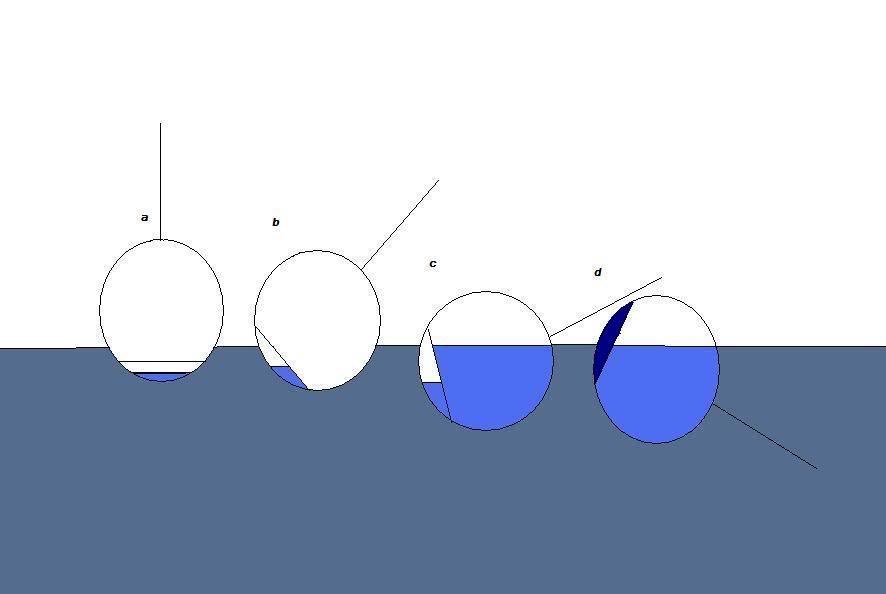
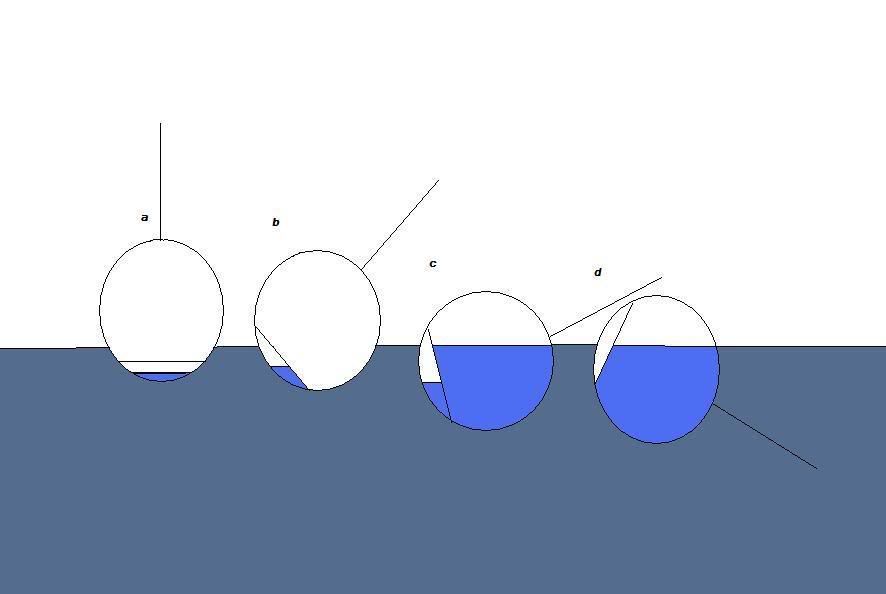 . Image C shows a partially filled ballast tank and a swamped cabin. The tank should by its own buoyancy keep the boat on its side. Image A and B show a partially filled ballast tank in the upright and heeled positions. Image D shows a fully buoyant ballast tank. I think even a partially filled tank would