I've been pretty bummed about my sailing trip and haven't been back in the boat since returning from Florida. BUT, I can update this thread since there might be some interest.
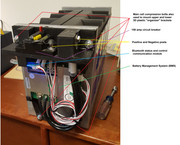
The size of the battery is 6.8" wide and the bay under the steps is 7.3" wide. I completed a wooden box to go around the battery because no off-the-shelf battery box would both hold the battery and fit under the steps. The following picture is the box using 3mm plywood and before I used several layers of fiberglass to reinforce and water proof the wood. Currently the top is still open as I wanted to use it a while and make sure all is well. I'm debating about sealing the top off with wood and fiberglass so as to eliminate risk of water intrusion. Haven't decided. The battery fits fine under the stairs and the stock wood hatch has about an inch of clearance to the battery.

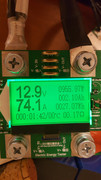
The battery went into the boat and some trivial wiring was jury-rigged so we could use the refrigerator, head fan and to charge phones and tablets for the Mug Race. The refrigerator was already filled with essentials for the trip and cooled on AC power before switching over to the battery option at April 30th. I also installed the watt meter between the fridge and battery to isolate usage just for it. However, the USB charging port I wired came loose on the trip down. Fortunately, the fridge has a USB port on it... unfortunately, that muddied the testing I was trying to do on the fridge's usage.
The fridge
viewtopic.php?f=8&t=28046&start=15 was set for 37F as we just had plenty of beer, Gatorade and snacks for the trip. No ice type requirements. It got opened quit a bit on Friday, Saturday and Sunday. I left it on and in the boat the following week to get seven days of usage. Although not opened during this period, and even though ambient wasn't in the 70's and 80's, the boat when closed up got considerably hotter.
Total usage on the battery for the 7 days was right at 120 Ah. This included composting head fan, charging three phones and a tablet a couple of times.
The fridge (and other trivial loads) averaged 8.6 watts over the seven days. Less than one of the stock bulbs in the boat.
Since turning off the fridge, the only thing on the battery is the fan that vents the composting head and an occasional Bluetooth hook up. BTW, I am currently getting these numbers from the battery from my office which is about thirty feet from boat and through three walls and the boat hull. I'm a little surprised it hooked up. The battery still has 152 Ah (56%) left. It has not been charged since placed in the boat on April 30th.
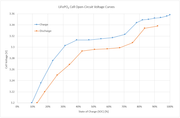
You are correct, a LiFePO4 battery has a far flatter curve and slightly higher curve for voltage as a function of SOC. The app uses the following values for estimating SOC and energy left.
14 to 14.6 volts = 100% SOC
13.6 = 80%
13.2 = 60%
12.8 = 40%
12.4 = 20%
11.2 = 0%
Unlike the bad situation of running a lead-acid battery to 0% SOC, the BMS protects the LiFePO4 battery and shuts off any load when the battery reaches this 0% SOC. This is still well above the cell manufacturers spec. Their test for 2500 cycles was drawn down to 10.0 volts.
OverEasy wrote: ↑Wed May 12, 2021 10:33 am
You previously explained the amount of draw down capacity that the LiFePO4 cells was considerably more than the SOP Lead-Acid variety’s 50% capacity before the cells start to degrade. Am I correct in recalling that the LiFePO4 voltage remains virtually constant or did I fumble this aspect?
Whereas lead-acid likes being trickle charged and kept at 100%, all lithium chemistries like to say around 50% SOC for storage. The closer you bracket around 50%, the longer the battery life is. That is why Tesla is claiming a million mile battery when it is used between 20% to 80% SOC. For this specific battery, they can be routinely charged / discharged the complete 100% SOC. Tests show doing this at 1C rates (272 Amps in this battery's case) will yield a cycle life of 2500 cycles. Because I chose to use the compression plates, this goes up to 3500 cycles. There are no tests, but predictions are multiple tens of thousands of cycles are expected at lower charge/discharge rates and bracketing the 50% SOC number and avoiding 0% and 100% SOC as much as possible. Thus, me keeping it at the 56% SOC until I next need it is the best thing for the battery.


 for the second season. One big advantage on my boat is that I only have a small outboard, a 15 HP Yamaha High Thrust. It has a lighting coil and I limited the max voltage to 14.2 Volts by fitting a different rectifier/regulator. The battery is charged by the lighting coil and two 40 Watt solar panels. We became virtually independent from shore power.

 is too confining with the Mercury BigFoot taking the entire area.
  I'm definitely more in the chaos theory / jury-rig level of designs.
 If its linear with respect to room volume...