

Portable Generator
-
mastreb

- Admiral
- Posts: 3927
- Joined: Wed Feb 09, 2011 9:00 am
- Sailboat: MacGregor 26M
- Location: Cardiff by the Sea, CA ETEC-60 "Luna Sea"
- Contact:
Re: Portable Generator
This is spam. The link is to a rental company that rents nothing less than 30kw units.
-
kevinnem
- First Officer
- Posts: 324
- Joined: Tue Jul 19, 2011 11:43 am
- Sailboat: MacGregor 26X
- Location: Calgary, Alberta
Re: Portable Generator
hmmm, I saw the same, maybe he needs that much power 
Biggest we every used was a 500 KW. It was for a concert in a field, .. lights take a lot of power.
Biggest we every used was a 500 KW. It was for a concert in a field, .. lights take a lot of power.
-
kurz

- Admiral
- Posts: 1312
- Joined: Mon Dec 06, 2010 9:07 am
- Sailboat: MacGregor 26M
- Location: Zürich, Switzerland, Europe
How much does the Autobard give?
hello
ok, it does not concern the portable generator. But I am interested how much ampere my Mercury60HPefi will give at which rpm. They just show the max, but I do not know at which speed. Does anyone know more?
thanks - kurz
ok, it does not concern the portable generator. But I am interested how much ampere my Mercury60HPefi will give at which rpm. They just show the max, but I do not know at which speed. Does anyone know more?
thanks - kurz
-
Catigale

- Site Admin
- Posts: 10421
- Joined: Fri Jun 11, 2004 5:59 pm
- Sailboat: MacGregor 26X
- Location: Admiral .............Catigale 2002X.......Lots of Harpoon Hobie 16 Skiffs....Island 17
- Contact:
Re: Portable Generator
I plotted the 50EFI in another thread a few years back, the data is in the service manual...in another continent at moment,,,, 
-
Catigale
- Site Admin
- Posts: 10421
- Joined: Fri Jun 11, 2004 5:59 pm
- Sailboat: MacGregor 26X
- Location: Admiral .............Catigale 2002X.......Lots of Harpoon Hobie 16 Skiffs....Island 17
- Contact:
Re: Portable Generator
Found it
This is an old thread but I found my Merc 50 HP Bigfoot manual with the following alternator charge curve - the charge curve is highly asymptotic as given by the following table
RPM output in Amps
Idle 0
800 8
1000 12
1500 16
2000 18
3000 19
and the mfg acceptance is 19.5 mps at 5000 rpm
I dont know if the 2 stroke is the same but Ill guess that it is.
Keywords MERCURY Alternator charge RPM curve
This is an old thread but I found my Merc 50 HP Bigfoot manual with the following alternator charge curve - the charge curve is highly asymptotic as given by the following table
RPM output in Amps
Idle 0
800 8
1000 12
1500 16
2000 18
3000 19
and the mfg acceptance is 19.5 mps at 5000 rpm
I dont know if the 2 stroke is the same but Ill guess that it is.
Keywords MERCURY Alternator charge RPM curve
Re: Portable Generator
One thing to watch out for if you've installed a larger battery bank....are the alternator/charging coils of your outboard rated "continuous"....having just burned out our charging coil because of a switch being left open to our 2 x 186 amp Gel batteries....Suzuki turned around and not warranted the repair due to "overloading"
-
1st Sail
- Captain
- Posts: 680
- Joined: Wed Dec 31, 2008 11:58 am
- Sailboat: MacGregor 26M
- Location: Moline, IL '06M 50hp Etec
- Contact:
Re: Portable Generator
Is this an issue with all OB's on boats with multiple batteries? I currently have 2 Optima marine batteries, connected via a Perko dual battery switch / combiner, with Etec 50. I usually charge each battery separately while motoring. Doing so peak charges each battery based on the batteries respective condition. I under stand charging both batteries in parrallel will result in total charge voltage limited by the weakest battery in the bank. Based on your experience it appears you could overload your OB generator by charging multiple batteries in parallel.
-
seahouse

- Admiral
- Posts: 2182
- Joined: Sun Dec 07, 2008 9:17 pm
- Sailboat: MacGregor 26M
- Location: Niagara at Lake Erie, Ontario. 2011 MacM, 60 hp E-Tec
- Contact:
Re: Portable Generator
Hey Bartmac - 
Sorry to hear about it, but it is interesting. I never considered it before, but that is a second reason to not use the switch on "both" when charging the batteries. The first reason is that the alternator on the motor is unable to electronically "interrogate" the batteries individually to determine their stage of charge, an therefore battery life will be shortened. The batteries (now they tell you, huh ) should be charged individually.
I have yet to find a real practical (or should I say "wise") application for the "both" switch position on our boats.
How far discharged were the batteries before this happened?
- Brian.
Sorry to hear about it, but it is interesting. I never considered it before, but that is a second reason to not use the switch on "both" when charging the batteries. The first reason is that the alternator on the motor is unable to electronically "interrogate" the batteries individually to determine their stage of charge, an therefore battery life will be shortened. The batteries (now they tell you, huh
) should be charged individually.I have yet to find a real practical (or should I say "wise") application for the "both" switch position on our boats.
How far discharged were the batteries before this happened?
- Brian.
-
Sumner

- Admiral
- Posts: 2375
- Joined: Sun Jan 04, 2009 3:20 pm
- Sailboat: MacGregor 26S
- Location: SE Utah
- Contact:
Re: Portable Generator
I think the problem wasn't that the OB alternator was 'overloaded' because of the battery, but that the problem resulted because it was not connected to a battery...1st Sail wrote:Is this an issue with all OB's on boats with multiple batteries? I currently have 2 Optima marine batteries, connected via a Perko dual battery switch / combiner, with Etec 50. I usually charge each battery separately while motoring. Doing so peak charges each battery based on the batteries respective condition. I under stand charging both batteries in parrallel will result in total charge voltage limited by the weakest battery in the bank. Based on your experience it appears you could overload your OB generator by charging multiple batteries in parallel.
Switch was in the 'open' position and the outboard was not connected to a battery.bartmac wrote:....having just burned out our charging coil because of a switch being left open to our 2 x 186 amp Gel batteries..
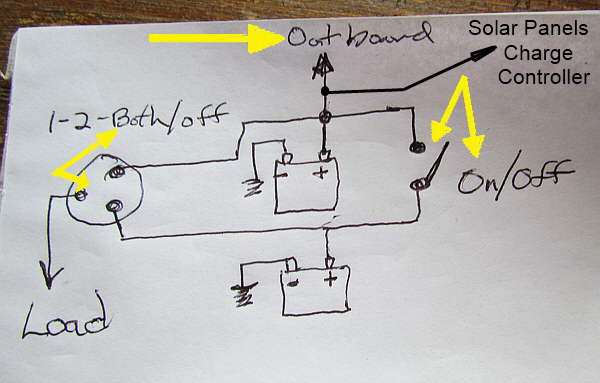
Above is a simplified diagram of how our batteries are wired to the outboard. The one is always connected to the outboard so that no matter how the 1-2-Both-Off switch is set the outboard will always be connected to one battery. We also have the 'combiner switch' on the right side 'ON' all of the time.
If needed for some reason we can isolate which battery is used for the load and by moving a couple wires, such as disconnecting the ground wire on the #1 battery it could be taken out of the circuit. Both of our batteries are withing 6 months of each other and the same manufacture and type.
You can charge two batteries that are in parallel quicker than one at a time. As the battery gets over 75%-80% of charge the charge rate goes down no matter how many amps the charging source can put out so two batteries in parallel will make better use of the charging source.
To do this you need to also use the 2 batteries in unison so that you are drawing them both down. This will also be better for them vs. drawing one down and then the other. You will be less likely to go under 50% charge on them. We have always been able to start the outboard using the batteries in this mode, but if you worry then put....

http://www.defender.com/product.jsp?pat ... &id=750182
...a 'true combiner in the battery circuit and don't use the 1-2-Both-Off switch for the load and the combiner will take the 'start battery' out of the load circuit if voltage drops and you will still be able to start the outboard,
Sum
Our Endeavour 37
Our Trips to Utah, Idaho, Canada, Florida
Our MacGregor S Pages
Mac-Venture Links
-
seahouse
- Admiral
- Posts: 2182
- Joined: Sun Dec 07, 2008 9:17 pm
- Sailboat: MacGregor 26M
- Location: Niagara at Lake Erie, Ontario. 2011 MacM, 60 hp E-Tec
- Contact:
Re: Portable Generator
Hey Sum!
Ahh yes, good thought... an open circuit is the more likely culprit for the burn out. Might there be a simple protective diode to replace in that event?
Your circuit arrangement certainly does have advantages (set it and forget it, sort of- but watch your state of discharge) and battery life is not such an issue if you have closely matching (=identical) batteries that are equally discharged.
I like it. Another good battery managemant strategy you've presented there!
Regards -Brian
Ahh yes, good thought... an open circuit is the more likely culprit for the burn out. Might there be a simple protective diode to replace in that event?
Your circuit arrangement certainly does have advantages (set it and forget it, sort of- but watch your state of discharge) and battery life is not such an issue if you have closely matching (=identical) batteries that are equally discharged.
I like it. Another good battery managemant strategy you've presented there!
Regards -Brian
-
Sumner
- Admiral
- Posts: 2375
- Joined: Sun Jan 04, 2009 3:20 pm
- Sailboat: MacGregor 26S
- Location: SE Utah
- Contact:
Re: Portable Generator
We have a...seahouse wrote:...but watch your state of discharge) and battery life is not such an issue if you have closely matching (=identical) batteries that are equally discharged. ...... Regards -Brian
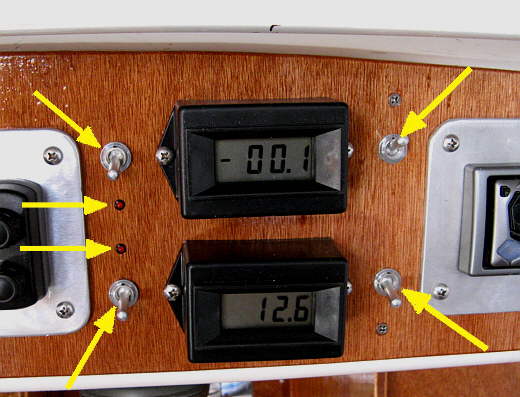
...digital voltmeter and amp meter that....
http://purplesagetradingpost.com/sumner ... de-25.html
... I find very handy and they weren't that expensive. The solar now provides over 90% of our power needs on trips, but sometimes we do supplement it ....
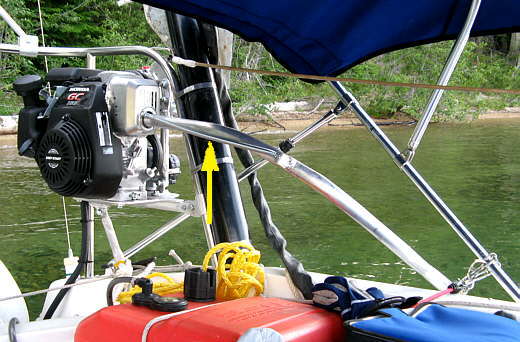
...with the gen-set....
http://purplesagetradingpost.com/sumner ... de-13.html
.... If we need it I'll start it up first thing in the morning if possible since that is when the batteries are usually the lowest and can take the largest charge. Even though it is a....
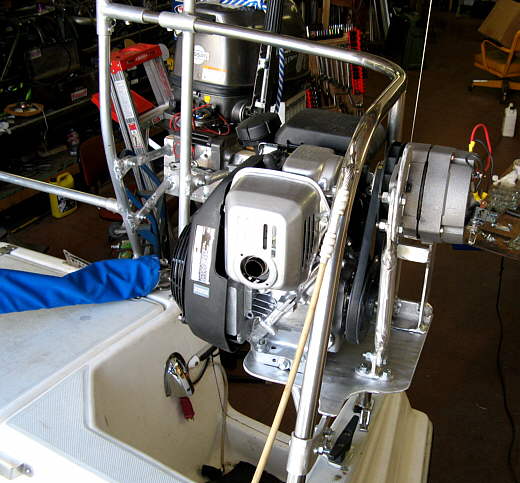
..... 60 amp alternator on the gen-set we will rarely see more than 22-24 amps at first charge and then as the battery voltage increases the amps go down. Usually after about 20 minutes or so they will be down to 9-12 amps and I'll shut the gen-set off as now the charging curve goes way down as the batteries are over 80% charged. The solar then does a great job of finishing the charge and topping them off. I think in almost 2 months out on the last trip we used the gen-set 2-4 hours total on the trip.
The Endeavour came with an expensive battery monitor, but I like the volt/amp gauges so much we got them also for the Endeavour and we have two 6 volt battery banks on that boat and one 12 volt starter battery. We will use the combiner I posted above between the 6 volt banks and the 12 volt starter battery. There will be a load selector switchfor the 6 volt banks, but we will run them in parallel almost all of the time to better charge and use them.
There is more on the boat's re-wiring here...
http://purplesagetradingpost.com/sumner ... de-30.html
Sum
Our Endeavour 37
Our Trips to Utah, Idaho, Canada, Florida
Our MacGregor S Pages
Mac-Venture Links
-
seahouse
- Admiral
- Posts: 2182
- Joined: Sun Dec 07, 2008 9:17 pm
- Sailboat: MacGregor 26M
- Location: Niagara at Lake Erie, Ontario. 2011 MacM, 60 hp E-Tec
- Contact:
Re: Portable Generator
Thanks for that, Sum. It’s been quite a while since I’ve given your site a good read-through, other than links you've posted here and there, which thank you for.
It now looks like I’m overdue for another thorough read-through of your site. This time through the different eyes of a Mac owner. Always very impressive, all of it, to both you and Ruth- thanks for sharing.
-Brian. (hoping you don’t get sick and tired of hearing praise over and over again)
It now looks like I’m overdue for another thorough read-through of your site. This time through the different eyes of a Mac owner. Always very impressive, all of it, to both you and Ruth- thanks for sharing.
-Brian. (hoping you don’t get sick and tired of hearing praise over and over again)
-
Sumner
- Admiral
- Posts: 2375
- Joined: Sun Jan 04, 2009 3:20 pm
- Sailboat: MacGregor 26S
- Location: SE Utah
- Contact:
Re: Portable Generator
Well it is nice know that we have been able to help others, but remember that Ruth and I just started with this boat thing a couple years ago so always make sure that what we have done is also in your best interest before applying any of it. Also we have learned tons ourselves on this site and a couple other ones, so thanks to everyone else who takes the time to post here and on either their own site or other sitesseahouse wrote:.. (hoping you don’t get sick and tired of hearing praise over and over again)
,Sum
Our Endeavour 37
Our Trips to Utah, Idaho, Canada, Florida
Our MacGregor S Pages
Mac-Venture Links
-
mastreb
- Admiral
- Posts: 3927
- Joined: Wed Feb 09, 2011 9:00 am
- Sailboat: MacGregor 26M
- Location: Cardiff by the Sea, CA ETEC-60 "Luna Sea"
- Contact:
How batteries are charged and why its safe to charge in para
It's safe to charge multiple deep cycle batteries in parallel even if they're different ages and types. As Sum stated, its also faster to charge batteries in parallel, and there's no way that you could "burn out" an alternator charging even bad batteries. Batteries don't suck power from an alternator or charging circuit, they simply accept whatever is available, and they can't "over-draw" a charging current. This is because the batteries resist being charged.
A "deep-cycle" battery refers to physical construction of the battery that allows it to be safely drawn down to no charge without damaging the battery. Deep cycle batteries use thick lead plates without holes that are much stronger than the numerous thin plates used in typical automotive starting batteries. Thin plates with holes maximize surface area between the lead and the electrolyte, which maximizes the ability of the battery to emit power. This is called the "cold cranking amps" rating of the battery--how much power it can give off.
In typical lead-acid automotive starting batteries, if you drain the battery to zero, hydrogen gas bubbles are created that destroy the thin lead plates in the battery. They can be "deep cycled" as few as fifty times and be killed. Drain down to zero, and being left to sit at zero for a period of time essentially kills the battery. For longevity, they always have to have some level of electrical charge.
With deep-cycle batteries this is not the case, and deep-cycle should always be used when you could routinely use all the power in a battery, such as is the case with a boat house battery.
With our small outboards, starting batteries are absolutely not necessary. Consider that even a 90hp outboard is developing less than half the power of a typical car and a quarter the power of a sports car. Any engine that can be rope-started by a human can be safely started by a true deep-cycle battery.
"Marine" batteries are simply a middle-ground between starting batteries and deep cycle batteries, and they typically also use all stainless on the terminals and are sealed and waterproof. Often they have a handle.
In any case, true deep-cycle batteries are the way to go for both starting and house batteries on a Mac.
All batteries, regardless of chemistry, charge fastest when they're empty, and their resistance to charge increases logarithmically (on an up-curving slope) as they become charged. So the first 50% of a battery charge might take only 20 minutes, but you'll only get 25% more in the next 20 minutes, 13% more in the next 20 minutes, 7% more in the next 20 minutes, etc.
When you have multiple batteries in parallel, which ever battery is most depleted will take the most charging current: Power flows most readily to path of least resistance. Both will charge, but the more depleted battery charges faster. Because of the exponentially increasing resistance to charge, the depleted battery will eventually "catch up" to the less depleted battery, and at some point they will be charging at the same rate.
So, for example, if you have a battery completely depleted and one depleted only 50%, the completely depleted battery will get to 50% in slightly more than 20 minutes (using the time scale from the example above) and as the two batteries become similar in charge, more power will be available to the more charged battery.
Because resistance is increased as the batteries charge, the "acceptance" of charge goes down and less electricity is drawn from the alternator to charge the batteries. By charging in parallel, you "double" the amount of total "acceptance" (which you can think of as the opposite of resistance) which means you can essentially charge both batteries in only slightly more time as one battery when you are at the tail end of the top-off of charge.
I'm not sure if this makes sense to everyone, but the bottom line is that once a good battery has topped off, its resistance to charge reaches 100% and it's basically done. It is still being "pressured" by the alternator, but deep cycle batteries are designed to take charge pressure and they don't need to be cut-off from the charging circuit the way other chemistries do.
For example, Lithium-Ion is extremely sensitive to undervoltage death AND overvoltage death, so each cell must be charged independently so that the charging circuit can individually control exactly how they're charged to prevent damaging them. Letting them gang charge in parallel could result in overvoltage to a cell that is not as depleted as others, killing that cell and destroying the pack. This doesn't happen with lead-acid or AGM deep cycle batteries.
Charge controllers can optimize charging time and provide a modicum of protection against over-voltage, but they're generally not necessary with deep-cycle batteries because they're built to not be killed by the charge/discharge cycle. If you don't have a deep-cycle battery, you should use both a controller and a low-voltage cut-off that will protect the battery from being too deeply discharged. The best thing to do is stick with deep-cycle batteries that don't need charge controllers.
Charge controllers charge in three or four phases: A full power "bulk charge" to about 80%, a reduced voltage (or pulsed power) charge beyond that, and an even more reduced topping charge from about 95% and up. The purpose of reducing the voltage or chopping the charge into pulses is to reduce the heat created by the resistance to charging, which generates gasses in the battery and decreases its life. Heat is what ultimately wears batteries out. Because charge controllers detect the depth of discharge of the battery, they must charge batteries separately from one another and you cannot use them to charge batteries in parallel.
Avoid all the complexity of charge controllers, low-voltage cut-off, and complicating wiring by just using true deep cycle batteries that are sturdy enough to handle a raw charge and deep depth of discharge.
Consider that you can also directly wire solar panels to deep cycle batteries without a solar charge controller as long as the panels provide 2 watts or less per 50 amp-hours of total battery capacity in your string of batteries. Beyond that, you only need a 14 volt regulator, but those are harder to find than a true charge controller so you should probably just use a charge controller.
A deep cycle battery should last about six years in routine use.
A "deep-cycle" battery refers to physical construction of the battery that allows it to be safely drawn down to no charge without damaging the battery. Deep cycle batteries use thick lead plates without holes that are much stronger than the numerous thin plates used in typical automotive starting batteries. Thin plates with holes maximize surface area between the lead and the electrolyte, which maximizes the ability of the battery to emit power. This is called the "cold cranking amps" rating of the battery--how much power it can give off.
In typical lead-acid automotive starting batteries, if you drain the battery to zero, hydrogen gas bubbles are created that destroy the thin lead plates in the battery. They can be "deep cycled" as few as fifty times and be killed. Drain down to zero, and being left to sit at zero for a period of time essentially kills the battery. For longevity, they always have to have some level of electrical charge.
With deep-cycle batteries this is not the case, and deep-cycle should always be used when you could routinely use all the power in a battery, such as is the case with a boat house battery.
With our small outboards, starting batteries are absolutely not necessary. Consider that even a 90hp outboard is developing less than half the power of a typical car and a quarter the power of a sports car. Any engine that can be rope-started by a human can be safely started by a true deep-cycle battery.
"Marine" batteries are simply a middle-ground between starting batteries and deep cycle batteries, and they typically also use all stainless on the terminals and are sealed and waterproof. Often they have a handle.
In any case, true deep-cycle batteries are the way to go for both starting and house batteries on a Mac.
All batteries, regardless of chemistry, charge fastest when they're empty, and their resistance to charge increases logarithmically (on an up-curving slope) as they become charged. So the first 50% of a battery charge might take only 20 minutes, but you'll only get 25% more in the next 20 minutes, 13% more in the next 20 minutes, 7% more in the next 20 minutes, etc.
When you have multiple batteries in parallel, which ever battery is most depleted will take the most charging current: Power flows most readily to path of least resistance. Both will charge, but the more depleted battery charges faster. Because of the exponentially increasing resistance to charge, the depleted battery will eventually "catch up" to the less depleted battery, and at some point they will be charging at the same rate.
So, for example, if you have a battery completely depleted and one depleted only 50%, the completely depleted battery will get to 50% in slightly more than 20 minutes (using the time scale from the example above) and as the two batteries become similar in charge, more power will be available to the more charged battery.
Because resistance is increased as the batteries charge, the "acceptance" of charge goes down and less electricity is drawn from the alternator to charge the batteries. By charging in parallel, you "double" the amount of total "acceptance" (which you can think of as the opposite of resistance) which means you can essentially charge both batteries in only slightly more time as one battery when you are at the tail end of the top-off of charge.
I'm not sure if this makes sense to everyone, but the bottom line is that once a good battery has topped off, its resistance to charge reaches 100% and it's basically done. It is still being "pressured" by the alternator, but deep cycle batteries are designed to take charge pressure and they don't need to be cut-off from the charging circuit the way other chemistries do.
For example, Lithium-Ion is extremely sensitive to undervoltage death AND overvoltage death, so each cell must be charged independently so that the charging circuit can individually control exactly how they're charged to prevent damaging them. Letting them gang charge in parallel could result in overvoltage to a cell that is not as depleted as others, killing that cell and destroying the pack. This doesn't happen with lead-acid or AGM deep cycle batteries.
Charge controllers can optimize charging time and provide a modicum of protection against over-voltage, but they're generally not necessary with deep-cycle batteries because they're built to not be killed by the charge/discharge cycle. If you don't have a deep-cycle battery, you should use both a controller and a low-voltage cut-off that will protect the battery from being too deeply discharged. The best thing to do is stick with deep-cycle batteries that don't need charge controllers.
Charge controllers charge in three or four phases: A full power "bulk charge" to about 80%, a reduced voltage (or pulsed power) charge beyond that, and an even more reduced topping charge from about 95% and up. The purpose of reducing the voltage or chopping the charge into pulses is to reduce the heat created by the resistance to charging, which generates gasses in the battery and decreases its life. Heat is what ultimately wears batteries out. Because charge controllers detect the depth of discharge of the battery, they must charge batteries separately from one another and you cannot use them to charge batteries in parallel.
Avoid all the complexity of charge controllers, low-voltage cut-off, and complicating wiring by just using true deep cycle batteries that are sturdy enough to handle a raw charge and deep depth of discharge.
Consider that you can also directly wire solar panels to deep cycle batteries without a solar charge controller as long as the panels provide 2 watts or less per 50 amp-hours of total battery capacity in your string of batteries. Beyond that, you only need a 14 volt regulator, but those are harder to find than a true charge controller so you should probably just use a charge controller.
A deep cycle battery should last about six years in routine use.
-
raycarlson
- Captain
- Posts: 789
- Joined: Wed Jul 30, 2008 1:42 pm
- Sailboat: MacGregor 26M
- Location: tucson,az
Re: Portable Generator
question for sumner?? how has that little honda GC160 performed for you on your genset ?. i have one mounted to a little air compressor and two 50' hoses attached to dive regulators that we snorkle with in shallow water less than 30', ours seems to be indestructable.sorry to hijack but this has been discussed to death.