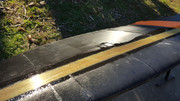
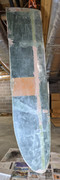
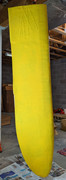
Ixneigh wrote: ↑Thu Nov 19, 2020 6:45 pm
I was under the impression that the squared off ends (of the DB) were to reduce tip votices. What made you decide on an elliptical end?
I would like to start off saying I have no grand claims to expecting a noticeable speed gain. Since I haven't sailed it in a couple of years AND when I did, it was with a broken D/B, I won't have any way to tell. I am mainly doing it, because being an engineer, I want to play using my training for my own projects.
This D/B will have far less drag because of the elliptical shape AND the more exacting foil cross-section. BUT... the D/B drag is a small fraction of the total drag and the boat already will reach hull speed, so I don't expect more speed. I do hope, I will have better stall characteristics... it will stall at higher angles of attack and stall more gently than the stock D/B. IOWs it should be kinder, and be able to point better. Should being the operative word. I also chose the elliptical shape, because the biggest hinderance to ANYONE making the elliptical shape is building it. IT has always been its biggest drawback from early Snider cup planes... on. Mass war-time production of the Spitfire was slower than other planes because of the complexity. That all goes away in my case since the 3D computer aided design and 3D printer will make the cores within 3 decimal places accurate... trivial. Now to your question...
The short answer (Oops - already failed that one

) the tip vortices are far less with an elliptical tip than the squared-off tip. If you are willing to just take my word for it, you might want to skip the following blather.
The long version (since I would want to know why) - The tip vortices are caused by the pressure being higher on one side of the wing (D/B) than the other. The high pressure bleeds over to the low pressure side and swirls down stream causing lots of drag. Since the squared-off wing has a lot of area at the tip its has lots of pressure it wants to spill off to the low pressure side. It turns out through analysis and testing they found that the pressure on that squared-off wing effectively had an elliptical shape. So when they tested it by making the wing elliptical, they found it created just as much lift as the squared-off wing, even though it has less area. BUT as a benefit, it had less weight and less drag.
Vortices only occurs when lift is being created. If going DDW, there are no vortices. So the elliptical shape has no advantage except there is a little less skin drag. Which brings up another downside to my D/B design. If going DDW and I pull up the board, the big hole in the truck around that tip will create a lot of drag. I discount that as the boat seems to be faster just off the wind anyway and a little D/B is useful for that speed. That, you'll note by the lower rear bumper I've put into the design just above the ellipse.
Now the most common comparison of the two is WW2 Spitfire vs Mustang.
https://www.airspacemag.com/flight-toda ... 180971225/ And depending on a person's bias one or the other is best. What articles like that fail to factor in is the purpose of those two planes. Like boats, there is no BEST. Just best at some aspect. The Spitfire was meant for defense of England. It had to climb very fast to altitude. It needed a lot of lift and had to have low drag. The Mustang was optimized for long distance cruise so it could reach deep inside of Germany. At cruise speed, very little lift is needed compared to the great speed so the vortices are small because the wing is going like our DDW boat. The added complexity of manufacturer was not justified in making it go faster or further.
Re: Strength how much stronger is the build than the original?
Strength is a sensitive subject. Too much strength is even more harmful than too little. In the D/B situation, if you make it too-strong and have a D/B strike, you break the boat hull. Which is better... having to replace a D/B or tow in and repair a sinking boat? I have chosen to match the skin's strength as best I can so if I get a strike the trailing edge continues to fail first as the stock unit. As far as bending of the D/B I have made it stronger. I used the number found by Roger's holding down the boat by the mast. I also added a safety factor. IOW, it should not break even with wind strong enough to knock-down the boat. The safety factor is to hopefully account for my lack of fiber glassing building ability. I am using Epoxy instead of Polyester.
Re: build time wouldn’t it be quicker to fix the old DB and use fairing epoxy to alter the foil? A template could be made to check the foil at various points for accuracy.
Oh hull Yeah! But I like projects as much as sailing. Before the boat had to be put-up, I did try to fix the D/B. However, trying to bond a structural member inside the other proved beyond my building ability. It broke off on the first sail. As it still sailed about the same with the shorter length, I'll clean up the stub bottom and have it as a backup in case the elliptical one breaks.

Also... this is an experiment and I have learned from my work. As someone pointed out above, IF I have to do another, I'll 3D print the molds and just layup the D/B like they build the originals.
Re: Hoisting what about using the cabin top winch? A rope clutch could be installed on that side for the jib sheets. (To free up the winch if needed)
Ix
I'm only putting as much metal/concrete ballast as needed to make it barely float. I don't have the number with me, but it seemed to be about 35 lbs. Even this I didn't want to lift all the time. I ain't getting younger. That is why I added the 2:1 block inside the D/B. That way I don't have any paraphernalia above deck. Over the years I've grown to hate wires behind furniture I can still see. I want to minimize all that clutter in my vision. Its a pet-peave.
That's why when I go to make my rear arch and new boom (later MX-n projects being designed) the main sheet tackle, boom-vang tackle, out-haul tackle, traveler tackle, one line reef tackle, will ALL be inside with only one line coming out in sight.
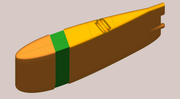


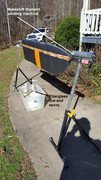
 flush with the surface of the ABS foils.