Battery drained

A forum for discussing topics relating to MacGregor Powersailor Sailboats
User avatar
Russ
Admiral
Posts: 8299
Joined: Thu Oct 11, 2007 12:01 pm
Sailboat: MacGregor 26M
Location: Bozeman, Montana "Luna Azul" 2008 M 70hp Suzi

Re: Battery drained

Post by Russ »

Sounds like the charger is getting juice and putting out 20 amps to the batteries. So that's good news.
From the photos, it looks like it's directly connected and the A/B All switch position doesn't matter.

The tags on your batteries indicate they are 3 years old which should still have some life unless really abused.

Upgrading to marine-grade circuit breaker shouldn't be difficult. Where is that breaker mounted? The charger in the head is an unusual location. I wonder why it was mounted there. The photo looks like it has cooling fans on top. Perhaps airflow was a concern.

With the exception of the main cable to the A/B Both switch, all connections to the battery should be fused and should be as close to the terminal as possible. Some people have fused the heavy cable to the outboard, however I've read some good reasons not to fuse the starter circuit.

Looking at your setup, my guess is the A/B Both switch is controlling power to the outboard and all other wires are run direct to the battery.

I have 2 batteries. One dedicated starting battery and a house battery. My A/C charger is fused at the + terminals where they connect to the batteries.

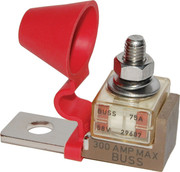
My House battery has a terminal block fuse. This might be an easy fix for your situation.
https://www.amazon.com/Blue-Sea-Systems ... B0019ZBTV4

Image

Mounts on the post and effectively fuses everything downstream. I also have spares because it's not easy to find.

I also have inline fuses for other things connected (charger, stereo memory power). The main power to my switch panel is protected with one of these in line breakers. I went with a breaker so I can reset in a hurry if needed in an emergency. It is close to the battery terminal.

https://www.amazon.com/Tiwerlfe-Circuit ... B0CX7ZVTRL
--Russ
User avatar
Be Free
Admiral
Posts: 1890
Joined: Fri Nov 23, 2012 6:08 pm
Sailboat: MacGregor 26X
Location: Steinhatchee, FL

Re: Battery drained

Post by Be Free »

I typed this up yesterday but it apparently never got sent:

Now your first item: tracing and understanding the electrical system on your boat is a very important part of safely operating it.

Your boat (and mine), as it was delivered from the factory, had a rudimentary electrical system that just barely allowed it to pass minimal safety regulations. It had a circuit for the navigation lights and one for the steaming light (on the front of the mast). That is the minimum that US Coast Guard (and by extension US state) regulations required. It also had a circuit for the interior lights and a couple of wires that fed the small fuse panel. When you pull out that small fuse panel you will find that your "ground bus" is a bolt with a nut on the end running through a bunch of ring terminals. Most of the wiring is white 16 gauge lamp cord. That's about it. It was never great, but it's probably still working.

Other than engine-related wiring, everything else you see on the boat was probably installed by a previous owner. Until you check it out you have no way of knowing if it was done in a professional manner or not.

By the time you are done you should know what every wire does, where is is run, and whether or not it is sufficient for the job. Be on the look out for solid wire (never on a boat), wire nuts (again, never), wing nuts on battery posts (also never), possible chafe points, and exposure to moisture.
Bill
2001 26X Simple Interest
Honda BF40D
"If I were in a hurry I would not have bought a sailboat." Me
User avatar
Be Free
Admiral
Posts: 1890
Joined: Fri Nov 23, 2012 6:08 pm
Sailboat: MacGregor 26X
Location: Steinhatchee, FL

Re: Battery drained

Post by Be Free »

On to new stuff.

Looks like you are well on your way to understanding your wiring. I'm in total agreement with Russ regarding your batteries, the irrelevance of the battery switch to charging, and the need to fuse both batteries. The batteries are matched in capacity and age so they are well suited to be connected in parallel by the battery switch.
Bill
2001 26X Simple Interest
Honda BF40D
"If I were in a hurry I would not have bought a sailboat." Me
green
Engineer
Posts: 152
Joined: Sat Apr 10, 2021 10:47 am
Sailboat: MacGregor 26M
Location: Carolina Beach / Durham, NC (Jordan Lake)

Re: Battery drained

Post by green »

Russ wrote: Thu Jul 11, 2024 6:21 am My A/C charger is fused at the + terminals where they connect to the batteries. My House battery has a terminal block fuse.
Thanks for this description, Russ. It’s really helpful.

I ordered a marine panel, two block fuses, an inline fuse, and the noco genius.

Could you clarify the information quoted above? Do you have block fuses on both positive terminals, or just the house positive terminal?
User avatar
Russ
Admiral
Posts: 8299
Joined: Thu Oct 11, 2007 12:01 pm
Sailboat: MacGregor 26M
Location: Bozeman, Montana "Luna Azul" 2008 M 70hp Suzi

Re: Battery drained

Post by Russ »

I had a picture someplace but can't find it and of course the boat is 90 minutes away.

I don't have an A/B/All switch. Every other boat I've owned had the A/B/All/Off switch and EVERYTHING was connected to that switch so you could disconnect EVERYTHING or share both batteries with everything. That made sense when I had a Yanmar diesel to start and sometimes one batt was dead or if it was very cold, I could combine both for extra juice.

Your PO must have implemented the A/B/Both/Off switch to the outboard. From your photo, it looks like your battery switch allows you to start the motor and charge batteries from either battery but the house battery is connected to the panel.

Back to your question:

I have the Terminal Post fuse on the House battery positive ONLY. It's redundant as everything that connects to the house battery also has an inline fuse or the inline breaker for the circuit going to the switch panel.

My starter battery is isolated from the house
It has the main (thick) power cable to the outboard
a wire to the battery charger (with an inline fuse)
a wire to my combiner (inline fused).

My house battery has
a wire to the battery charger (with an inline fuse),
a wire to my combiner (inline fused).
a wire to my switch panel (inline circuit breaker)


BWY installed a combiner that will join (like your A/B/BOTH switch can), automatically when the starter battery is receiving 13v and will then charge the house battery from the outboard.
--Russ
green
Engineer
Posts: 152
Joined: Sat Apr 10, 2021 10:47 am
Sailboat: MacGregor 26M
Location: Carolina Beach / Durham, NC (Jordan Lake)

Re: Battery drained

Post by green »

This is really really helpful information.

My buddy who is a landscape lighting guru came out with me this morning and brought his multimeter.

The panel has 120

The input to the charger converter has 120

But the output from the charger converter has 0. Nothing registered at the batteries either. Confirmed the fuse on the converter charger is good.

I think my next step is to have about inspected by the mechanic here at the marina. It could be my converter charger is either not working or not wired correctly.

I’m open to other ideas and hypotheses, of course. Thanks to everyone for all this great advice so far
User avatar
Russ
Admiral
Posts: 8299
Joined: Thu Oct 11, 2007 12:01 pm
Sailboat: MacGregor 26M
Location: Bozeman, Montana "Luna Azul" 2008 M 70hp Suzi

Re: Battery drained

Post by Russ »

But the output from the charger converter has 0. Nothing registered at the batteries either. Confirmed the fuse on the converter charger is good.
This is some good diagnostic data.

No power out would indicate the charger is failed. However, did I see in a previous post it was reading 20 amps?
"2. With the switch in the off position the converter/charger reads 0. With the switch in the on position it hovers around 20."
Where were those amps going? What "switch" was on?

It looks like a high quality charger that can support up to 3 separate batteries at once. It does have a reverse polarity fuse. But that would only blow if faulty installation.

Code: Select all

INTERNAL FUSE REPLACEMENT
The INTELI-POWER MARINE converter/charger has one, two or
three user replaceable fuses located behind the access panel. The
fuse(s) will blow ONLY in the event of a battery being connected to
the unit in reverse
The manual claims it is a smart charger and perhaps it's smart enough to not try to charge a totally flat battery. I know my cheap 12v portable charger won't charge a battery with less than 10v. I think some outboard alternator behave the same.

Do you have a portable charger you can attach just to get the batteries up?

If you tested the output contacts of the charger and get no DC voltage (need to change multimeter to DC volts), it could be a failed charger.

Here's the manual. Maybe even call them to see how to test it. Phone: 269-781-4241
https://www.progressivedyn.com/wp-conte ... Manual.pdf
--Russ
green
Engineer
Posts: 152
Joined: Sat Apr 10, 2021 10:47 am
Sailboat: MacGregor 26M
Location: Carolina Beach / Durham, NC (Jordan Lake)

Re: Battery drained

Post by green »

Russ, you were right about switching to DC. When we did that we registered the current coming out of the converter charger.

My house battery appears to be dead, and it might be that the charger is too smart to charge it in its state. I have a charger coming tonight that should charge a battery from zero. Hopefully it will take a partial charge and I can test again charging from shore power.

I have someone coming next week to look at the panel and advise on replacing with the marine version I purchased.

Progress!
User avatar
Russ
Admiral
Posts: 8299
Joined: Thu Oct 11, 2007 12:01 pm
Sailboat: MacGregor 26M
Location: Bozeman, Montana "Luna Azul" 2008 M 70hp Suzi

Re: Battery drained

Post by Russ »

That is progress.

So the charger was reading 20amps? I wonder where those Amps were going.

What is the voltage of the battery?
--Russ
green
Engineer
Posts: 152
Joined: Sat Apr 10, 2021 10:47 am
Sailboat: MacGregor 26M
Location: Carolina Beach / Durham, NC (Jordan Lake)

Re: Battery drained

Post by green »

Two steps forward, one step back.

I have 2 12v AGM 79Ah batteries. On a recommendation in this thread, I purchased a Noco genius 5x2. I connected it to both batteries and plugged directly into AC via an extension cord (not shore power cord).

The noco shows that it charged one battery but not the other. I tried using repair mode on the other battery, but I had to interrupt the attempt to go sailing.

Prior to sailing I noticed a small amount of water around the battery tray. Not that much.

When I returned from sailing I had more. I hand pumped 11-13L. I checked under the aft lockers and they were dry. The ballast plug bowl forward was dry.

Prior to sailing I estimate that the ballast water level was 1.75” from the top. Now it’s 2.5”. So it seems like the ballast lost 0.75” over the past few days,

Has anyone experienced water near the batteries? I’m thinking I might pull the boat on the ramp, drain the ballast, put it back in the water, and see if I get any more water below.

I’d appreciate any tips or troubleshooting ideas.

I should add that the boat rocked a lot today at anchor and temporarily dockside. We were in an area with a lot of wake to the boat, definitely rolled back-and-forth and was jostled a good bit
User avatar
Be Free
Admiral
Posts: 1890
Joined: Fri Nov 23, 2012 6:08 pm
Sailboat: MacGregor 26X
Location: Steinhatchee, FL

Re: Battery drained

Post by Be Free »

green wrote: Sun Jul 14, 2024 6:05 pm Two steps forward, one step back.

I have 2 12v AGM 79Ah batteries. On a recommendation in this thread, I purchased a Noco genius 5x2. I connected it to both batteries and plugged directly into AC via an extension cord (not shore power cord).

The noco shows that it charged one battery but not the other. I tried using repair mode on the other battery, but I had to interrupt the attempt to go sailing.

...
Just addressing the battery charge question on this one. If any assumptions are wrong please let me know. It may change my advice.

I'm assuming that you connected the positive cable from each side of the charger to each of your batteries. The negative is probably the same way but it does not matter as much. It's better to connect them to each battery but connecting to a negative bus is not the end of the world. There are very good reasons why you may need to do it but you probably don't have the need on your boat based on what you've told us so far.

I'm also assuming that you set the charger to charge AGM batteries on each side, not just on one the side that charged. I'm pretty sure that this charger can charge dissimilar batteries simultaneously.

If you did all of that then you did everything right.

Here's where I suspect you may have gone wrong. By any chance did you have your battery switch set to ALL? If you did then it is possible that you confused the charger.

For this example let's say that battery 1 charged and battery 2 did not.

A "smart" charger will try to assess the state of the battery before it begins charging. It will do this primarily by measuring the voltage of the battery before it begins. As soon as the charger finishes testing battery 1 it will begin charging battery 1 using a profile appropriate to the results of the test it just ran.

If you have your battery switch in the ALL position, then battery 1 and battery 2 are connected in parallel. From an electrical viewpoint they are one battery. If the charger is still testing battery 2 when battery 1 starts charging, the testing circuit may be confused by the voltage that it sees coming from the other side of the charger (through the switch) thinking that voltage it sees was being provided by battery 2.

The result may be that the wrong profile is chosen or the time in the correct profile is wrong. Sometimes it will make no difference. Sometimes it may think that battery 2 is already fully charged when all it is actually seeing is the other side of the charger. I suspect the latter was the case here.

If you were charging in the ALL position, try it in any other position and see if you get a different result. If possible, test in the OFF position but Off, 1, or 2 will remove the connection that may be confusing the charger.

Be very careful with the Repair mode. It supplies 15V or so to the battery regardless of the actual need. This is usually only needed with an extremely sulfated battery or one that is very dead. Hopefully the charge won't leave it in this mode for long. The expected response of the battery is to "boil" the electrolyte with the goal of stirring up the "sludge" of lead, lead sulfate, and electrolyte in the bottom of your battery. If you stay in that mode too long you can end up losing electrolyte, warping your plates, or deforming your battery case (sometimes quite violently).

Think of it like a defibrillator for your battery. It's an indispensable tool at the right time but you only want to use it when you actually need it.
Bill
2001 26X Simple Interest
Honda BF40D
"If I were in a hurry I would not have bought a sailboat." Me
User avatar
Be Free
Admiral
Posts: 1890
Joined: Fri Nov 23, 2012 6:08 pm
Sailboat: MacGregor 26X
Location: Steinhatchee, FL

Re: Battery drained

Post by Be Free »

green wrote: Sun Jul 14, 2024 6:05 pm ...
Prior to sailing I noticed a small amount of water around the battery tray. Not that much.

When I returned from sailing I had more. I hand pumped 11-13L. I checked under the aft lockers and they were dry. The ballast plug bowl forward was dry.

Prior to sailing I estimate that the ballast water level was 1.75” from the top. Now it’s 2.5”. So it seems like the ballast lost 0.75” over the past few days,

Has anyone experienced water near the batteries? I’m thinking I might pull the boat on the ramp, drain the ballast, put it back in the water, and see if I get any more water below.

I’d appreciate any tips or troubleshooting ideas.

I should add that the boat rocked a lot today at anchor and temporarily dockside. We were in an area with a lot of wake to the boat, definitely rolled back-and-forth and was jostled a good bit
Now, on to the water issue.

The suggested water level is 1" below the lip of the vent. 1.75" is too low and 2.5" is way too low.

It is very easy to trap an air bubble in the ballast tank if the boat is not sitting "on her lines" (level). That may be the entire answer to your .75" difference over a couple of days. I don't have the dimensions of the ballast tank handy but my gut feeling is that 11-13L of water in a tank that size would not account for .75" of drop so I don't think the water is coming from your ballast tank.

Mostly for future reference, if you find water in the collar around the ballast vent then the plug is probably leaking. Most of us use an expanding plug with a lever on the end. You can adjust the initial diameter of the plug by holding the rubber part in your hand and twisting the lever. Clockwise will make the plug larger, counterclockwise makes it smaller. You said you had no water in the collar so you don't have a leak there.

There are four penetrations of the hull in an X. I'm pretty sure that the M has the same number but in slightly different spots.

The drain in the anchor locker would be my last suspect. It's hard to get water to run up that drain hole and even if the tube was leaking it would be very likely to make a wet spot in the v-berth that would tell you where it was coming from.

If you have a sink in the head on an M that would be another one. On the X the drain comes through pretty low and leaks are not unheard of. The same goes for the galley sink. Both of these would be most likely to leak while you are heeled (or rocking) and either could let in a couple of gallons if the hose connection had been compromised. They are well worth checking.

I'm pretty sure you have a similar drain for the engine well. A leak there would require the boat to be sitting low enough to keep it underwater or for waves coming from astern to hit it and back it up. If it were underwater due to too much weight on the stern then you would likely have a lot more than three gallons of water in the bilge.

There are also penetrations for wiring and steering that may leak when water comes from astern. I think I remember something about the rudders that some have indicated caused small leaks. If you had been getting "pooped" all day I'm sure you would have suspected something in that area already.

You did not mention one, but the most likely spot (to me) would be any type of bilge pump exit port. None of our boats came with bilge pumps and it is very easy to hook one up wrong and actually cause a leak. If you have a bilge pump, start looking there.

Second choice would be the head or galley drains (assuming an M has them). I've had issues with mine (now fixed) when heeled or in rough water. One time with considerably more than 13L of water in the bilge!
Bill
2001 26X Simple Interest
Honda BF40D
"If I were in a hurry I would not have bought a sailboat." Me
User avatar
Russ
Admiral
Posts: 8299
Joined: Thu Oct 11, 2007 12:01 pm
Sailboat: MacGregor 26M
Location: Bozeman, Montana "Luna Azul" 2008 M 70hp Suzi

Re: Battery drained

Post by Russ »

I will second "Be Free" info on the A/B/All switch. That is a good theory.
My batteries have the negative poles connected and the positive are isolated into "house" and "starter" batteries.

I suppose you could try disconnecting the flat battery and connect the charger directly. That might at least rule out a bad battery.
Honestly, I know very little of AGM batteries other than they charge differently from lead acid.


Water:
The most common place water gets into these boat is from above as rain. Often it sits in different places and when the boat rocks will settle in the lowest spot, the battery area.

The "M" has one thru hull in the transom that connect the sink and motor well drains. When ballast is in, mine is BELOW the water line.
If this were leaking, I would expect it to leak all the time. Do you have a bilge pump? Does it go off?

Ballast tank leaks are rare, extremely rare and when they happen are generally slow seeping leaks.

You could drain the ballast by full throttle and opening the gate valve and vent and letting it drain and then close. No need for the ramp.

As Be Free mentioned, water can also come in via the engine/steering through the motor well, however you said that area seemed dry.

I would focus on the battery issue and keep an eye on water intrusion. Have you had rain lately? Because that's the most common place for water.
--Russ
green
Engineer
Posts: 152
Joined: Sat Apr 10, 2021 10:47 am
Sailboat: MacGregor 26M
Location: Carolina Beach / Durham, NC (Jordan Lake)

Re: Battery drained

Post by green »

Thanks for the water advice. The water in the battery compartment is back after a calm night with no rain. Ballast level appears to be 3.5”. It was 2.5” last night.

I’ll drain the ballast and see.
User avatar
Russ
Admiral
Posts: 8299
Joined: Thu Oct 11, 2007 12:01 pm
Sailboat: MacGregor 26M
Location: Bozeman, Montana "Luna Azul" 2008 M 70hp Suzi

Re: Battery drained

Post by Russ »

The ballast going down sure is suspicious. From your observations, it is a possible source.

Again, it's very rare to have ballast leaks, but it's been reported to occur.

You could drop some of these tablets in the ballast tank and see if the water turns blue and you can find a trail.

https://www.homedepot.com/p/Korky-Leak- ... /300302459
--Russ
Post Reply