DIY Shore Power Install

A forum for discussing boat or trailer repairs or modifications that you have made or are considering.
User avatar
Wind Chime
Captain
Posts: 866
Joined: Sun Jan 21, 2007 4:30 pm
Sailboat: MacGregor 26X
Location: Vancouver, B.C. Canada. 2000-26X, Suzuki-50hp, 8' Walker-Bay tender (with sailkit)
Contact:

Re: DIY Shore Power Install

Post by Wind Chime »

This thread has been very helpfull for me, thanks guys!
It even encouraged me to dust off my Don Casey "Sailboat Electrics Simplified" book last night :)

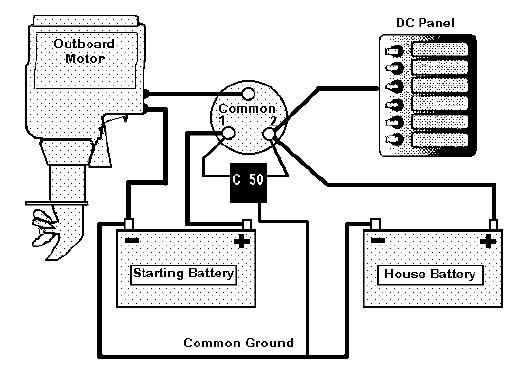
So ... if I install a selector switch (1-both-2-off) and the C-50 combiner the way it is outlined in either of the options #1 & #2 (below), I can;
- leave the selector switch in the "both" postition and it will be the same as what I had now? (below).

Plus
- still give me the other options of isolating battery 1 or battery 2
- as well as shut the entire system to "off"?

This would be the best of both worlds for me.

Option #1
Image

Option #2
Image

What I have now.
Image
Last edited by Wind Chime on Mon Oct 27, 2014 8:19 pm, edited 2 times in total.
User avatar
RobertB
Admiral
Posts: 1863
Joined: Sun Jun 05, 2011 7:42 pm
Sailboat: MacGregor 26M
Location: Clarksville, MD

Re: DIY Shore Power Install

Post by RobertB »

I have taken this setup a bit further. I have three batteries that can all be isolated using two Perko type switches. The first switch (labeled "Motor") is connected to the motor (common), the "starting" battery (A) and the second switch labeled "House" (B). The second switch is connected to the DC distribution panels (common), house battery 1 (A) and house battery 2 (B). I also have a digital DC voltmeter hooked to the lead between the switches where I can monitor the voltage on any battery or the charging system. All three batteries also have feeds from the battery charger (the ProMariner charger can maintain three separate batteries). When on the charger at home, I make sure the batteries are isolated from each other. When motoring, I can put all on charge. I use the battery terminal switches as shown above. All negative leads hook to a heavy duty buss bar near the batteries.
User avatar
Sumner
Admiral
Posts: 2375
Joined: Sun Jan 04, 2009 3:20 pm
Sailboat: MacGregor 26S
Location: SE Utah
Contact:

Re: DIY Shore Power Install

Post by Sumner »

Wind Chime wrote:
So ... if I install a selector switch (1-both-2-off) the way it is outlined in either of the options #1 & #2 (below), I can;
- leave the selector switch in the "both" postition and it will be the same as what I had now? (below).

Plus
- still give me the other options of isolating battery 1 or battery 2
- as well as shut the entire system to "off"?

This would be the best of both worlds for me....
Image

The option above allows you to either start the outboard or receive a charge from it to either battery individually or both at the same time.

The house loads can also draw from both batteries at the same time or from house battery alone. You can't have the house load on only the starting battery. If that is ok then it will work for that. If you want the option of also being able to have the house loads draw from either battery separately then you need another switch or....

...... do like I've done and have the switch select which battery or both and have the common side of the switch go to both the house loads and the outboard. Then the outboard will always be charging both batteries and if you want to start it on one battery or the other change the switch for starting and at night if you want to make sure you don't draw down one battery put the switch to just the house battery. Since our outboard would pull started we never took the switch off of "both" and always had power to start the outboard, but I did watch the voltage.

I'm having trouble with your diagram.....

Image

For instance you have the negative on the #1 battery going to the DC breaker box positive and not sure about how you are wiring from there to Main Fuse and Buss Pole??

Sumner

============================
Our MacGregor 26-S

Our Endeavour 37

Our Trips to Utah, Idaho, Canada, Florida

Mac-Venture Links
User avatar
Wind Chime
Captain
Posts: 866
Joined: Sun Jan 21, 2007 4:30 pm
Sailboat: MacGregor 26X
Location: Vancouver, B.C. Canada. 2000-26X, Suzuki-50hp, 8' Walker-Bay tender (with sailkit)
Contact:

Re: DIY Shore Power Install

Post by Wind Chime »

Sumner, I appreciate your time. (and I'm sure others are reading and learning a little as well :)
...... do like I've done and have the switch select which battery or both and have the common side of the switch go to both the house loads and the outboard. Then the outboard will always be charging both batteries and if you want to start it on one battery or the other change the switch for starting and at night if you want to make sure you don't draw down one battery put the switch to just the house battery.
Are you suggesting that your set-up is like in the diagram (below) from Blue Sea website?
Go to house breaker panel from the common pole instad of the #2 pole?
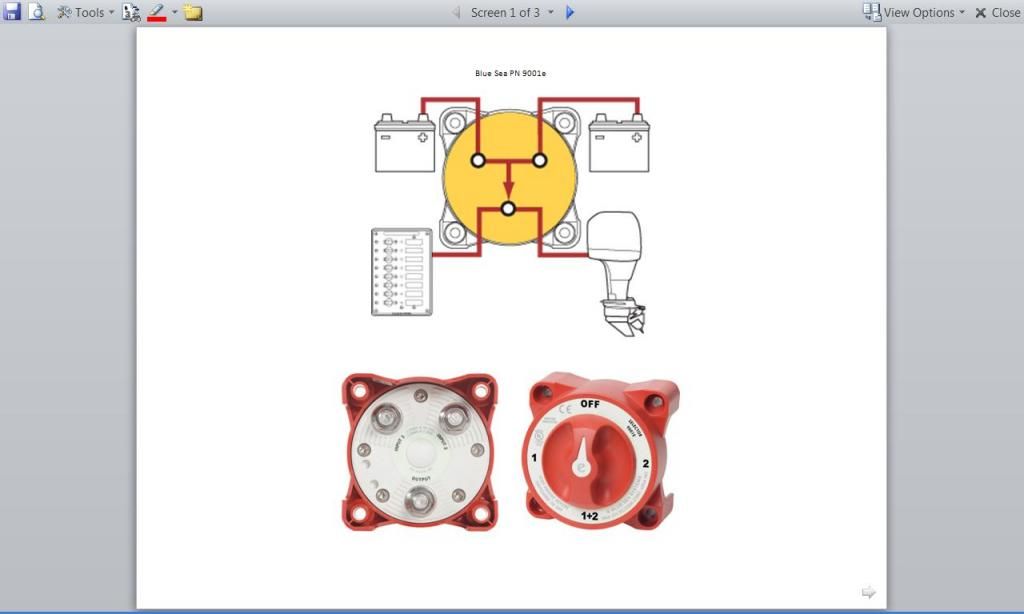
Image

Also fyi:
- the combinder (C-50) can be attached to a 3 way toggle switch (auto-on-off)

RE: my diagram

Good catch - my diagram is wrong. The poles on the D/C breaker panel are reversed - sorry for any confusion.

The + buss pole in the diagram is a single pole.
So an 8-AWG red wire goes;
- from the + battery #1 into the C-50
- then out of the C-50 into the + single buss pole
. then out from the + single buss pole to:
(1) an 8-AWG wire to main-fuse then DC breaker panel
(2) as well as an 8-AWG wire to the + battery #2.
User avatar
Sumner
Admiral
Posts: 2375
Joined: Sun Jan 04, 2009 3:20 pm
Sailboat: MacGregor 26S
Location: SE Utah
Contact:

Re: DIY Shore Power Install

Post by Sumner »

Wind Chime wrote:...Are you suggesting that your set-up is like in the diagram (below) from Blue Sea website?
Go to house breaker panel from the common pole instead of the #2 pole?

Image
...
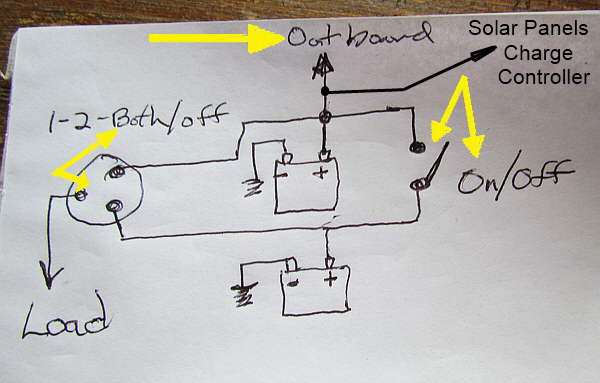
Yes I would consider that in your case. I did something similar but with an added switch. When you look at the following remember that our 9.8 HP can be started by hand (never have) and wanted to make sure I didn't take a chance on burning out the diodes in the alternator so wanted the motor always connected to a battery. Unless you can also start yours by hand this scenario would never take place so I wouldn't wire like I did in the following.

Image

Note the following is copy/paste from one of my web pages ( http://purplesagetradingpost.com/sumner ... de-30.html ) .....
To avoid ever burning out the outboards alternator the wire to and from the stern for the outboard and gen-set, top arrow, goes directly to the top battery and are always connected to it. I have a heavy duty switch between the two batteries and usually keep it, right arrows, in the on position so that both batteries are charged jointly by the outboard and/or gen-set. The power from the solar array goes through a MPPT charge controller and then ties into this system where the stern power comes in above the top battery. So that output is going to either the top battery or both batteries.

The off/1/all/2 switch, left arrow, puts power to the load from either battery or both of them. Normally it is in the both mode. I only kept the option of getting the load from the bottom battery in the rare case the top battery had a major problem. At that time I could also easily take it out of the circuit by disconnecting the positive lead from it. Then I would have to leave the main switch in the #2 position so that the outboard would be connected to the second battery.

I don't anticipate doing that, but can if needed. Thus the main switch stays turned to the 'all', both batteries, position and the other switch stays turned 'on'.
As noted above the main switch has always been in both and the secondary switch always closed. My batteries need replacing so now I'm going to ditch the two 12 volt batteries and move to two 6 volt batteries in series so the wiring and switches are going to change. Also I'm adding two new 12 volt batteries for the 24 volt trolling motor so a lot will change,

Sumner

============================
Our MacGregor 26-S

Our Endeavour 37

Our Trips to Utah, Idaho, Canada, Florida

Mac-Venture Links
User avatar
RobertB
Admiral
Posts: 1863
Joined: Sun Jun 05, 2011 7:42 pm
Sailboat: MacGregor 26M
Location: Clarksville, MD

Re: DIY Shore Power Install

Post by RobertB »

Earlier, it was mentioned that the engine alternator circuit could be damaged if there was nothing connected to the leads from the battery.
Is this definite for the ETEC60?
I use a second Perko type switch to switch between the "starting" battery (my reserve in case I run the house batteries down) and the house battery switch. If so, I guess I need to figure out a way to prevent using the "Off" setting.

Oh, and it appears the ETEC motor does not have an alternator - this line of engines uses a magneto.
User avatar
Sumner
Admiral
Posts: 2375
Joined: Sun Jan 04, 2009 3:20 pm
Sailboat: MacGregor 26S
Location: SE Utah
Contact:

Re: DIY Shore Power Install

Post by Sumner »

RobertB wrote:Earlier, it was mentioned that the engine alternator circuit could be damaged if there was nothing connected to the leads from the battery. ...
It might possibly be hurt but not necessarily for sure I would think.

I've never owned a larger outboard like what you guys have on X's and M's. Once started if not connected to a battery will they continue to run? If they will then I guess you might worry about someone turning the switch to 'off' while they are running. If no one can do that then I don't see a problem as you will have to have it connected to start it.

I'd be looking in the owner's manual for recommendations on this,

Sumner

============================
Our MacGregor 26-S

Our Endeavour 37

Our Trips to Utah, Idaho, Canada, Florida

Mac-Venture Links
User avatar
RobertB
Admiral
Posts: 1863
Joined: Sun Jun 05, 2011 7:42 pm
Sailboat: MacGregor 26M
Location: Clarksville, MD

Re: DIY Shore Power Install

Post by RobertB »

Nothing in the owners manual, I plan on calling BRP/Evinrude to check.
I use two selector switches. One hooked to the battery, one to the boat/house circuits. The battery one switches between the single car battery (left over from an old car) and the house battery switch (and this switches between the two house batteries).
When on shore/driveway power, all batteries are isolated so the charger can monitor each independently. When underway, I switch both switches to ALL so all batteries can charge from the motor. My only worry is if one of the "crew" set the motor switch to NONE by mistake.
User avatar
Sumner
Admiral
Posts: 2375
Joined: Sun Jan 04, 2009 3:20 pm
Sailboat: MacGregor 26S
Location: SE Utah
Contact:

Re: DIY Shore Power Install

Post by Sumner »

RobertB wrote:Nothing in the owners manual, I plan on calling BRP/Evinrude to check.
I use two selector switches. One hooked to the battery, one to the boat/house circuits. The battery one switches between the single car battery (left over from an old car) and the house battery switch (and this switches between the two house batteries).
When on shore/driveway power, all batteries are isolated so the charger can monitor each independently. When underway, I switch both switches to ALL so all batteries can charge from the motor. My only worry is if one of the "crew" set the motor switch to NONE by mistake.
My manual for a Tohatsu 9.8 has the following in the section on connecting the outboard to the battery...

Image

Also the manual talks about the ignition being via a magneto and then goes on in another part to talk about the output from the alternator. A magneto and alternator or very similar and I believe both need rectifying circuits in order to put out 12 volt dc that can charge a battery.

I think one of the main differences is an alternator needs a certain voltage to 'excite' it so that it produces. You start your car on the battery and then the alternator becomes 'excited' and starts putting out. No battery...no start. A mag can run without the battery and if you can turn the motor over it can produce enough for spark and the engine will start. It also sounds like from further reading that the mag can operate in worst physical conditions...

http://atvconnection.com/articles/a-pri ... systems-2/

Some of the differences between the two..

http://askville.amazon.com/major-differ ... d=71076263

Sumner
User avatar
Tomfoolery
Admiral
Posts: 6135
Joined: Tue Jul 05, 2011 7:42 am
Sailboat: MacGregor 26X
Location: Rochester, NY '99X BF50 'Tomfoolery'

Re: DIY Shore Power Install

Post by Tomfoolery »

Sumner wrote:A mag can run without the battery and if you can turn the motor over it can produce enough for spark and the engine will start. It also sounds like from further reading that the mag can operate in worst physical conditions...
Which is why small aircraft use either dual (independent) magneto systems with two sparkplugs in each cylinder, or a modern fancy ignition system, but with an independent magneto system, again with two plugs. Or at least the ones I flew did. Decades ago. :P :wink:
User avatar
Sumner
Admiral
Posts: 2375
Joined: Sun Jan 04, 2009 3:20 pm
Sailboat: MacGregor 26S
Location: SE Utah
Contact:

Re: DIY Shore Power Install

Post by Sumner »

Tomfoolery wrote:
Sumner wrote:A mag can run without the battery and if you can turn the motor over it can produce enough for spark and the engine will start. It also sounds like from further reading that the mag can operate in worst physical conditions...
Which is why small aircraft use either dual (independent) magneto systems with two sparkplugs in each cylinder, or a modern fancy ignition system, but with an independent magneto system, again with two plugs. Or at least the ones I flew did. Decades ago. :P :wink:
Yep, all the electronics could fail and the plane could still fly....a good thing :) .

Image

We ran one on Hooley's Stude and I never got shocked by it but that doesn't mean that I never thought that it might not happen :wink: ,

Sumner

============================
Our MacGregor 26-S

Our Endeavour 37

Our Trips to Utah, Idaho, Canada, Florida

Mac-Venture Links
User avatar
Wind Chime
Captain
Posts: 866
Joined: Sun Jan 21, 2007 4:30 pm
Sailboat: MacGregor 26X
Location: Vancouver, B.C. Canada. 2000-26X, Suzuki-50hp, 8' Walker-Bay tender (with sailkit)
Contact:

Re: DIY Shore Power Install

Post by Wind Chime »

Thanks for all the great advice folks … this site is invaluable for firsthand experience - much appreciated! (thanks Heath)

I checked my “Project Box” in the garage last night and turns out I already have a Blue Sea selector switch (1-all-2-off). Ha, Ha - found a few other goodies I had forgot were in there as well :)

I will be rewiring our existing D/C system similar to Sumner’s set-up with the new 1-all-2-off selector switch and still incorporating the combiner (which comes with an auto-on-off option as well). I also have a much better idea of how to wire the new A/C shore-power system.

Now … about the inverter?

Existing System:
We run a small 300 watt inverter mainly for the TV/DVD and laptop. The inverter is directly attached to the house battery +/- poles, and is mounted in the same area as the battery, with an A/C extension cable running in the bilge from the inverter to the TV.

New System:
I am planning to install a “source selector switch” in-line between the; 30 amp shore-power input (through hull connector); and the A/C breaker panel. This will allow me to switch between shore-power (dock) and inverter power (anchor). All GFI outlets will receive A/C from the same breaker panel and the source being either from the; A/C from dock, or A/C from on-board inverter.

Question:
Is it more power efficient to run A/C or D/C over a longer wire run? Or does it matter?

Example:
1) Longer A/C current wire: mount the inverter in the battery area - longer A/C wire is from the inverter to the source selector switch.
2) Longer D/C current wire: mount the inverter closer to the source selector switch - longer D/C wire is from the battery to inverter.

(Source Selector Switch)
Image
Image
Last edited by Wind Chime on Thu Oct 23, 2014 11:34 am, edited 1 time in total.
User avatar
RobertB
Admiral
Posts: 1863
Joined: Sun Jun 05, 2011 7:42 pm
Sailboat: MacGregor 26M
Location: Clarksville, MD

Re: DIY Shore Power Install

Post by RobertB »

Recommend you evaluate wire run choice (AC vs DC) based on current. Higher current, more heat from resistance per foot of wire, more voltage loss. AC is a higher voltage thus for a specific power load it uses less current. So in my opinion, choose to use longer AC run.
User avatar
RobertB
Admiral
Posts: 1863
Joined: Sun Jun 05, 2011 7:42 pm
Sailboat: MacGregor 26M
Location: Clarksville, MD

Re: DIY Shore Power Install

Post by RobertB »

Just found this on the Evinrude FAQ webpage:

Do I need a battery to run a rope start Evinrude E-TEC outboard?
No. A battery is not required to run the rope start models. However, if you have electrical accessories you want to operate and would like to take advantage of the charging system, the capability is already there. In the event of a battery failure with an electric start model, the engine can be rope started and run without the battery.
User avatar
Wind Chime
Captain
Posts: 866
Joined: Sun Jan 21, 2007 4:30 pm
Sailboat: MacGregor 26X
Location: Vancouver, B.C. Canada. 2000-26X, Suzuki-50hp, 8' Walker-Bay tender (with sailkit)
Contact:

Re: DIY Shore Power Install

Post by Wind Chime »

I also need some good advice on a potential problem I may have created … good thing advice is free on this site - or I’d be broke :wink:

In our new A/C System, I want to install a “Source Selector Switch”, to choose between the two A/C power options;
1) Shore-Power (@ Dock)
2) Inverter-Power (@ Anchor)

The source selector switch must be installed before the breaker panel, so the same breaker panel and electrical outlets are used for both A/C power sources (shore & inverter). Very convenient, but … when using the inverted power source, I looks like it creates a power loop between the inverter and the battery charger :o

I would think that charging the battery with the inverter would just run the battery flat quick … or would it make endless power :D

Besides ensuring the 15 amp breaker to the battery charger outlet is turned off when using inverter power, is there any other way to avoid this, or any other big foreseeable problem?


Image
Post Reply