Hi MallardAdjusted!
This is getting a bit on the ridiculous


side.
Reminds me of the pseudo debaters in the school cafeteria conversations about how to travel faster than the speed of light or going backward in time….

… Doesn’t mean I wouldn’t like to but it just ain’t gonna happen

I know from your other posts that you are smarter than this so I figure your jus pranking me.
But all the same not quite sure where you are coming from….as some might actually think you found the ‘golden loophole’….. not.
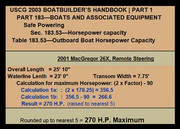
The reference to the general design reference 183.53 is interesting but something of a red herring given the manufacturer’s explicit statement:

The USCG gives deliberate deference to the manufacturer’s stated recommendations over that of general guidance information. This is because the manufacturer is better positioned to know what the actual construction/design/materials utilized. These specific aspects are the limiting characteristics, not generalized guidance information.
The 183.53 general guidance is non-specific reference material that doesn’t address what the material is, the fabrication process or the actual design characteristics.
The 183.53 guidance is an envelope baseline reference for preliminary design guidance. It is providing an upper reference potential horsepower limit for a generalized external envelope for a potential vessel have a proposed length and width. It is not a license to mount that engine on an actual vessel based upon that simplified generalized calculation. No competent cognizant USCG Design Engineering Office would allow that.
While you might have attempted to befuddle a particular insurance agent with this I doubt that the underwriters engineer would give it any relevant credence. (The aspect that you declared it is the item of merit in this and that is your ace in the hole regardless of whether the agent adjusted the policy cost or not relevant to the engine size.

That or the agent humored you and just faked it by not giving you the higher policy cost as a discount for multiple policies or customer loyalty like my insurance agent does when I’m up front with actualitys rather than hiding them


. )
So, let me ask the obvious question:
Q: If a boat is made of tissue paper, varnish, and cellophane tape by 8 year olds to the external envelope geometry of a Mac26X then you still propose that you could legitimately hang a 270 hp engine on it based on 183.53?
A: Obviously not, you’re smarter than that!
Similarly, any manual comment related to engine size about pull starting, weight, fuel economy, etc… are only consolation remarks to salve those whose desires leaned toward larger engines for whatever reasons they may have …..
MacGregor wasn’t a dolt. He was a sharp intelligent capable individual who was more than smart enough to have competent talented individuals working for and advising him. He also very deliberately made the specific statement regarding engine power:
“The boat is designed for an outboard motor of no more than 50 horsepower. Do not use a larger engine.”
Now if someone wants to know the maximum recommended horsepower for a Mac26X or a Mac26M it is 50 hp per the manufacturer.
Similarly, if someone chooses to install a larger oversized engine they are exceeding the manufacturer’s recommendation and are doing so ‘at risk’ or in other words are acting as pioneers seeking to personally find out how far they can go and ‘get away with’.
Personally I think it’s great that there are those individuals willing to do this as it give me greater confidence in the inherent strength and durability of the Mac26X and Mac26M design, materials and construction.

I find it reassuring and gives me confidence in our vessel that it has the potential to adequately handle what may be incurred
during normal and reasonable adverse circumstances.
I still figure you’re pranking me…
Best Regards
Over Easy



 ).
).




 … Doesn’t mean I wouldn’t like to but it just ain’t gonna happen
  That or the agent humored you and just faked it by not giving you the higher policy cost as a discount for multiple policies or customer loyalty like my insurance agent does when I’m up front with actualitys rather than hiding them
