Inquisitor wrote: ↑Mon Dec 21, 2020 1:19 pm
As indicated, I show a rebound voltage of 0.22 volts. This was used later in the test to determine the voltage to stop the test = 12.20 - 0.22 = 11.98 volts. Sure enough after stopping the test at 11.98 volts, the voltage rebounded to 12.20 volts after about ten minutes.
Either way, I really only have 22 amp-hours I can count on.
First, excellent use of a surprise cycle to predict the end of test target voltage.
Second. Sorry it's only 22 amp-hours, but proud of you for figuring it out. You are probably one of a very few that actually know what they have to work with. Bravo!
Jimmyt
P-Cub-Boo
2013 26M, Etec 60, roller Genoa, roller main
Cruising Waters: Mobile Bay, Western Shore, Fowl River
Inquisitor wrote: ↑Mon Dec 21, 2020 3:26 pm
But didn't you say you burned yours out the first time you used it? That's not exactly a glowing reference... actually, I think it is glowing.
Nope, but due to my twisted mis-use of the English language, I can see how you might think that.
Whatever paint or stamping Lube that was left on it from the factory smoked off on my first test. The tester is still fine.
And you are correct. Resistance testing produces heat.
Jimmyt
P-Cub-Boo
2013 26M, Etec 60, roller Genoa, roller main
Cruising Waters: Mobile Bay, Western Shore, Fowl River
Inquisitor wrote: ↑Mon Dec 21, 2020 3:26 pm
But didn't you say you burned yours out the first time you used it? That's not exactly a glowing reference... actually, I think it is glowing.
Nope, but due to my twisted mis-use of the English language, I can see how you might think that.
Whatever paint or stamping Lube that was left on it from the factory smoked off on my first test. The tester is still fine.
And you are correct. Resistance testing produces heat.
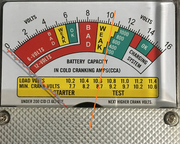
You got me almost sold. Let me see if I understand this device... If my battery is capable of 500 CCA, via some black-magic, this meter will show the needle midway between the 400 and 600 like...
How or what does it show me to show how much low amperage capacity the battery has... for running stuff like lights and marine electronics?
OR
...is there some correlation between CCA and low-current rate capacity, that I've failed to stumble into on the Internet?
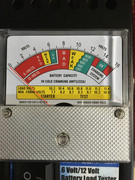
It is a one-hit wonder. Shows you voltage and cranking (surge) amps. It was designed for testing cranking batteries. I may not have stated that clearly earlier, but it won't tell you diddly squat about amp hours. And.... I don't have a batman decoder ring that will convert cranking amp capacity to amp-hours at any usage rate.
Only good for cranking current testing for cranking, or dual purpose batteries.
Jimmyt
P-Cub-Boo
2013 26M, Etec 60, roller Genoa, roller main
Cruising Waters: Mobile Bay, Western Shore, Fowl River
Oh, and it ain't magic. Just a big resistive load that can dissipate 12000 watts. So, as the manual says, the test should only be performed for a few seconds. I don't know if you've ever held 10-12 hair dryers in your hand before, but I'm sure you can imagine...
Jimmyt
P-Cub-Boo
2013 26M, Etec 60, roller Genoa, roller main
Cruising Waters: Mobile Bay, Western Shore, Fowl River
Jimmyt wrote: ↑Mon Dec 21, 2020 4:20 pm
Oh, and it ain't magic. Just a big resistive load that can dissipate 12000 watts. So, as the manual says, the test should only be performed for a few seconds. I don't know if you've ever held 10-12 hair dryers in your hand before, but I'm sure you can imagine...
At some point, I think I'd get the clue and let go.
Jimmyt wrote: ↑Sat Dec 19, 2020 10:39 am
Keep an eye on it while charging. I don't know that your charger will continue to force 12 amps into it as it approaches full charge. I don't believe I've ever seen any of my chargers do that. So, I don't know that 15.9 volts is a realistic voltage for the gear you're using. I would focus more on giving it plenty of time, then check the resting voltage to see if you've made 12.7.
Otherwise, I like the protocol,
If you watch it and it continues to force 12 amps in, tell me to go pound sand!
I'm obviously a little behind on this thread but I did not see anyone address this when I scanned ahead a little. The charger does not "force 12 amps" into the battery; the battery pulls 12 amps from the charger. The charger can limit the amperage it delivers and it can vary the voltage but it can never deliver more amps than the battery is asking for.
Bill
2001 26X Simple Interest
Honda BF40D
"If I were in a hurry I would not have bought a sailboat." Me
All of the following pertains to flooded lead acid batteries. AGMs are close, but not exactly equivalent in how they work. Lithium and all of its relatives are not even on the same planet.
+1 on the amp hour rating. The rating is for a completely discharged battery. It it also based on a 20 hour rate for most batteries (if it does not say differently you can assume 20 hours). If you have a 100 AH deep cycle battery that means you can pull a steady 5 amps out of it for 20 hours and it will be completely dead. That does not mean you can pull 10 amps for 10 hours (it will be less time) or that you can pull 1 amp for 20 hours (it will be more time). If you have the detailed specs (including Peukert constant) from the manufacturer and if you can accurately track the amps pulled from the battery you can accurately calculate the amount of run time left on the battery. That is what the expensive battery monitors are doing.
For maximum battery life even a deep cycle battery should only be discharged to 50%. An occasional trip lower, even to 100% discharge will not kill a healthy deep cycle battery, but it will shorten its life. That is why it is important when comparing various battery types and chemistries to compare usable amp hours per dollar.
Cranking batteries are rated by Cold Cranking Amps. Deep cycle batteries are rated by Amp Hours. There is no direct conversion between the two. There are some ways to approximate an equivalence but they are not really accurate. It is also important to understand that a cranking battery or a hybrid battery should only be discharged to around 70%. Most cranking batteries and even some "marine batteries" will be permanently (sometimes irreparably) damaged by a discharge to 50% or lower.
In summary: a 100 AH deep cycle battery can safely deliver 50 AH without shortening its life. A 100 AH "marine" or hybrid battery can deliver about 30 AH (maybe a little more) without hurting it. A cranking battery is not really designed to be discharged much at all but taking it down 30% will not hurt it significantly as long as it gets back to 100% reasonably soon. Taking a cranking battery to 50% or lower will significantly shorten its life and will often kill it completely if it is left discharged.
Charging these batteries is a whole other topic but the short take-away is that they all take longer to charge than to discharge. That is because while you can pull a steady amperage out of at any reasonable rate, the battery will be the one who determines the amperage when it is charging. Remember the previous post re: "pushing" vs "pulling" amperage during charging? The battery will initially take a fairly high amperage (usually around 20%-30% of the AH rating is usually recommended but you can go as high as 150% below 80% State of Charge - NOT recommended in general) when it is discharged, but that rate will significantly drop off as it gets closer to being fully charged. It is important that your battery be brought back to 100% charge on a regular basis. Consistently charging to 80% or even 90% (when the battery is taking the charge very quickly) causes your battery to sulfate and will significantly shorten its life or permanently damage it if it is allowed to continue.
Bill
2001 26X Simple Interest
Honda BF40D
"If I were in a hurry I would not have bought a sailboat." Me
Be Free wrote: ↑Tue Dec 22, 2020 7:48 am
OK, all caught up...
...It is important that your battery be brought back to 100% charge on a regular basis. Consistently charging to 80% or even 90% (when the battery is taking the charge very quickly) causes your battery to sulfate and will significantly shorten its life or permanently damage it if it is allowed to continue.
Lots of great information. Sounds like you might have something to do with that industry???
Jimmyt wrote: ↑Sat Dec 19, 2020 10:39 am
Keep an eye on it while charging. I don't know that your charger will continue to force 12 amps into it as it approaches full charge. I don't believe I've ever seen any of my chargers do that. So, I don't know that 15.9 volts is a realistic voltage for the gear you're using. I would focus more on giving it plenty of time, then check the resting voltage to see if you've made 12.7.
Otherwise, I like the protocol,
If you watch it and it continues to force 12 amps in, tell me to go pound sand!
I'm obviously a little behind on this thread but I did not see anyone address this when I scanned ahead a little. The charger does not "force 12 amps" into the battery; the battery pulls 12 amps from the charger. The charger can limit the amperage it delivers and it can vary the voltage but it can never deliver more amps than the battery is asking for.
Absolutely agree for an actual battery charger with a regulated output.
However a tinkerer, with an unregulated power supply, might find a different result.
It is my understanding that applying excess voltage (and current) through an unregulated source will cook the battery. The hotter it gets, the more current it tends to take (briefly). And, your lead acid battery becomes a paperweight (best case) in fairly short order. And, as a side benefit, you're releasing some rather entertaining gases. Now, if you aren't lucky and apply unregulated voltage to your lead-acid battery in a sparking atmosphere...
Jimmyt
P-Cub-Boo
2013 26M, Etec 60, roller Genoa, roller main
Cruising Waters: Mobile Bay, Western Shore, Fowl River
Jimmyt wrote: ↑Sat Dec 19, 2020 10:39 am
Keep an eye on it while charging. I don't know that your charger will continue to force 12 amps into it as it approaches full charge. I don't believe I've ever seen any of my chargers do that. So, I don't know that 15.9 volts is a realistic voltage for the gear you're using. I would focus more on giving it plenty of time, then check the resting voltage to see if you've made 12.7.
Otherwise, I like the protocol,
If you watch it and it continues to force 12 amps in, tell me to go pound sand!
I'm obviously a little behind on this thread but I did not see anyone address this when I scanned ahead a little. The charger does not "force 12 amps" into the battery; the battery pulls 12 amps from the charger. The charger can limit the amperage it delivers and it can vary the voltage but it can never deliver more amps than the battery is asking for.
Absolutely agree for an actual battery charger with a regulated output.
However a tinkerer, with an unregulated power supply, might find a different result.
It is my understanding that applying excess voltage (and current) through an unregulated source will cook the battery. The hotter it gets, the more current it tends to take (briefly). And, your lead acid battery becomes a paperweight (best case) in fairly short order. And, as a side benefit, you're releasing some rather entertaining gases. Now, if you aren't lucky and apply unregulated voltage to your lead-acid battery in a sparking atmosphere...
When I started to charge it before the discharge capacity test, it started out at the 12.65 volts. I read that the high-amperage charging might help reverse some of the sulfated plates. I always have charged at the 2 amp setting and that has always gotten this 12.65. I never considered pushing it. Now, I'm reading that its good to do it sometimes (doesn't say how often). I tried at the 10 amp and it jumped up to 14 and started slowly climbing. Checking the charge chart of I did watch it like a hawk. Over time, the voltage went up into the 15's but the current dropped below 8. I then put it on the 50 amp setting and the current came back up to about 12 and the voltage in the mid 15's. From here I was checking it almost constantly to make sure it didn't exceed 15.9 volts and to keep a hand on the charger to make sure it didn't overheat. Once it reached 15.9 volts it steadied on its own and the current started dropping all on the 50 amps setting. Very interesting to watch the battery's behavior.
... well compared to paint drying and watching golf.
Since the battery rested for over 48 hours and settled on 12.92 volts I hoped this was a good sign.
AND if I did screw it up... no big loss. I've already written this off as an experiment. Especially since I only have 22 amp hours to use.
You didn't hurt anything. You describe a charging process that you tinkered with, but was being electronically regulated.
I was not sure how old of a charger you had "My charger is just an old Craftsman 2/10/50 amp unit." or how it operated.
Sounds like it all went fine.
Be Free confirms that the amp-hour rating is to full discharge, so another piece of good info in your thread. Certainly will help me if I ever get around to my solar mod.
Jimmyt
P-Cub-Boo
2013 26M, Etec 60, roller Genoa, roller main
Cruising Waters: Mobile Bay, Western Shore, Fowl River