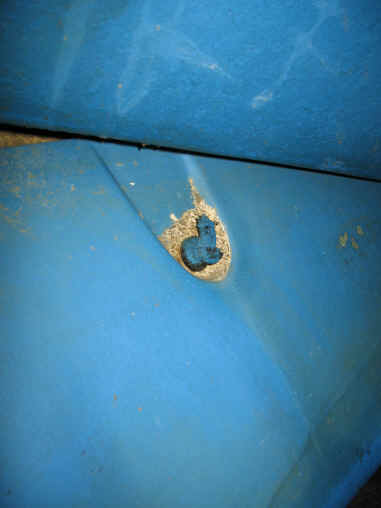
Kelly Hanson East wrote:Opie - I think you are right on this one. My

board took 7 years before I replaced it (and it hadnt broken yet) - three years in a slip, and the rest trailered. Im sure the wear point is the famous FG hole it feeds up at the top of the board. Maybe a piece of heat shrink sheath could provide some chafe protection there?
I disagree with the most commonly held opinion that the line is wearing at the mast support tube exit hole at the top of the trunk.
My line was worn thru the sheathing at only one spot, and that was at same place it was dragged across the back edge of the board, whenever the board was raised or lowered.
Since the line moves about a two feet total, then the line would also be feeding two feet thru the hole at the top of the trunk, and its wear would be spread over the two-foot span of line, instead of the singular place of abrasion seen on the photo above, and on my line also. Therefore the wearing would not be due to its moving there. The wear would have to be static there, just due to the board hopping up and down a but, but most of us tighten it completely when raised, so I don't see the wear happening at that point.
But there is a explanation how the line would wear in only one spot, or only over a couple of inches, from raising and lowering the board each time.
The edge of the board where the line passes..... the line makes about a 75 degree arc from its pivot from up to all the way down, and the lifting line is attached near the center of the board, not at the edge, as is the case of the rudders if using a thru-shackle. Therefore the line has to drag across the back of the board in its motion coming up, and that sawing would occur across a foot or so of board edge, but only across an inch or so of line.
Part of the problem is that the line is not fed from the recessed part of the board which would allow it to pass more vertically and not drag across the edge of the board. The line has to bend over that edge of the board, since it comes from a hole where the board is fatter, and has to pass thru a hole centered at the top of the arc. In effect, the board edge is moving across the line in one place, not the line feeding across a point of wear. That trailing edge of the board is alot "sharper" than the radiused edge of the trunk's hole. One other member has done the same as I plan, after drilling a second hole in the board above the first, or next to it actually, depending on the board's position.
The hole I drilled is in the same direction as the line, when the board is completely lifted, and therefore slightly aft when the board is down. That second hole allows the line to be knotted on the recess side, and then pass thru the board, move only an inch or two on the all-curved side of the board, and back thru the board to exit upwards on the recessed side again. That way, the line does not have to bend across the edge of the board as much. The inch or so of line exposure on the offside of the board is not at the board's fattest point, so it should not be bearing against the trunk on the line, and I bedded a partial groove between the two holes there, to bury the line halfway, 3/16" being half of the 3/8 line diameter. .... Hopefully the line pulling from closer to the boards centerline will reduce the sawing across its edge.
It's a tricky question of whether the wear is coming from the hole at the top of the trunk, or from the edge of the board. Those two locations on the line are only a few inches apart. But the pattern of wear being only in one spot of the line indicates the wear is NOT coming from the line being drawn in the direction of its length over a point. It would have to occur from the board just being in the raised position and stressing the line in the one spot. When the board is tightly cleated in the up position, if the one place in the line was against that one place at the hole, the board might have some bouncing moment that stretches the line and relaxes it causing that wear. This wear would be worse if the edge was rough, but on my boat, the edge was smooth, and did not look like any appreciable wear to the edge had occurred there.
That is possible, that a smooth edge could still stress and eventually cut the sheath of the line, but doesn't seem as likely to me, as the wear of the line across the board's edge, which would be caused from the board being raised and lowered. Careful comparison of the worn place in the line puts it at the edge of the board, for my line, and it looks like the same in the photos in the post of this thread, taking into account the amount of line in the knot.
Added observations or opinions ?
 Does the CB line bear against the fore edge of the hole, or aft edge ?