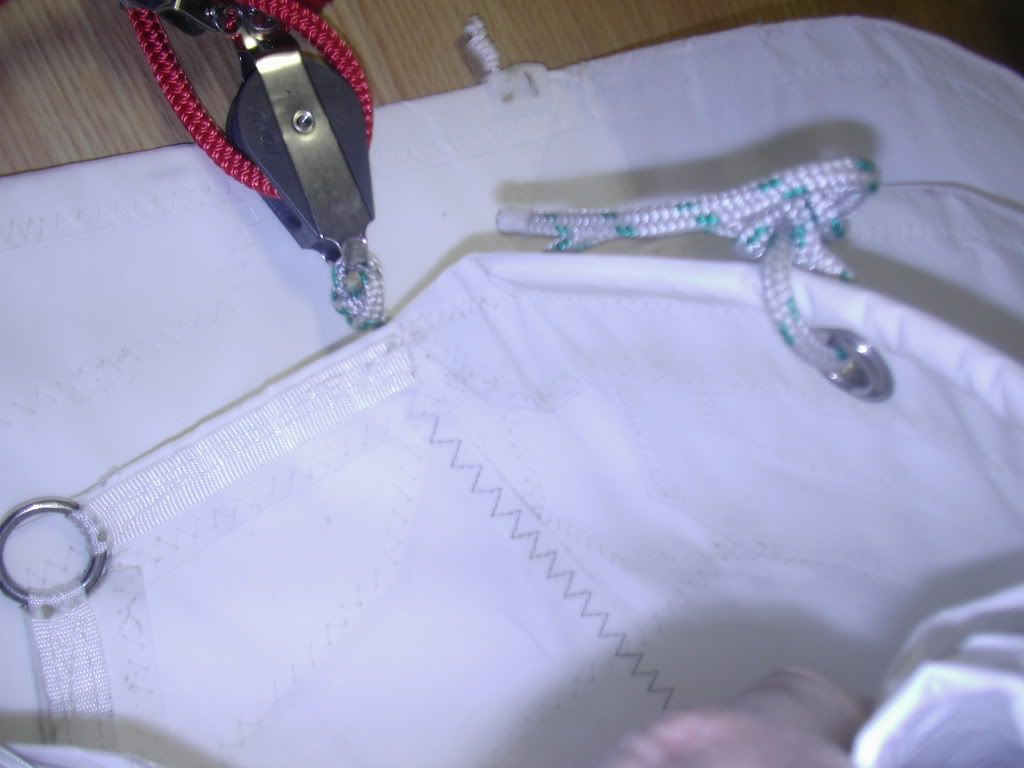
1. At the bottom of the luff of the mainsail there is a large chromed cringle; do you guys normally ensure that this is looped onto the ramshorn, or do you sail loose-footed? I have tried both, and the shape of the sail is very very different - specifically, if I hook it over the ramshorn, the luff gets taught long before the sail reaches the top of the mast and the sail itself is a lot flatter.
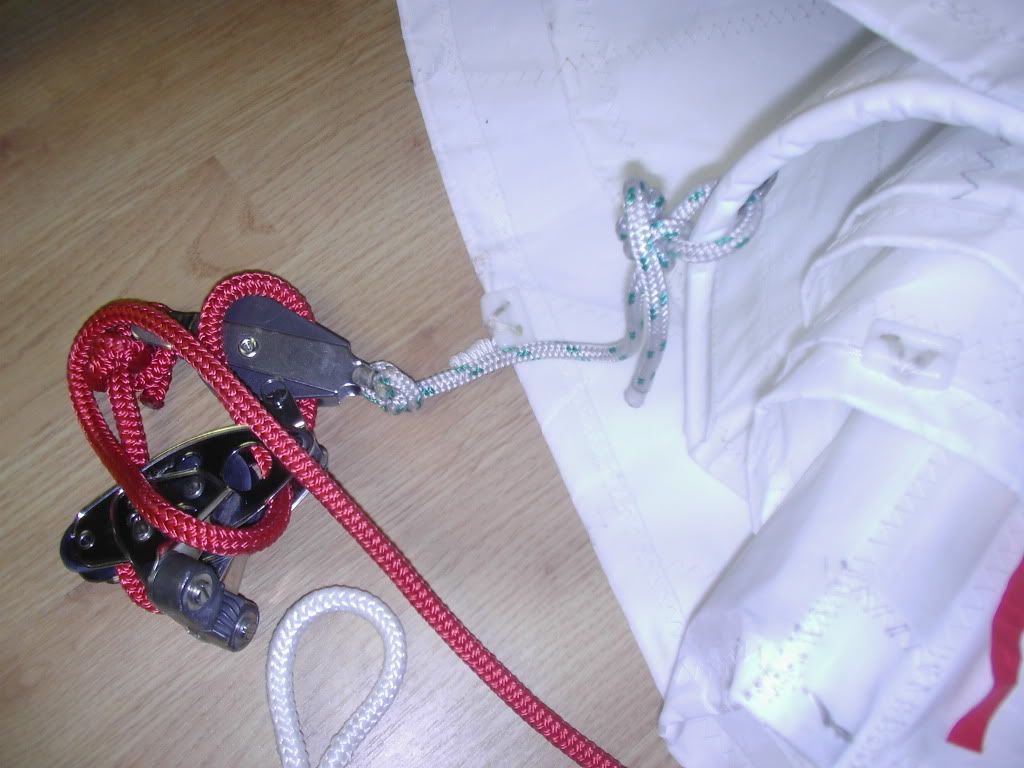
2. At the other end of the mainsail, has anyone come up with a decent mod to actively manage outhaul tension? The single length of 3/8 line hooked around the plastic cleat on the boom is fairly clumsy, resulting in either a completely tight foot or pretty slack and baggy sail, with nothing in the middle.
all comments gratefully received, all inspired knowledge and suggestions cycnically stolen and claimed as my own
Greeetings Magnetic,
I can give you an answer on question 1 - the cringle is for reefing the main. It is hooked to the ramshorn when reefing, thus explaining why you got a short main with it hooked!
-seacatcapt
firstly the reefing point is much further up the sail; secondly, the manual states that "the ring in the lower front corner of the sail attaches to the stainless steel ears on the gooseneck with a 1/4" x 1 1/2" bolt and locknut"
However, when I attach the ring in this way, no matter how much I tension the luff (via the halyard), the sail is still 4+ inches short of the top of the mast
all thoughts gratefully etc
Last edited by magnetic on Wed Apr 20, 2011 9:09 am, edited 1 time in total.
I think the sail being 4" short of the mast top is pretty much standard.
My old factory sail and my new Musclehead were/are about what you describe.
Perhaps you are a victim of "shrunken bolt rope"?
It's not a bad idea (IHMO) to cut the stiches that sew the bolt rope to the sail at the clew area.
By doing that, when your haul the main halyard, the sail will be tight and not just the bolt rope.
It was the first thing I did to my Musclehead.
The stiched end of the bolt rope in my old sail eventually rose in the sail pocket about 1 1/2 inches by the time it was retired.
#1 I have one cringle approx 12" above the mainsail tack ring I beleive I had that installed for my cunningham when I had my mainsail converted to a loose foot , my next cringle is approx 42" to 48" up from the tack ring http://i844.photobucket.com/albums/ab1/ ... 0001-1.jpg
The main on this boat is so small and light that even while not really trying I can get the luff way too tight. And the sail will stretch over time slightly. Four or five inches is not a problem.
We are not talking 10000 dollar tailored suits here. I dont have any issues with the cleat for the out haul. A person of average strength can over tighten it. Mine seems to adjust easily without bothering to put on extra hardware.
I did however have a sail maker add three additional reefing eyelets so I have a total of five. This makes tying in the reef point much easier and makes a nice neat seaman-like reef.
Also instead of using that bulky jib block and stainless plate affair, I tied a plastic shelled block with stout line where it would normally attach. Yes I saw the admonishment to be careful when doing mods to the rigging. I am quite sure I can use that block to pull the boat right over on her beam ends with the current set up and it will not scratch the mast or bind between the upper shroud tangs.
I also added a topping lift.
firstly the reefing point is much further up the sail; secondly, the manual states that "the ring in the lower front corner of the sail attaches to the stainless steel ears on the gooseneck with a 1/4" x 1 1/2" bolt and locknut"
However, when I attach the ring in this way, no matter how much I tension the luff (via the halyard), the sail is still 4+ inches short of the top of the mast
all thoughts gratefully etc
Magnetic--The mast is 6" taller than the maximum sail height to accommodate the factory reefing mainsail option using the stock sail, which stands about 6" off the boom.
my stock mainsail is not loose footed and certainly does not stand 6 inches off the boom - the first reefing point is also significantly higher. In Highlander's first picture, the ring I am talking about is clearly visible at the lower front corner of the sail, on the extreme left of the photo
magnetic wrote:my stock mainsail is not loose footed and certainly does not stand 6 inches off the boom - the first reefing point is also significantly higher. In Highlander's first picture, the ring I am talking about is clearly visible at the lower front corner of the sail, on the extreme left of the photo
Magnetic--it's not the sail that stands off the boom, it's the furler roller bar. It's a different boom with a roller furler on it, and it's a factory option. That optional mainsail roller furler requires the mast to be 6" higher than without.
On my there is a squared off u-shaped bracket that sits on top of the goose neck. The bolt that hold the boom on the goose neck goes down through this u-shaped bracket. At the top of each arm of this u-shaped bracket there is a hole. And through this hole goes a cotter pin with a ring ding to hold it in place. I use this pin to hold the cringle at the bottom of the luff in place...keeps it from rising up or pulling back away from the mast.
I also have the issue where my sail does not quite go all the way to the top. But it is pretty close. The luff is nice and tight.
I have sailed many hours with this cringle not attached...forgot to hook it up a few times and lost the cotter pin once or twice. But I could tell no difference in performance...the sail was very, very, very slighlty loose in the bottom corner at the boom/mast intersection.
And as for my outhaul...I tie it off as tight as I can pull it to the cleat on the end of the boom. I have never adjusted this...just no need to adjust.
I don't seem to have any pictures of that bracket and pin...
Humm go figure I thought this was why it is called Fractional rigging .. The Main sail stops a small fraction of the overall mast length/height.. from the top??? I better stick to playing my guitar and finishing my honey-do list hahahaha back to one o r the other
Divecoz wrote:Humm go figure I thought this was why it is called Fractional rigging .. The Main sail stops a small fraction of the overall mast length/height.. from the top??? I better stick to playing my guitar and finishing my honey-do list hahahaha back to one o r the other
Technically fractional means the jib doesn't go all the way up. Mainsail not going all the way is just wasted mast
mastreb wrote: Mainsail not going all the way is just wasted mast
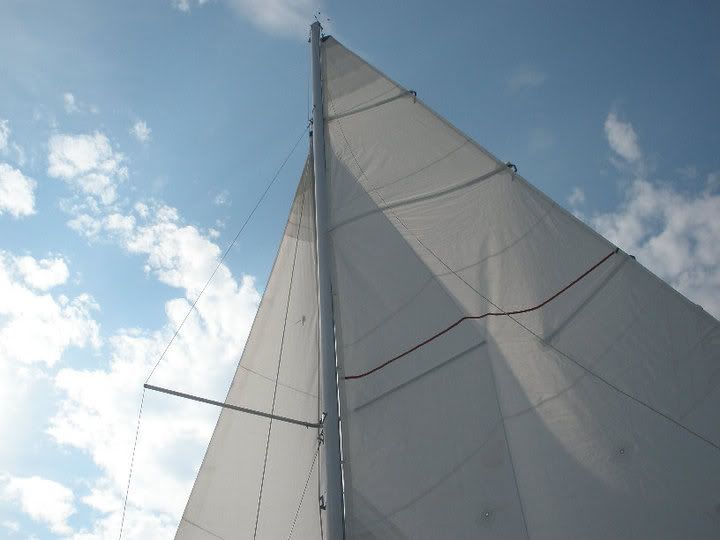
Is this the gap from the top you are talking about? That is as high as I can raise my sail. Pretty sure the rigging would not allow proper sail tension if the sail went much closer to the top.
1. At the bottom of the luff of the mainsail there is a large chromed cringle; do you guys normally ensure that this is looped onto the ramshorn, or do you sail loose-footed? I have tried both, and the shape of the sail is very very different - specifically, if I hook it over the ramshorn, the luff gets taught long before the sail reaches the top of the mast and the sail itself is a lot flatter.
I don't know what a ramshorn is but the luff of the sail is where the sliders attach and run up the mast. The ring at the tack of the sail goes exactly where the manual says, the bolt in the gooseneck holds the tack in place. If you have some baggy slack right at the tack near the boom and it appears you can raise the sail a bit more and you can clearly see there is room at the mast top then you have another problem, espedcially if the sail feels taught and the leech is tight. I have this problem all the time with both my oem doyle sail and the Musclehead, and what I do to overcome it is release the boom vang and the mainsheet when I hoist the mainsail facing into the eye of the wind. This allows me to get that last couple inches of luff pulled tight so that there is no baggy pocket right there at the tack. You can also tighten the outhaul at this point before you tighten the boomvang and mainsheet. After you tighten the outhaul you can tighten the boomvang then the mainsheet then you can bear off the eye of the wind and fill your nice flat sail. This works great for strong winds but in light airs you may wish to have that baggy pocket at the tack to create a bigger belly in the mainsail and catch more wind.


 there is a squared off u-shaped bracket that sits on top of the goose neck. The bolt that hold the boom on the goose neck goes down through this u-shaped bracket. At the top of each arm of this u-shaped bracket there is a hole. And through this hole goes a cotter pin with a ring ding to hold it in place. I use this pin to hold the cringle at the bottom of the luff in place...keeps it from rising up or pulling back away from the mast.
 I thought this was why it is called Fractional rigging .. The Main sail stops a small fraction of the overall mast length/height.. from the top??? I better stick to playing my guitar and finishing my honey-do list hahahaha
  back to one o