Fail Unsafe
Posted: Tue May 03, 2011 5:29 am
so, there I was powering along solo at around 12 knots, ballast out, into about a Force 4 off the east coast of Sai Kung, when I noticed that the sunbrella cover on the 150 Genny was flapping about a bit, so I slowed right down and went forward to sort it out. The forestay and the sail itself appeared to be fine, just the cover a bit flappy, so I decided to unzip it and carry on motoring without it. Who knows, I might decide to actually sail a bit later on when I wasn't heading directly into the wind.....
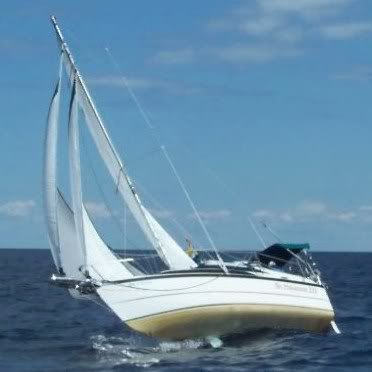
Anyhow, of course, the is not going to have any of this "leave the wheel unattended" nonsense, and as soon as I'm up on the foredeck the first puff of wind causes the bow to veer off onto what I suppose was a broadish reach, at which point the now-unsheathed 150 Genny decides it's time to unfurl itself. Quite how, I don't know, as the line was cleated off, but anyhow, more of that in a moment. We now have me on the foredeck with a big Genoa flapping uncontrollably in a Force 4, with the boat beam on to some 5ft+ waves and no ballast in, no boards down, and no obvious way of getting the sail either sheeted or rolled back in. Mild concern at this point..... (I was of course wearing a lifejacket, and thought I might actually need it...
  )
)
As I have commented before, the inside of the furler drum on the Mac was designed solely with the intention of removing fingers, and although I could see that the line was still fully out (it should have been wound right up as the sail unfurled), there was no quick way of getting the mechanism to work as intended, especially as I was now lurching about at 30 degrees or more. If I had somehow managed to furl it back in by hand, it would only have run out again the moment I let go, so that wasn't really an option, and the sail was flogging itself to death. What to do? I seriously considered sending out a PAN PAN call to the Coastguard (Hong Kong Marine Department) but didn't.
1. I got back and turned the nose back into the wind to calm everything down
2. Opened the ballast valve PDQ, taking care to maintain (1) while it filled, dropped the rudders and
3. Ferry-glided the boat horizontally for about 400 yards - it took forever - until I was in the lee of a cliff, killed the engine and went forward again
4. I managed to get the sheets attached to the Genoa, and tied the Starboard side off pretty tight to stop the sail flogging itself to death. Bad move. The boat took this as an invitation to start sailing, and the shore beneath the abovementioned cliff started rapidly coming into view. Plan B.
5. Turned downwind, let the sheet right out so that the sail was in two minds which side of the mast it wanted to set on (mini-gybes, but nothing half as scary as the previous scenario)
6. At this point I decided to re-furl the sail by hand, which took almost 10 minutes against the pressure of the wind, and I wrapped the sheets around the sail to stop it unfurling again. I then swallowed hard and put my fingers into the Jaws of Death - i.e. the furler drum - to wind the furling line back on, which involved passing the entire 20+ feet of line around and around the drum. I eventually got there, by which time I had moved just over 2 nautical miles downwind of my original position. {ON EDIT} as pointed out below, this is utter nonsense, as the line needed to be fully out once the sail was furled back on. Upon reflection, what I in fact did was to lift up the drum and re-seat it to make sure that it was fully engaged on whatever internal mechanism it sits on, such that the furler itself could no longer rotate freely without involving the line on the drum. All I know is that I was more than half expecting to lose a pinky or two...
Having been really quite worried, I was elated, but over the next few hours I gave some seriosu thought to how nasty this could have been - especially if it had happened at night or in a stronger wind. I still don't know what it was that allowed the sail to unfurl in spite of the drum being tied off, and when I subsequently unfurled the sail and enjoyed some actual sailing later in the day, everything worked just like it says in the book.
My point is this; because the furler is attached to the forestay and not a halyard, there appears to be no way of dropping the Genoa without dropping the mast (which was clearly not an option here). That is a very, very powerful sail in a Force 4, and its virtually impossible to hang on to it by hand. If it goes out and decides to stay out, you have a potentially serious problem on your hands, and although I am no hero, I am really really pleased that I was able to figure out a way to react to this situation. It could have been very different.
Has anyone else experienced this, or worried about what would happen if the furler jammed? I love my , and am actually coming to believe that she is a far better sailing boat than she is under power, but what with the disaster waiting to happen if the daggerboard drops when powering at speed, this second risk item seems to indicate a less-than-well-thought-out design, from a safety perspective at least.
In closing, the antifouling Neville applied in Dubai didn't work at all in Hong Kong and after 4 months on the mooring Morwenna was carrying an absolute forest of marine worms on the hull, limiting speed to about 12 knots and messing directional stability about. I still think the Honda BF50 is a truly awful motor, but after being serviced, scrubbed down and re-antifouled she got back up to 16 knots SOG on the way home, which isn't bad (though it hammers the fuel consumption). However, take those mittens off the wheel for even half a nanosecond, and who knows which way the next puff of wind or wave will take you....
Anyhow, of course, the
is not going to have any of this "leave the wheel unattended" nonsense, and as soon as I'm up on the foredeck the first puff of wind causes the bow to veer off onto what I suppose was a broadish reach, at which point the now-unsheathed 150 Genny decides it's time to unfurl itself. Quite how, I don't know, as the line was cleated off, but anyhow, more of that in a moment. We now have me on the foredeck with a big Genoa flapping uncontrollably in a Force 4, with the boat beam on to some 5ft+ waves and no ballast in, no boards down, and no obvious way of getting the sail either sheeted or rolled back in. Mild concern at this point..... (I was of course wearing a lifejacket, and thought I might actually need it... )As I have commented before, the inside of the furler drum on the Mac was designed solely with the intention of removing fingers, and although I could see that the line was still fully out (it should have been wound right up as the sail unfurled), there was no quick way of getting the mechanism to work as intended, especially as I was now lurching about at 30 degrees or more. If I had somehow managed to furl it back in by hand, it would only have run out again the moment I let go, so that wasn't really an option, and the sail was flogging itself to death. What to do? I seriously considered sending out a PAN PAN call to the Coastguard (Hong Kong Marine Department) but didn't.
1. I got back and turned the nose back into the wind to calm everything down
2. Opened the ballast valve PDQ, taking care to maintain (1) while it filled, dropped the rudders and
3. Ferry-glided the boat horizontally for about 400 yards - it took forever - until I was in the lee of a cliff, killed the engine and went forward again
4. I managed to get the sheets attached to the Genoa, and tied the Starboard side off pretty tight to stop the sail flogging itself to death. Bad move. The boat took this as an invitation to start sailing, and the shore beneath the abovementioned cliff started rapidly coming into view. Plan B.
5. Turned downwind, let the sheet right out so that the sail was in two minds which side of the mast it wanted to set on (mini-gybes, but nothing half as scary as the previous scenario)
6. At this point I decided to re-furl the sail by hand, which took almost 10 minutes against the pressure of the wind, and I wrapped the sheets around the sail to stop it unfurling again. I then swallowed hard and put my fingers into the Jaws of Death - i.e. the furler drum - to wind the furling line back on, which involved passing the entire 20+ feet of line around and around the drum. I eventually got there, by which time I had moved just over 2 nautical miles downwind of my original position. {ON EDIT} as pointed out below, this is utter nonsense, as the line needed to be fully out once the sail was furled back on. Upon reflection, what I in fact did was to lift up the drum and re-seat it to make sure that it was fully engaged on whatever internal mechanism it sits on, such that the furler itself could no longer rotate freely without involving the line on the drum. All I know is that I was more than half expecting to lose a pinky or two...
Having been really quite worried, I was elated, but over the next few hours I gave some seriosu thought to how nasty this could have been - especially if it had happened at night or in a stronger wind. I still don't know what it was that allowed the sail to unfurl in spite of the drum being tied off, and when I subsequently unfurled the sail and enjoyed some actual sailing later in the day, everything worked just like it says in the book.
My point is this; because the furler is attached to the forestay and not a halyard, there appears to be no way of dropping the Genoa without dropping the mast (which was clearly not an option here). That is a very, very powerful sail in a Force 4, and its virtually impossible to hang on to it by hand. If it goes out and decides to stay out, you have a potentially serious problem on your hands, and although I am no hero, I am really really pleased that I was able to figure out a way to react to this situation. It could have been very different.
Has anyone else experienced this, or worried about what would happen if the furler jammed? I love my
, and am actually coming to believe that she is a far better sailing boat than she is under power, but what with the disaster waiting to happen if the daggerboard drops when powering at speed, this second risk item seems to indicate a less-than-well-thought-out design, from a safety perspective at least.In closing, the antifouling Neville applied in Dubai didn't work at all in Hong Kong and after 4 months on the mooring Morwenna was carrying an absolute forest of marine worms on the hull, limiting speed to about 12 knots and messing directional stability about. I still think the Honda BF50 is a truly awful motor, but after being serviced, scrubbed down and re-antifouled she got back up to 16 knots SOG on the way home, which isn't bad (though it hammers the fuel consumption). However, take those mittens off the wheel for even half a nanosecond, and who knows which way the next puff of wind or wave will take you....