arknoah wrote:I need to install jiffy reefing on my 1984 Macgregor 25. Does anybody have specific recommendation on buying a reefing kit, like one from Harken or another manufacturer? Is it better to go with the kit versus buying components? I’d also like recommendations on the sealant to buy once I install fairleads or other items into the deck.
In addition, I recall seeing where one manufacturer recommends installing a device at the mast to contain the slugs so the reefing is more effective. Since I’m not able to weld one like Sumner, is this really necessary and is there another way to do it? I tried using the search to answer these questions but couldn’t find all I wanted.
Thanks in advance for your help.
Hi,
Nobody has jumped in here yet with info specific to the Mac 25, so I'll offer some advice. If you want more specific advice, please post pictures of your boom and gooseneck and I'll do my best to help. Does your mainsail have slides or a boltrope?
I sail on San Francisco Bay, where winds range from 0 to 25 or 35 knots. I've been reefing and un-reefing for over 30 years, on many different boats with different gear.
Where do you sail? What's your budget for adding reefing?
There are two general approaches. You've got to pick one first and then we can work on the details.
Option 1: All reefing lines lead forward to the mast.
It's a relatively easy project to install the hardware for reefing with lines lead forward.
First you heave-to to get the boat quiet and level and self-steering, even in rough conditions. Then you go to the base of the mast to put in the reef while the boat takes care of itself.
Heaving to is an easy maneuver to learn. Sailors have been heaving to in order to reef for a long, long time -- because it works. Reeing this way works and it's not physically hard to do, especially with the small mainsail of a 26 footer.
For hardware, you will need one line, one block, and one horn cleat for the reef clew. You will need a hook at the gooseneck . And some low stretch line and a small SS ring That's it.
The picture below shows reefing gear for a double reefed mainsail with lines lead forward along the boom. Everything needed for reefing can be reached from a sitting position on the starboard side of the mast, while the boat is on starboard tack. The cleats on the boom are for the aft reefing lines. The gooseneck has a reefing horn attached for the front of the reef. The main halyard is held by a horn cleat on the mast.
<br><br>

<br><br>
I realize that I haven't described the hardware needed on the aft end of the boom, and I'm running short on time. In brief, you tie the line around the boom, run it up and through the reef cringle, down to a cheek block at the outboard end of the boom, and then forward to the cleat on the boom.
Option 2: Run sail control lines aft to the cockpit.
This is a much bigger project than installing reefing lines at the mast. It's nice to have, but you really don't need to do it. It adds time to rigging too.
If you plan to run the reefing lines aft, you should also run all these other lines (if you have them) to the cockpit, so you're not scrambling back and forth. They also need to be accessible when you reef: main halyard, vang, topping lift, outhaul (so you can ease it when shake out the reef and haul the main back up)
If you're going to run lines aft to the cockpit, double line reefing is more reliable than single line, for a lot of reasons. The key is that you use separate lines for the front and back of the reef, because you're pulling the front of the sail in one direction, and the back of the sail in the other. It's mechanically simpler and more precise than using one line to pull the sail in two different directions. It's less friction so it takes less strength. It's less likely to damage the luff of the sail.
Fair winds,
Judy B


 .
.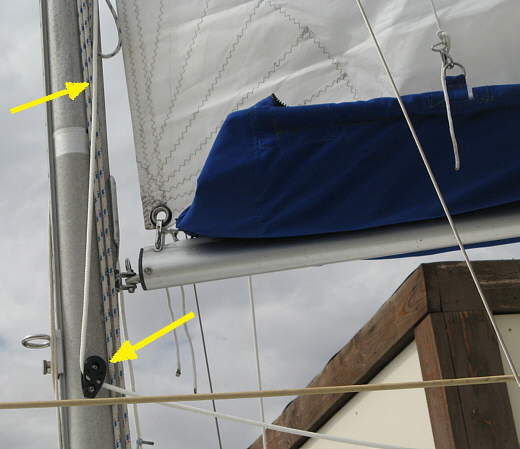
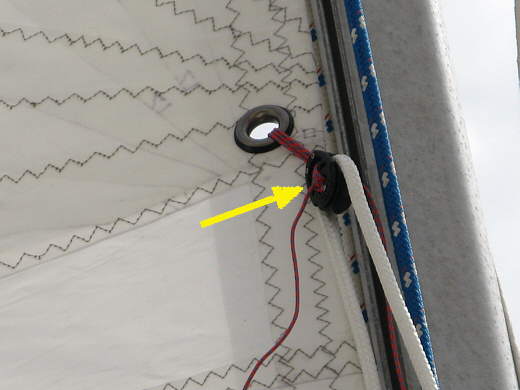
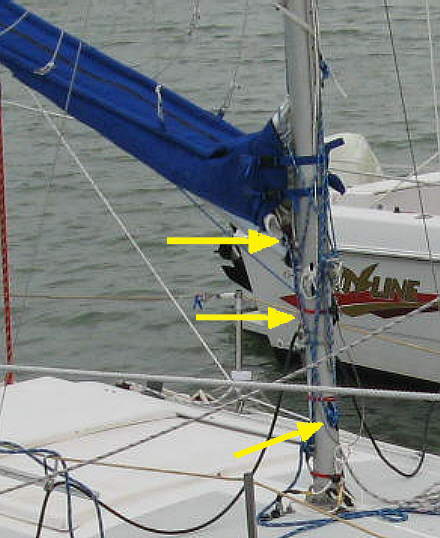

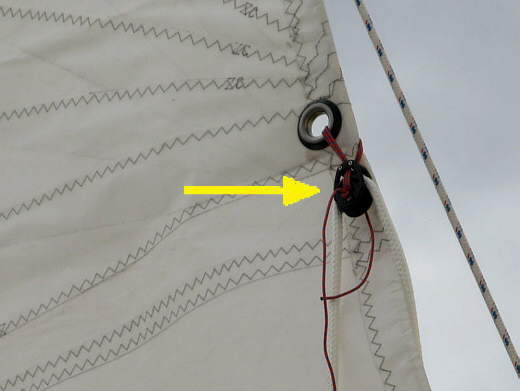
 , with the line led to the aft end of the boom. I do end up with spaghetti in the cockpit when reefed but I just do a sheeps head with it and it goes away