Page 1 of 1
wire size from motor to batteries
Posted: Sun Aug 16, 2015 12:51 pm
by ris
My alternator is supposed to charge the batteries at 22 amps. It is around 14 feet from the motor to the battery switch. A couple of questions: Do I run the wires straight to the batteries or to the battery switch? (plan to use (2) 6 volt trojan batteries as starting battery and house battery will be a 2nd bank of trojans batteries) What size wire should I use from motor to start batteries? Are all the wires supposed to just lay in the bilge or should they be in conduit above the bilge? I can wire a house but this boat wiring is a little different with all the fuses to protect wiring and choosing wire sizes. Plan to put charger. switches and breakers on board aft of galley and above were start battery are on

. Have also thought of putting batteries under v-berth to put weight forward, any thoughts on batteries under v-berth? We are planning on starting great loop in early 2016 which is part of the reason for 2 large battery banks and new motor. Chinook should have started his road trip part of his loop voyage this weekend. Thanks for the help.
Re: wire size from motor to batteries
Posted: Sun Aug 16, 2015 3:53 pm
by Russ
You can start our motors with a motorcycle battery. Why the 2 big 6 volt Trojan batteries? Save them for house bank.
Lots of ways to do this. My motor has it's own battery....just for itself...just to start the motor. It's the original battery (7 years old) and going fine. Once it starts, power (charging) goes back into this battery. A combiner senses voltage is high (charging) and combines it with house to charge both. Disconnects (isolates) when motor shuts off.
You could have 2 banks and switch between them via the battery switch. Motor on the common pole of the switch so it charges whatever bank is active.
Re: wire size from motor to batteries
Posted: Sun Aug 16, 2015 4:05 pm
by Sumner
Using 2 banks of 6 volt batteries is a great idea but I'd put them all into one house bank and not separate them. There are a couple ways to do this. One would be by using......
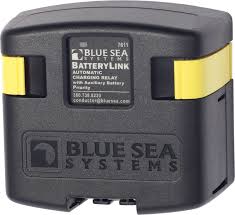 https://www.bluesea.com/products/7610/S ... 4V_DC_120A
..... a combiner between them or tying them together with a 1-2-Both-off switch but I'd just tie them permanently together and I'll show that in a minute. Doing so would be the best for charging them and for battery life as you wouldn't draw them down as far and they would charge as one large bank which is the most efficient way to charge them. If you tied the two banks together and then wanted to have a start battery I'd use the combiner between it and the house bank.
The other real plus is you would have the outboard attached to the entire bank always so no chance that you would be running it and someone accidentally throws the 1-2-Both-Off switch to 'Off' where you could damage the outboard's charging system. This is how I have mine wired.
So what if the batteries somehow go dead and you have an outboard that you can't pull start. Also take one of these....

... on the boat. Besides backup for starting the outboard you have an air compressor if you take a bike with you. It also simplifies filling an inflatable with a 12 volt pump as you can take it to the inflatable and connect the jumper cables to the pump leads. I took one with me on the last trip and used it for that but never had to use it to start the outboard. The house bank never went below about 60% in 3 months only using solar (the outboard only puts out 6 amps and didn't run it much for 500-600 miles).
Here is how I'd wire it....

The four 6 volt batteries are wired as one bank and notice the positive connects to one set and the negative ground to the other. That helps in charging and in using them to keep them all equal.
There are two on/off switches. One to disconnect the solar if you have that and the other to disconnect the house loads from the house bank.
Notice you can only disconnect the outboard by manually disconnecting it's power or ground leads. A good safety feature to protect the charging system on it.
If one set of batteries had a serious problem you could easily disconnect that set from the other by again disconnecting either the lead between them or the power or ground lead on one or the other in the set. You should never have to do that though.
On the correct wire size for the run from the outboard it probably isn't what the charging system puts out but should be based on the current the outboard needs to start or whichever is higher. It should also be based on the total distance from the outboard to the battery not to a switch between one if you do go that route (I wouldn't). I can post wire size calculators if you need it but we need to know the draw when the outboard is starting to compare it to the possible charging amps.
Also don't forget that just because the outboard can put out 22 amps that as the batteries charge they won't take that current. It will drop as they top off. So you end up running the outboard a long time to top them off. That is where the solar does such a nice job as it can fill them over hours. If the batteries are way down then let the outboard to its thing and if you have an amp meter (nice to have for this very situation) when the amps get down to what your solar can supply or even say below 15 amps with the outboard running turn it off if you don't need it and let the solar do the rest.
I'd put in a volt meter for sure so that you can monitor battery voltages at a glance and I also put in an amp meter that use a shunt on the negative side of the battery but this isn't really needed but with it you can see what different loads are and how many charging amps are going to the batteries at any time as mentioned above.
If there are questions just ask and I realize people are enamored with 1-2-both-off switches but in most cases they aren't the best way to wire the system, especially in your case using a great setup of four 6 volt batteries. That is a smart move for a trip like this,
Sumner
============================
1300 miles to the Bahamas and back -- 2015
The MacGregor 26-S
The Endeavour 37
Trips to Utah, Idaho, Canada, Florida
Mac-Venture Links
Re: wire size from motor to batteries
Posted: Sun Aug 16, 2015 4:36 pm
by ris
RussMT if you already have 1 battery to start why not add a second and you have a start and house bank in one with the addition of one battery, I was thinking I could add another 2 trojans for the main house bank but use the start/house bank as a second bank. I have to use a cpap at night which consumes a lot of power so if you are on the hook in bad weather for a couple of days the 2 house banks might come in handy. We will have a 1000 watt honda generator if we run both sets of batteries down but we have no solar. I simply do not know how much battery power we will need for extended cruising, so thought of adding 1 battery is not that big of a deal.
Re: wire size from motor to batteries
Posted: Sun Aug 16, 2015 4:51 pm
by ris
Sumner I guess you posted while I was busy answering RussMT. Being kind of ignorant of this DC electrical stuff, just assumed the two banks should be separated. In your diagram, forgetting the solar part, it seems all that needs to be done is add on/off switch between batteries and breaker panels. Is this correct? We are getting the 60hp Honda high thrust motor have no idea about wire size to start it, but there is #6 that was used to start the 50 hp suzuki (now gone) but there are 2 or 3 different lengths of wire connected together. Would like to install one continuous piece. Which is why we were wondering what size of wire from motor to batteries. Where would the battery charger be wired in? Thanks for your help Sumner and yours also RussMT.
Re: wire size from motor to batteries
Posted: Sun Aug 16, 2015 6:00 pm
by Sumner
ris wrote:.....In your diagram, forgetting the solar part, it seems all that needs to be done is add on/off switch between batteries and breaker panels. Is this correct? .
Yes, but I would also follow the ABYC standards and put fuses on the output (positive side) of each set of 6 volt batteries...
 http://www.genuinedealz.com/blue-sea-sy ... minal-fuse
...and size the fuse to the wire size going to the breaker panel and outboard. The key to the wire size needed for the run to the outboard is how many amps does it draw when starting. I can't find that in the manual but did find a warning problems if you don't use a large enough wire if you extend the cables that comes with the outboard. I'd be calling Honda tech and telling them the total distance from the outboard to the batteries (consider the bends in the route--use a piece of line to simulate the wire run). Then ask them what size wire you should use in conjunction with the stock wiring or if you should shorten it and just run one length of larger wire for the entire run. The link I supplied above also has a wire calculator with it and they have about the best price on wiring I've found and they are who I've used for all the wiring on the Mac and Endeavour.
ris wrote:.....Where would the battery charger be wired in? Thanks for your help Sumner and yours also RussMT....
Make the wire from the fuse on the battery top to the breaker the same size so that the fuse is protecting that run along with the run to the outboard. If the wiring works out I'd run the pos. from the outboard and charger to the one pos. post and would put in an on/off switch only in the one from the charger and in the one to the breaker.
Then the neg. from the outboard and charger to the negative post on the 2nd set of 6 volt batteries and that is where you would also run a negative wire going to a bus-bar to which you could run the neg. side of all the house loads.
Depending on location another option would be to run from the pos. post on the one set of 6 volt batteries to one post of a twin post terminal. Also attach the pos. wires to the outboard/charger and breakers to that post. Then run a wire from the neg. side of the other set of 6 volt batteries to the post along with the pos. wires from the outboard/charger/breakers to the other post on the twin post terminal. Make all of those wires the same size as what you need to run back to the outboard so the battery fuses can protect them,
Sumner
============================
1300 miles to the Bahamas and back -- 2015
The MacGregor 26-S
The Endeavour 37
Trips to Utah, Idaho, Canada, Florida
Mac-Venture Links
Re: wire size from motor to batteries
Posted: Sun Aug 16, 2015 6:08 pm
by Sumner
It also looks like that motor has emergency pull start capabilities not that I might be able to do that

Sumner
============================
1300 miles to the Bahamas and back -- 2015
The MacGregor 26-S
The Endeavour 37
Trips to Utah, Idaho, Canada, Florida
Mac-Venture Links
Re: wire size from motor to batteries
Posted: Sun Aug 16, 2015 7:19 pm
by walt
Sumner is right about sizing the wire for the starting current.
On my Nissan 9.8, there is a sticker on the outboard starter motor that says 0.5KW i.e., 500 watt.
If you assume 12 volts and use ohms law, this gives a current of 500/12 = 41.6 amps
I have measured the starting current on this outboard and its around 35 amps at "room temp" and about 50 amps when very cold - like udder 40F.
So.. the current I measured is somewhat close to the calculation based on the label on the outboard.. If you can find this same type of power sticker on the starter, you probably could use this to estimate starting current.. I think you will probably end up with four gauge wire.
Can’t add much to what Sumner said but I was wondering what the purpose of the switch is in your diagram that isolates the solar charge controller from the batteries? You can leave the solar charge controller connected while charging from any other source like the outboard, or AC plug in charger.
Re: wire size from motor to batteries
Posted: Sun Aug 16, 2015 7:32 pm
by Catigale
walt wrote:Sumner is right about sizing the wire for the starting current.
On my Nissan 9.8, there is a sticker on the outboard starter motor that says 0.5KW i.e., 500 watt.
If you assume 12 volts and use ohms law, this gives a current of 500/12 = 41.6 amps
I have measured the starting current on this outboard and its around 35 amps at "room temp" and about 50 amps when very cold - like udder 40F.
So.. the current I measured is somewhat close to the calculation based on the label on the outboard.. If you can find this same type of power sticker on the starter, you probably could use this to estimate starting current.. I think you will probably end up with four gauge wire.
Can’t add much to what Sumner said but I was wondering what the purpose of the switch is in your diagram that isolates the solar charge controller from the batteries? You can leave the solar charge controller connected while charging from any other source like the outboard, or AC plug in charger.
Your voltage will drop to about 10 volts when you crank so 50 amps is probably a conservative estimate.
Don't forget the total wiring run is twice the distance between battery and motor.
You can use the more forgiving 10 % voltage drop chart for the correct wiring gauge.
You will find 6 AWg will be fine for your starter application. Make good connections and splices and put them in places where they can be easily inspected and maintained
Re: wire size from motor to batteries
Posted: Sun Aug 16, 2015 8:15 pm
by walt
starter says 500W, I measure about 35 amps, use this to scale at your own risk of course.
Here is a number comparison of 4 gauge vs. 6 gauge. For this example, let’s say your outboard starter uses 60 amps (complete guess based on my 9.8 hp using 35 amps but its what I will use for this example).
Either four or six gauge wires are good at starting fires with a 12 volt battery so you if you go to the higher gauge wires, you definitely want to fuse this at the battery.
For 60 amp starting current, let’s say you pick a 100 amp fuse. In my case, I have 35 amps and I have a 90 amp breaker - it’s never blown from starting..
So we picked a 100 amp fuse. The fuse needs to blow before the wire rating and 4 gauge wire has a chassis wiring rating of 135 amps and 6 gauge is 100 amps. Now likely the 100 amp fuse would "probably" be OK with a chassis rated wire of 100 amps. But the four gauge defiantly has some margin.
Second thing is assume you have a 20 foot run or wire (40 foot round trip). Your outboard charger has a regulator that cuts back on charging current as the battery voltage goes up. Any impedance in the wire between the batteries and the charger results in a voltage drop. So the regulator in the outboard is at the end of the wire to the battery so sees the voltage drop in the wire and thinks the battery voltage is higher than it really is - causing the regulator to cut back on charging too soon..
A 6 gauge wire is .391 ohm/1000ft. At the outboard charging current of 20 amps, this is a drop of .316 volts. I.e., the outboard regulator will think the battery voltage is .316 volts higher than it actually is and cut back on charging sooner.
A 4 gauge wire is .2485 ohms/1000ft. At the 20 amp charging current, the drop in the wire is .198 volts.
So.. both 4 of 6 would probably work.. however you will get more charging current out of the outboard with the four gauge wire.
Re: wire size from motor to batteries
Posted: Sun Aug 16, 2015 9:04 pm
by walt
Just another thing somewhat interesting since you have a 1000 watt generator.
You can charge a healthy lead acid battery at 0.2 times its capacity in buik charging.
Ie, if you have 200 amp hour of battery, you could charge this in bulk with 40 amps.
You can buy AC to DC chargers that will charge at 40 amps. 40 amps at 13 volts DC is 520 watts.. So you can buy an AC battery charger that will charge at 40 amps and power it with the 1000 watt generator. Running the generator 1/2 hour per day would be the same order as a 50 to 100 watt solar panel (not counting what your outboard puts out). This all assumes you are operating the batteries in bulk mode.
Re: wire size from motor to batteries
Posted: Sun Aug 16, 2015 9:26 pm
by Sumner
walt wrote:... I was wondering what the purpose of the switch is in your diagram that isolates the solar charge controller from the batteries? You can leave the solar charge controller connected while charging from any other source like the outboard, or AC plug in charger.
That is true the solar charge connector can be left connected at all times and I do that by never opening that switch. I have it so that if one needs to isolate that circuit because there is a problem there or one wants to service the charge controller or panels they can just throw a switch and the circuit is isolated. A person could leave out that switch if they wanted and just disconnect the connection between the controller and batteries if needed.
After talking to a Blue Sky tech about this he recommended actually cutting the positive on the controller to the battery and the positive from the panels to the controller at the same time. So I use a double pole switch to control both sides at once. Still not needed just one of the added things I did to make service easier or if I need to isolate that circuit if there is a problem there.
I need to disconnect the 24 volt charge controller from my two 12 volt batteries that are in series when I switch them to being in parallel to use as a house bank at times. That controller is a Morningstar 24 volt charge controller and they have a sequence where you first disconnect the controller from the batteries and then the panels so I use two switches to do that instead of one. Most people though are never going to have this situation.
I'd do like Walt suggests and go with a wire that is if anything over-sized as on a long trip you want to optimize your batteries and charging them as much as possible and the wire is a one time buy that you get benefits from over and over,
Sumner
============================
1300 miles to the Bahamas and back -- 2015
The MacGregor 26-S
The Endeavour 37
Trips to Utah, Idaho, Canada, Florida
Mac-Venture Links
Sumner