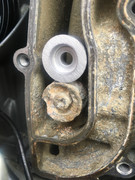
Hello sailor's... pictured is my 2001 Honda BF 50 internal anode located in the water jacket with the new sitting on top of the old . Having owned my 01X for 4 years now, it was definitely Time to take a look not knowing if it had ever been changed. Lots of info, and horror stories out there regarding engine corrosion. Thankful this site is still in operation and many thanks to all involved . Bill
Re: Check your outboard internal anodes
Posted: Sat Jan 18, 2020 4:42 pm
by DaveC426913
Cool.
Uh. Is there a way of checking that that doesn't involve cracking open my service manual?
Hello sailor's... pictured is my 2001 Honda BF 50 internal anode located in the water jacket with the new sitting on top of the old . Having owned my 01X for 4 years now, it was definitely Time to take a look not knowing if it had ever been changed. Lots of info, and horror stories out there regarding engine corrosion. Thankful this site is still in operation and many thanks to all involved . Bill
Was the motor flushed after each use? If you can, give some idea of how the motor was used and how often you flushed it. Fresh or salt water use or mix? Any info you can give would be helpful.
Bottom line - it looks like it's doing what it's supposed to, and you caught it while there was still plenty of it left.
Re: Check your outboard internal anodes
Posted: Sat Jan 18, 2020 8:06 pm
by the dude
Dave and Jimmy,I'm sure my picture has been causing a lot of CONSTRUCTIVE ANXIETY, well guess what ....I still have it! I don't have a service manual and i just found out there is another one!Two per engine,located inside the water passages on both intake and exhaust side.The water jacket cover on the exhaust side wasn't to bad other than the trim tab switch is in the way on one lower bolt.I just went out and knocked the snow off the cover and popped the lid and i do not like the looks or location of the other one..maybe some other sailor can educate us.Did i turn this post into "the winter of internal anode discontent"? Maybe but one thing is for sure .with a Mac you don't have to rely on the engine to have fun! PS:on a mooring ball for the season on LI sound and flushed at the season end in a 30 gal. bucket,Jimmy you are right it looks like it did its job..don't ask me if I'm going to change the other one! My own post is coming back to haunt Me ...lol
Re: Check your outboard internal anodes
Posted: Sun Jan 19, 2020 3:46 am
by dlandersson
Ok, on a 1998 Mercury 50 HP, I have trim tab anodes, not internal anodes. Anybody know anything about internal anodes on the Merc?
Hello sailor's... pictured is my 2001 Honda BF 50 internal anode located in the water jacket with the new sitting on top of the old . Having owned my 01X for 4 years now, it was definitely Time to take a look not knowing if it had ever been changed. Lots of info, and horror stories out there regarding engine corrosion. Thankful this site is still in operation and many thanks to all involved . Bill
Re: Check your outboard internal anodes
Posted: Sun Jan 19, 2020 7:29 am
by Jimmyt
the dude wrote: ↑Sat Jan 18, 2020 8:06 pm
Dave and Jimmy,I'm sure my picture has been causing a lot of CONSTRUCTIVE ANXIETY, well guess what ....I still have it! I don't have a service manual and i just found out there is another one!Two per engine,located inside the water passages on both intake and exhaust side.The water jacket cover on the exhaust side wasn't to bad other than the trim tab switch is in the way on one lower bolt.I just went out and knocked the snow off the cover and popped the lid and i do not like the looks or location of the other one..maybe some other sailor can educate us.Did i turn this post into "the winter of internal anode discontent"? Maybe but one thing is for sure .with a Mac you don't have to rely on the engine to have fun! PS:on a mooring ball for the season on LI sound and flushed at the season end in a 30 gal. bucket,Jimmy you are right it looks like it did its job..don't ask me if I'm going to change the other one! My own post is coming back to haunt Me ...lol
Yep, you "encouraged" an immediate scouring of my engine manual. Looks like all of mine are external in the Etec. I found out the hard way about pulling the prop every year and greasing the splines, so didn't want a similar lesson on anodes. Thanks for the usage clarification. I'm in brackish water and flush after every use. Just did water pump and was trying to meaningfully compare the condition of your water passages to mine.
Understand not being enthused about having to do repairs in the snow. I have a hard time getting mine done in an air conditioned basement....
Re: Check your outboard internal anodes
Posted: Sun Jan 19, 2020 8:22 am
by the dude
I hit the jackpot and didn't have to go to far either! Seems that Opie posted in 2009 on this very subject complete with pictures and advice.I will try and re-post that thread. Bill
Hey Dude, was your engine clear of the water while stored or partially immersed? I get that its rarely rinsed but that could have been galvanic corrosion too if it touches the water while stored.
Re: Check your outboard internal anodes
Posted: Mon Jan 20, 2020 12:04 am
by kurz
do you think it does matter wheter the motor is tilted up or not? Concerning galvanic corrosion it could be transfered by the bolts the ob is connected to the boat. And also the frame of the ob is all time in the water. Ok, mostly there is the colour on the motor frame, but I would not count on this personally...
Smart guys could mesure it out with a multimeter I guess...
Re: Check your outboard internal anodes
Posted: Mon Jan 20, 2020 12:47 pm
by Russ
Thanks for posting this thread because I had no idea these engines had INTERNAL anodes. I'm going to order some new anodes now and I'll replace them when I do the water pump impeller this spring.
Doing a bit of searching I found several Youtube vids. It's strange that Honda makes it so difficult to replace them. You have to pull so much apart to access.
I found these videos that show EASY replacement of the anodes from ports. My Suzuki seems pretty simple to do.
Re: Check your outboard internal anodes
Posted: Mon Jan 20, 2020 1:04 pm
by Russ
While shopping for anodes, I learned even more. You need to use the correct metal for your water.
Interestingly, if you are in freshwater and your anode looks new, it may not be working. I'm going to change mine out for Mg anodes.
Zinc Alloy Anodes = Salt water only
Not recommended for use in fresh water
Aluminum Alloy Anodes = Salt or Brackish water
Not recommended for use in fresh water
Proven to last longer than zinc due to increased capacity
Magnesium Alloy Anodes = Fresh water only
Not recommended for use in salt or brackish water
The only alloy proven to protect your boat in fresh water
Russ wrote: ↑Mon Jan 20, 2020 12:47 pm It's strange that Honda makes it so difficult to replace them. You have to pull so much apart to access.
This raises the question of how often they need replacing.
Those anodes, while clearly eroded, still have quite a bit of bulk to them, but I have no idea how surface deposition affects efficiency over time.
Yes, Good question. I know little about outboard engines. However, I had no idea they had internal anodes. Nowhere in my Seloc Suzuki service manual does it address anodes. Yet apparently on my motor, they are easier to change than spark plugs per the youtube videos.
the dude's anodes don't look that bad. I found a video where the owner changes them EVERY YEAR.
I have a plate under the mounting bracket that touches the water. After 10 years it looks a little worse than new. I don't know, I just ordered a set of Magnesium (freshwater) anodes for $30. Since it's easy to replace, I'll do it.
One question still exists; does leaving the motor foot in the water increase anode deterioration? Would tilting it up be advisable?
Re: Check your outboard internal anodes
Posted: Mon Jan 20, 2020 7:22 pm
by the dude
Hello Sailors, a little more FYI on this internal anode topic.Talked with the PO today and he said he never changed the internal anodes so what you see in my pic is the 2001 BF50 original.It's my understanding that the anodes are only working when they are in contact with water.That would mean the anode on the stern is the most active because it is below the waterline.On my mooring the engine is trimmed up when not in use, so one would assume that the water drains through the engine water passages and out the lower end unit were the trim tab anode is.So at that point they are not active but the stern is.So the big question that comes to my mind is "how many hours are on that engine" and at what point does Honda recommend changing your internal anodes?,In looking at my 19 year old internal anode i have to say,that thing has been sailing most of its life.I know for me if wind direction allows it i have that engine off before i'm out of the channel and no wake zone.O yeah one other dilemma, the OEM anode is aluminium alloy,not zinc,so now i have to make sure the others are the same, but that's ok ,just be ready by spring,i'm going in early ,April i think.
 PS:on a mooring ball for the season on LI sound and flushed at the season end in a 30 gal. bucket,Jimmy you are right it looks like it did its job..don't ask me if I'm going to change the other one! My own post is coming back to haunt Me ...lol