

I had to buy asap an all aluminum tandem trailer due to the black one falling apart for my 26x but the setup is completely different, it looks similar to the aftermarket macregor ones here:
https://supersail.com/macgregor-replace ... 6-classic/
But its not, its a Continental for a 25ft boat, a used one. It has very long vertical side bunks and two short flat ones in front. I got the boat on supports over the trailer now but not sure whether:
1) the long vertical bunks should be parallel to each other or closer to each other toward front of boat
2) how far from edge of hull the bunks should be for correct weight distribution and no slipping off the side of boat. Seems kike the closer bunks are together the less likely that mighy happen but how close is too close together?
3) the short flat bunks im assuming just set up and angle to fit once i get large bunks set up
4) any other things i should know about trailer setup, maybe a good read somewhere or video? I have to move the whole winch trailer piece a couple feet forward as trailer was set up for a 23 ft boat
Here is what it looks like more or less:
https://dealer-cdn.com/klPS5G/7Inui8/20 ... YPdnLM.png
Thanks in advance if anyone reads the forum over the weekend
Urgent question about trailer setup

-
NiceAft

- Admiral
- Posts: 6701
- Joined: Tue Feb 01, 2005 7:28 pm
- Sailboat: MacGregor 26M
- Location: Upper Dublin,PA, USA: 2005M 50hp.Honda4strk.,1979 Phantom Sport Sailboat, 9'Achilles 6HP Merc 4strk
Re: Urgent question about trailer setup
Have you placed your  on the trailer to see the fit.
The bunks are obviously quite different then the factory trailer, but others have purchased trailers with those type of bunks.
See the fit and make a judgment.
I assume you tie down the boat when it’s on the trailer? Secured not just at the bow, but the stern also
on the trailer to see the fit.The bunks are obviously quite different then the factory trailer, but others have purchased trailers with those type of bunks.
See the fit and make a judgment.
I assume you tie down the boat when it’s on the trailer? Secured not just at the bow, but the stern also
Ray ~~_/)~~
Re: Urgent question about trailer setup
Its over the trailer now on blocks, im trying to find axle reference point from old trailer to a spot on boat. My main issue is how wide the long bunks should be spaced apart if anyone has those dimensions. I will be checking tongue weight as i go along.
I never tied down stern on original trailer but if advisable ill start
I never tied down stern on original trailer but if advisable ill start
-
NiceAft
- Admiral
- Posts: 6701
- Joined: Tue Feb 01, 2005 7:28 pm
- Sailboat: MacGregor 26M
- Location: Upper Dublin,PA, USA: 2005M 50hp.Honda4strk.,1979 Phantom Sport Sailboat, 9'Achilles 6HP Merc 4strk
Re: Urgent question about trailer setup
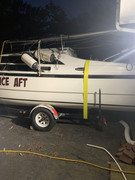
One good bump at 60MPH, or greater, and the boat can leave the trailer at the stern. The secure line at the bow makes for a great swivel point.I never tied down stern on original trailer but if advisable ill start
I know some here don’t do this, but that simply is not wise.
I secure with a ratchet strap. The one I have now is a 5,000 lb strap. The breaking point is greater.
Ray ~~_/)~~
Re: Urgent question about trailer setup
Gotcha. I followed thw rule used by many that trailer should be 12 inches from transom or less but that puts middle of my trailer wheels way behind the end of boat window (like a foot). I see that most ppl line up wheel or center of tandem wheels with end of this window. Tongue weight is 350. If i move boat back more on trailer tongue weight will decrease?
-
Jimmyt

- Admiral
- Posts: 3402
- Joined: Sat Jul 18, 2015 9:52 am
- Sailboat: MacGregor 26M
- Location: Mobile AL 2013 26M, 60 Etec
Re: Urgent question about trailer setup
Yes. The further back on the trailer you move the boat; the lighter the tongue weight.
350 is about right for a 26X or M. In my opinion of course.
350 is about right for a 26X or M. In my opinion of course.
Jimmyt
P-Cub-Boo
2013 26M, Etec 60, roller Genoa, roller main
Cruising Waters: Mobile Bay, Western Shore, Fowl River
P-Cub-Boo
2013 26M, Etec 60, roller Genoa, roller main
Cruising Waters: Mobile Bay, Western Shore, Fowl River
-
OverEasy
- Admiral
- Posts: 2873
- Joined: Mon Sep 28, 2020 11:16 am
- Sailboat: MacGregor 26X
- Location: NH & SC
Re: Urgent question about trailer setup
Hi Jwnj!
Here are photos of our empty Sea Lion trailer for reference on bunk placement:
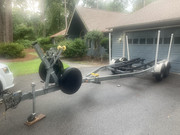
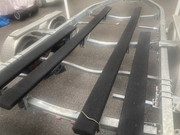
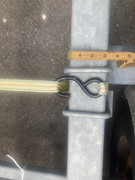
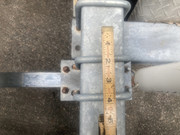
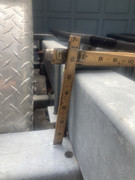
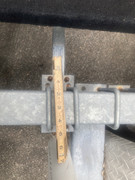
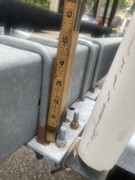
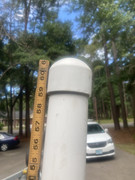
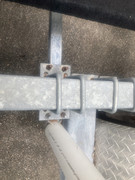
As our trailer is galvanized and subject to immersion into salt and brackish water in addition to fresh water we modified our cross members with upper and lower surface drain holes to ensure that water was not entrained within the box beams. Although your trailer is stated as being made from aluminum it might be prudent to ensure that you can avoid trapped or collected water.
Here are a couple side views to get perspective on fore/aft location:
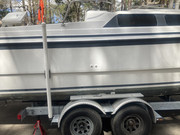
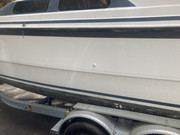
When setting up your trailer and boat loading please make sure to that the tongue weight is no less than about 8-to 10% of the combined trailer & boat weight to avoid fishtailing. Fishtailing is something to avoid at all cost!
Here are a couple of videos on that aspect for reference:
https://www.khq.com/news/watch-driver-l ... 41c2e.html
Here is a BoatUS informational video on boat trailering for reference:
Hope this helps!
Best Regards
Over Easy


Here are photos of our empty Sea Lion trailer for reference on bunk placement:
As our trailer is galvanized and subject to immersion into salt and brackish water in addition to fresh water we modified our cross members with upper and lower surface drain holes to ensure that water was not entrained within the box beams. Although your trailer is stated as being made from aluminum it might be prudent to ensure that you can avoid trapped or collected water.
Here are a couple side views to get perspective on fore/aft location:
When setting up your trailer and boat loading please make sure to that the tongue weight is no less than about 8-to 10% of the combined trailer & boat weight to avoid fishtailing. Fishtailing is something to avoid at all cost!
Here are a couple of videos on that aspect for reference:
https://www.khq.com/news/watch-driver-l ... 41c2e.html
Here is a BoatUS informational video on boat trailering for reference:
Hope this helps!
Best Regards
Over Easy


Re: Urgent question about trailer setup
Everyone thanks for the info!
My boat is still about 6" forward on trailer of the location you have in photo, but i dont know how i feel about all that boat overhanging trailer freely in rear especially since i have a large 500lb outboard. Tongue weight went down to 340lbs when i moved boat backwards a foot. Not sure if thats 10% as i cant weigh boat with things in it but im hoping for as little (safe) tongue weight as possible due to towing vehicle. I guess ill have to test out how it drives. The front tire on trailer does seem to have a little less room under fender than rear not sure if that means anything.
OverEasy, thanks for bunk photos, unfortunately mine are single and vertical so only about 2 inches of contact area but i think they are placed somewhere between your 2 bunks, maybe closer to your outer ones. If anyone has single long bunks and has distance between the 2, dont hesitate to post it
My boat is still about 6" forward on trailer of the location you have in photo, but i dont know how i feel about all that boat overhanging trailer freely in rear especially since i have a large 500lb outboard. Tongue weight went down to 340lbs when i moved boat backwards a foot. Not sure if thats 10% as i cant weigh boat with things in it but im hoping for as little (safe) tongue weight as possible due to towing vehicle. I guess ill have to test out how it drives. The front tire on trailer does seem to have a little less room under fender than rear not sure if that means anything.
OverEasy, thanks for bunk photos, unfortunately mine are single and vertical so only about 2 inches of contact area but i think they are placed somewhere between your 2 bunks, maybe closer to your outer ones. If anyone has single long bunks and has distance between the 2, dont hesitate to post it
-
OverEasy
- Admiral
- Posts: 2873
- Joined: Mon Sep 28, 2020 11:16 am
- Sailboat: MacGregor 26X
- Location: NH & SC
Re: Urgent question about trailer setup
Hi Jwnj
The big items like the trailer, boat and motor all have weight data.
The trailer has it on a DOT required data plate generally by the tongue or a couple feet back.
The motor weight should be in the manufacturers information papers or online.
The boat weight is in the MacGregor manual or in the electronic copy within the Forum’s resource section.
We studiously try to avoid traveling with full fuel tanks ( we generally try to travel with empty and dried out) when possible for long trips.
—-> the weight for gasoline commonly used is 6 lbs per gallon…. So in our setup with two 12 gallon tanks (24 gallons total) is 144 lbs.
—-> Generally there has been marine grade-fuel near to where we have launched.
—-> We have also planned our fuel consumption and our refueling to match our departure to avoid having excess fuel when hauling out.
—-> We’ve transferred excess fuel from the boat to the tow vehicle when circumstances have required it. In other cases we have also ‘paid it forward’ by giving it away at the ramp to those that are there launching, (which makes sense for us especially if it’s gonna be awhile before we get back on the water).
The same goes for water…the weight for water commonly used is 8 lbs per gallon…we travel with minimal water on board on long trips.
The Portalet is also something we try and travel with empty on long trips.
We added a portable A/C and a second battery which have their own weights (we weighed ours)
When packing clothes we try to minimize for long trips and plan on using laundry machines or hand wash once on the water.
We also have tended to minimize packed food for the road travel portion of our long trips (especially canned and cooler items) even though we have a Coleman Thermonic unit which we move to the tow vehicle to keep it powered enroute. If you have an ice type unit there is the weight of the ice to consider.
When packing the interior of the boat for road travel we watch where we put things to avoid putting too much in the aft berth. We have a 450 lb capacity electronic bathroom scale we verify tongue weight with before stating a long road trip.
We also watch how much we carry in our van and where it is loaded.
We try to load uniformity toward the center of the van taking into account the weight of people & locations along with the tongue weight.
This ensures that there is as uniform a load distribution on all four wheels of the tow vehicle.
We also try to stay below the vehicle data plate loading limits.
Importantly we limit our highway speed to 55 mph or less.
This is a hard rule for us to improve our safety margin and minimize wear on our van.
The faster one travels the worse the problem with fuel consumption, braking capability and fishtailing.
Mass x Velocity squared = Kinetic Energy …. Best to minimize all of the factors one can, especially if dealing with vehicle capacity limitations.
Anyway, that’s what we try to do.
We don’t want to be responsible for an accident that hurts, harms or maimes ourselves or others.
At that point saying ‘Sorry’ doesn’t cut it.
For us it’s a whole lot more fun doing it right and responsibly than worrying about the consequences of doing it wrong.
This is also why we are looking into potentially getting a larger tow vehicle like a Transit 250 Van to have greater tow and load capacity.
Kind of difficult (very difficult ) on a retirement income and the used vehicle market right now but it is something we’re attempting to figure out sooner rather than later.
Hope this helps some.
Best Regards
Over Easy
The big items like the trailer, boat and motor all have weight data.
The trailer has it on a DOT required data plate generally by the tongue or a couple feet back.
The motor weight should be in the manufacturers information papers or online.
The boat weight is in the MacGregor manual or in the electronic copy within the Forum’s resource section.
We studiously try to avoid traveling with full fuel tanks ( we generally try to travel with empty and dried out) when possible for long trips.
—-> the weight for gasoline commonly used is 6 lbs per gallon…. So in our setup with two 12 gallon tanks (24 gallons total) is 144 lbs.
—-> Generally there has been marine grade-fuel near to where we have launched.
—-> We have also planned our fuel consumption and our refueling to match our departure to avoid having excess fuel when hauling out.
—-> We’ve transferred excess fuel from the boat to the tow vehicle when circumstances have required it. In other cases we have also ‘paid it forward’ by giving it away at the ramp to those that are there launching, (which makes sense for us especially if it’s gonna be awhile before we get back on the water).
The same goes for water…the weight for water commonly used is 8 lbs per gallon…we travel with minimal water on board on long trips.
The Portalet is also something we try and travel with empty on long trips.
We added a portable A/C and a second battery which have their own weights (we weighed ours)
When packing clothes we try to minimize for long trips and plan on using laundry machines or hand wash once on the water.
We also have tended to minimize packed food for the road travel portion of our long trips (especially canned and cooler items) even though we have a Coleman Thermonic unit which we move to the tow vehicle to keep it powered enroute. If you have an ice type unit there is the weight of the ice to consider.
When packing the interior of the boat for road travel we watch where we put things to avoid putting too much in the aft berth. We have a 450 lb capacity electronic bathroom scale we verify tongue weight with before stating a long road trip.
We also watch how much we carry in our van and where it is loaded.
We try to load uniformity toward the center of the van taking into account the weight of people & locations along with the tongue weight.
This ensures that there is as uniform a load distribution on all four wheels of the tow vehicle.
We also try to stay below the vehicle data plate loading limits.
Importantly we limit our highway speed to 55 mph or less.
This is a hard rule for us to improve our safety margin and minimize wear on our van.
The faster one travels the worse the problem with fuel consumption, braking capability and fishtailing.
Mass x Velocity squared = Kinetic Energy …. Best to minimize all of the factors one can, especially if dealing with vehicle capacity limitations.
Anyway, that’s what we try to do.
We don’t want to be responsible for an accident that hurts, harms or maimes ourselves or others.
At that point saying ‘Sorry’ doesn’t cut it.
For us it’s a whole lot more fun doing it right and responsibly than worrying about the consequences of doing it wrong.
This is also why we are looking into potentially getting a larger tow vehicle like a Transit 250 Van to have greater tow and load capacity.
Kind of difficult (very difficult
 ) on a retirement income and the used vehicle market right now but it is something we’re attempting to figure out sooner rather than later.
Hope this helps some.
Best Regards
Over Easy
-
Herschel

- Admiral
- Posts: 1487
- Joined: Wed Sep 28, 2005 4:22 pm
- Sailboat: MacGregor 26X
- Location: Orlando, Florida
- Contact:
Re: Urgent question about trailer setup
I suspect all important decisions have already been made, but I'll throw in two comments. One, most, if not all tow vehicles will have a "tow/haul" mode feature in the transmission. Remembering to engage that is important to prevent the transmission from inadvertently trying to slip into overdrive and putting stress on the transmission. In my F-150 it limits me to the lower 7 of 10 gears. Secondly, in towing a travel trailer frequently for the last 12 years, I have come to understand another limiting factor in towing. That is the GCWR---the gross combined weight rating---which is the combined weight of the tow vehicle and the trailer being towed. The tongue weight is part of the cargo capacity CC rating of the vehicle. Both the GCWR and the CC are available in the specs of the tow vehicle. Both numbers are frequently humbling!