Hi All
The Quick Connect Fittings (QCF) have little O-RINGS inside that actually do the sealing.
They get old and get damaged.
Some will shrink over time with fuel contact.
Some will swell due to fuel additives or ethanol and get soft and them get worn away.
The O-RINGS can be replaced but can be a bit of a task.
GOOD automotive supply store will have a strong fine hook tool to accomplish this.
Replace with VITON material compound to avoid a repeat issue down the line.
Some QCF are physically damaged over time and use or develop burrs or gouges.
Given the size of these things blending of burrs generally doesn’t work out favorably.
It might be best to bite the bullet and replace them with new ones.
Fuel lines….
We replaced ours with new when we changed out to our new 12 gallon tanks.
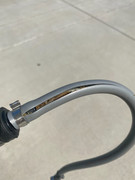
Bought the grey 3/8 dia from roll stock at West Marine.
Though this is a good product and has only been in use for the pst 18 months we’re going to upgrade to a better type next year.
The hose wall could be stronger as it tends to get pinched a bit too easily.
When we had our new Suzuki engine installed our installer used a heavier gauge black line that Suzuki recommends.
It looks to be much more durable and we are told that it doesn’t scuff and is very UV resistant.
The other option is getting Teflon core SST outer braid fuel lines made up.
This isn’t as difficult or expensive as one might think.
Commercial hose shops work with this all the time and generally can be found in most areas (with a little effort).
The advantage is they don’t collapse, last forever and look sharp!
Addenda Note: IF we were to go this route we’d made sure that the braided lines were not going to be under foot as we wouldn’t want any foot traffic wear to make any loose wire which could lead to an Owwie as we like being barefooted

when the weather is nice


Best Regards
Over Easy


PS: We also removed all QCFs from our set up as
1) I’m not gonna ever lug around a full 12 gallon fuel tank
2) the new Suzuki engine, unlike the old Tohatsu, doesn’t utilize a QCF when connecting the fuel line to the engine
3) the QCFs, especially the self sealing type, provide a significant flow restriction.
Addenda Note: 4) we always make sure that there is a sufficient “air gap” over the fuel level in the tanks to ensure that any vapor pressure doesn’t force liquid fuel up into the fuel level gauge wells or up against the fuel feed line fittings on the top of the tanks. Current regulation fuel tanks do not vent off excess pressure any more like the old ones did. The new ones only vent “inward” to prevent a vacuum from forming in the tanks. If there isn’t a sufficient air gap the vapor pressure build-up will force liquid fuel up against the fuel level gauge and fuel feed seals potentially leaking fuel. This tank pressurization effect may also be part of the reason marginal or compromised QCFs may experience leakage.