Page 1 of 4
Safe Heeling Angle???
Posted: Tue May 22, 2007 3:09 pm
by tjinca1
I am a pretty new 2001 26X owner, and very new to sailing. My old boat (a 1972 27' Coronado Sloop) didn't seem to incline as much as my 26X. Maybe because of the ballast?
Anyway, it scares my wife, even though I know it is self-righting, we aren't sailing in strong winds, etc. Ok, ok, maybe it scares me a little too! Being self-righting might save you, but it isn't fun to hit the water first, right?
In another post I read about an "inclineometer", which I will try to find, but from your experiences/opinions how much can I incline and still not worry about problems?
I have a feeling I can incline a lot more than I do, and I'd like to, but I want to know we're safe. Thanks for the help!
Posted: Tue May 22, 2007 3:34 pm
by eric3a
..
Posted: Tue May 22, 2007 4:09 pm
by LOUIS B HOLUB
I dont like the railing in the water either, or seeing those on board pale and white knuckled. I notice that my "X" will lay over quick then seem to settle in well during a good tack. Its that first "quick" lean over that will scare you. Ive never put it through any extremes, and dont plan any either. Watching the DVD showing the Mac pulled over on its side with only 120 lbs on the mast is interesting, especially how it rights itself so quickly. Thats one of the safety reasons along with the built in floatation that gives me and my crew comfort. One never knows if for any reason the Mac gets a knock down, or the cabin fills up, there remains floatation for the boat (as opposed to a weighted keel boat which goes to the bottom).
Posted: Tue May 22, 2007 4:23 pm
by DLT
Ultimately, I don't think the issue is "how much is safe". Rather, it seems the real issues is "how much is comfortable". Maybe "how much is normal"...
I think the boat can handle much more than I care to. So, in higher winds, I sail with the mainsheet in hand, ready to spill if it gets to be too much...
If you're experiencing more heel than you'd like, well, adjust your sheeting to the amount of sail you have up... The boat will likely sail better with no more than ~15 degrees or so...
But, a water ballasted boat WILL be more tender in the 0-10 degree heel range than a keel boat simply because it takes a bit of heel before that water ballast gets a chance to do its thing...
If you're not comfortable with 10-20 degrees of heel, then maybe a water ballasted boat is not for you...
Posted: Tue May 22, 2007 5:15 pm
by NiceAft
I guess I'm, lucky in that the admiral likes the thrill of heeling 30-35 degrees

That's when we start hearing everything that is not secured falling with a thud.

The boat doesn't move fast with heeling like that, but it sure is fun.
Once we forgot to close the ports on either side of the boat and while we were leaning at about 30 degrees I remembered. She went below to find water coming in through the starboard port. I told her that the sailing term for that is "SINKING"

Ray
Posted: Tue May 22, 2007 7:22 pm
by James V
The boat will self-right at 100+ degrees, the mast in the water, with a full ballest. It will come up. There is a sweet spot on all boats where it is most forgiving angle of heel.
In order to get used to this, find someplace where the winds and waves are constant and put the boat on a beam reach for hours, turn around and go back. Another thing to do is get a safety harness. Makes me feel safer.
Posted: Tue May 22, 2007 7:23 pm
by delevi
Anything up to 25 degrees gives you top performance. More than that and you start to slow down. As for safety, you will round up long before you are knocked down, unless you are hit with a sudden gust of 30 knots+ and have the sails sheeted in tight. I have been knocked down before and the boat does in fact spring right back up. As others have said, it's really based on how much heel you're willing to endure, or until the boat slows down. At that point, start reefing the sails.
Leon
Posted: Tue May 22, 2007 8:47 pm
by argonaut
After two years sailing this boat I totally agree with DLT, if you're heeling a lot you may be doing something wrong.It's not a Coronado with lead ballast it's just a different kind of boat. The real issue is sail controls. Macs often don't have a reefing setup in place and/or are missing a vang, two important functions on any sailboat but especially a light trailersailer.
You need to be able to flatten and reef the main to have a wider comfort range. So for me that meant adding some reef lines & cleat and a boom vang. Those two changes made a great difference in comfort for me. When I see chop on the water, around here that's like 12-17 mph, I just reef.
And without a vang adjusted to flatten the main you can't get the belly out of the sail, the boom lifts as the sail fills and consequently the sail generates a lot of lift and you spend a lot of time heeled over. The vang helped my heavy air sailing a lot.
Another help for me was running with the standard jib. Not enough wind is a rare thing here so I usually don't fly the genny. Points better upwind and I easily get 6-6.5 mph with the plain old jib.
Jut some things to try.

Posted: Tue May 22, 2007 9:09 pm
by eric3a
..
Posted: Tue May 22, 2007 9:25 pm
by Lease
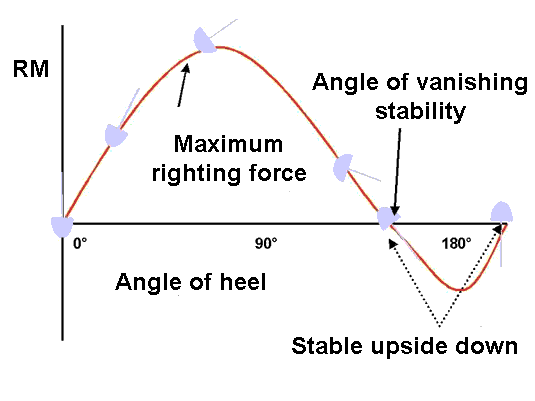
Which raises the point; has anyone ever seen a Mac stability curve?
It would be useful to know the point of vanishing stability for the Mac, or the maximum righting angle, the latter of which would be a good response to this type of enquiry.
Example:
Posted: Tue May 22, 2007 9:31 pm
by eric3a
..
Posted: Wed May 23, 2007 4:42 am
by Moe
tjinca1, the inclinometer is a good idea. It will give you a point of reference that can make you less uncomfortable.
Some inclination (heel) is normal on a sailboat. As another here said, you sometimes need to sit on the side away from the wind (leeward side) in light winds to give the boat some heel. But in normal winds, you should be sitting on the windward side so your weight opposes and reduces heel.
If possible, you want to keep the heel down to 15-20º. The further you heel, the more outboard on the leeward side the center of effort on the sails moves. This is like putting your outboard motor on a mount outboard on one side of the boat. It makes the boat want to go in a circle, or turn to the side away from that on which the boat is powered. When heel moves the driving point of the sails outboard on the leeward side, the boat wants to turn into the wind, also known as weather, and the boat is said to have weather helm.
A safe boat has at least a little weather helm in normal conditions. This ensures the boat wants to turn into the wind and stand back up. The opposite, lee helm, turns the boat away from the wind, causing the boat to become increasingly overpowered by the sails and heel more. Too much weather helm is also a bad thing, since you have to fight it with the rudders, which slows the boat. Too much application of the rudders to fight weather helm can stall them, rendering them ineffective.
You can reduce heel by easing the mainsheet and jib sheets, but only to a point. That point is where the sails start luffing.
You can reduce heel by making the sails less powerful by flattening them. Tighten the mainsail clew outhaul and the halyards to do this.
You can reduce heel by making the sails less powerful at the top, where they have the most leverage to heel the boat, by letting them twist. You do that on the mainsail by easing the vang, and on the foresail by moving the jib cars aft on their track. However, because this reduces the angle of attack, it makes the top tend to luff earlier as you ease the sheets. Luffing is hard on the sails and can even cause the mainsail to spit out and lose a batten.
To reduce heel further, you must reduce the amount of sail. It's better to know the wind speed ahead of time and reduce sail before experiencing excessive heel. Wind speed changes while you're out, so if you feel it increasing, you want to reduce sail before excessive heel becomes a problem. You can reduce sail by reefing the mainsail or switching to a smaller foresail. With roller furling, you can reduce the foresail size, but because this makes the sail baggy (more powerful for heel) right at the time when you want it to be flat (less powerful for heel), rolling in a roller furled sail is much less effective than switching to a smaller hanked on sail.
A small handheld wind meter can help you measure the wind to learn how much sail you need. We use a basic Kestrel 1000, but you can buy more expensive versions that include a thermometer (for calculating wind chill) and a barometer (for predicting weather).
We found on our 26X, the standard working jib with a full mainsail to be just right for us in winds of Beaufort Number 4 (BN4 or Force 4) which are those in the range of 11-16 nautical miles per hour (knots) or 13-18 statute mph. For winds of BN5, 17-21 knots or 19-24 mph, the working jib with the mainsail at the factory deep reef worked well. These setups kept heel down (and the Admiral happy) and allowed us to use the sail controls to balance the helm, meaning no rudder pressure either way was needed to keep the boat on its desired course. When I learned to sail as a kid, one of the exercises was sailing without a rudder to force us to learn to balance a helm and to steer with only the sail controls. It's a good method.
The working jib is a little weak in winds of BN1-3, 1-10 knots or 1-12 mph. We had a CDI Flexible Furler, so changing to a smaller sail wasn't practically easy enough. With hanked on sails, it would've been easy to go forward at 10 knots of wind to swap sails, in our case to a larger one for light winds.
The MacGregor powersailors are not designed to intentionally be sailed during Small Craft Advisories (BN6-7, 22-33 knots or 25-38 mph) much less in a Gale (BN8, 34-40 knots or 39-46 mph). I believe you're better off not sailing these boats in such weather. If you're caught out in these conditions, you'll probably find that motoring (at less than 5 knots or 6 mph) with ballast in, and centerboard and rudders down, is the better option. You may find that having the mainsail up at the deep factory reefing point, with no jib, adds some stability to help keep the boat from rolling side to side in these heavy seas.
Hope this helps,
--
Moe
Posted: Wed May 23, 2007 12:55 pm
by tjinca1
This really helped a lot. I learn more from your comments than any book. I really like to have a good amount of incline, I just wanted to see where you guys thought the best point would be. Seems like 15-25 degrees is what most of you ranged it. I'll look for an inclinometer online. I appreciate all the help!
Posted: Wed May 23, 2007 1:49 pm
by Frank C
Yeah, very nice description, Moe!
Called inclinometer in some catalogs, or sometimes just clinometer.
(mis-spellings for searching purposes, clineometer, inclineometer)
I like this one, the Lev-O-Gage. Choose the biggest one, the "Senior" version.
Mount it dead-center on the aft-lip of your sliding hatch.
Click here for West Marine Page

Posted: Wed May 23, 2007 2:31 pm
by DLT
Frank C wrote:I like this one, the Lev-O-Gage. Choose the biggest one, the "Senior" version. Mount it dead-center on the aft-lip of your sliding hatch.
Exactly what I did and recommend!