Wing Sail rig for the Mac

A forum for discussing boat or trailer repairs or modifications that you have made or are considering.
User avatar
mastreb
Admiral
Posts: 3927
Joined: Wed Feb 09, 2011 9:00 am
Sailboat: MacGregor 26M
Location: Cardiff by the Sea, CA ETEC-60 "Luna Sea"
Contact:

Re: Wing Sail rig for the Mac

Post by mastreb »

Hi Ix,

Thanks for the well thought out comments. All are right on the money, as usual.
Ixneigh wrote:Well I'm not convinced that the two wing sail rig will simplify sailing unless it the jib you just are determined to get rid of. Raising and lowering each wing on a new tack would put me off the idea straight away. I'm lazy and only want new ideas if they are going to be easier. I love to think about new ideas and am all for hard experimentation, but some points occurs to me when advanced for use on a full size Mac.
This a frame, and I have posted about it before, will be more effort to put up and down and stow for transport then the stock rig. The wing sails x2 will also be more effort to stow and cover. And heavier then a few bagged sails.
You're correct in that this won't make sailing less work, but it will make it simpler. I do intend to get rid of the headsail--the boat would be way over-sheeted running a jib as well as these wings. By simpler, I mean that while you have to expend more effort, you can sail well with far less skill.

This is because there's a single, simple maneuver for sailing: Hoist the correct wing for the tack, loose it's mainsheet completely until the wind rotates it to the 0 degree angle-of-attack, and pull back the wing 10 to 20%. That's it--now you've got as much lift as you can possibly get on that tack. So the skill and technique of sailing is dramatically simplified, but the physical effort of sailing is increased: No doubt hoisting these wings is a lot more effort than tacking.

I'm actually worried quite a bit about the time it will take to tack causing loss of momentum, but that's something that will be ironed out when I'm actually sailing this rig. It may well be best to raise the opposite wing loosed before turning, and dropping the former wing after the new wing is set. Although that's not going to work at all in the new configuration I'll talk about next.

Another major factor for this rig is that the trivial sailing skill translates to ease-of-automation: With capstans on the halyards and downhaul lines, a wind instrument, and power winches on the mainsheets with a tensiometer, a very simple piece of software can run this boat. Vic's autopilot for example would provide a platform that with a similar amount of effort as he's expended could control the trim of these sails and turn a boat into an automated ocean-going drone. Solar panels or a regen electric motor/prop can provide more than enough power to operate these sorts of controls indefinitely at sea, so it would be conceivable that a drone built this way could do a circumnavigation on its own.

So for ease of sailing it doesn't get any simpler than selecting a point on a chartplotter and kicking back in the cockpit while the boat sails itself :D
Ixneigh wrote:The extra 40 pounds aloft is a big big deal. The M is already too tender. Weighted dagger is more effort and probe to breaking unless a whole new and expensive one is built.
You're correct that this would be a much simpler proposition on either a catamaran (where it's ideal) or a full-keel monohull. But I like Macs, and I've figured out a way to mitigate the weight aloft problem very simply:

First, there are two centers of effort on a boat: The fore/aft CE we're all familiar with, and the port/starboard CE we never worry about because our mast is centered. When you fly a large drifter or spinnaker, the dramatic healing you see is caused by the fact that the P/S CE of those sails is off-board the boat to leeward, contributing quite a bit to heel. Reference any of Highlander's photos for an example of this 8).

It's a problem I'm very worried about for this rig, because the P/S CE is well to leeward to begin with, and only gets worse as the boat heels. Furthermore, the aloft weight of the wing is off balance and will contribute to heel as soon as heeling begins. It's not a good proposition.

The solution is to swap the wings. While it's easier to conceive of the rig with the starboard wing on the starboard side, all of the above problems are mitigated by switching the position of the wings. Now the aloft wing is on the windward side, the P/S CE is to windward countering heel and moving to the boat center as the boat heels, which is ideal, the mainsheet rigging is simplified and easily made to be on-deck rather than overboard, and the aloft weight contributes to stability until the boat is heeled beyond 60 degrees, at which point it begins to contribute to heel. This is far better proposition for stability in all cases. It does require that the chord of the wing can only be 130% of the beam of the boat however, but the wings I'm specifying meet that already.

The issues with this are as follows:

1) The wings sweep across the deck rather than overboard. On a beam reach, the wing will almost completely block fore/aft topside movement. On a Mac, this means going fore/aft through the cabin. I don't see this as a huge deal, as at all other points, the deck is open and available.

2) Wing-on-Wing performance is destroyed. I may find some combination that will move the boat, but the wings face the wrong way for ideal drag WoW. This means flying a spinnaker for downwind performance. Not ideal, but not any less ideal than a standard Bermudan rig. I'm pretty committed to avoiding a headsail because I don't want to lose full automation capability.

3) The aloft crossbar now has to have spreaders to keep the fore and aft stays out of the way of the wings. That's more aloft weight and complication, and not a trivial engineering problem.

4) The chord (width) of the wings is limited to 130% of the beam of the boat. They happen to be just about that anyway, but it becomes a hard limit because the trailing edge has to sweep inside the beam. It also means that the masts have to be vertical and not canted inward in an A frame configuration. Vertical simplifies the construction of the frame pretty considerably.

I'm going to test both configurations to see which works better in the real world.
Ixneigh wrote:In perfect sailing conditions, the wings may well be faster. Of course, the concept is sound. But it's real world sailing I'm worried about. Three month trips where the boat actually has to sail somewhere because gas is 6 buck a gallon when you can find clean gas. This puts a lot of wear on the sails. Even a production version will run thousands if built light, yet strong enought to stand up. Plus the regular Mac sails are cheap to replace if you mess one up by accident.
These wings can be simpler to produce than a standard sail because their is support every 18", so they don't have to be cut to deal with a lot of unusual force loading. They also won't ever blow out in any meaningful sense, and even if they do stretch a little, it won't matter much. I really don't see them being particularly more expensive than a mainsail of equivalent power, but this is something that only mass production and time will tell. In any case, they won't be twice the price and they should last more than twice as long.
Ixneigh wrote:Sailing down wind as I visualize the rigging and a frame will increase chances of damaging the wing if accidentally jibed. Uncontrolled jibes do happen dispite our best intentions (what me!?)
A good point, and another argument for keeping a spinnaker for downwind running. An alternative is to use two mainsheets, one on the trailing edge and one on the leading edge, that will keep the wing from moving at all once it's cleated off. But that complicates the sailing of it. A third option will be to bring both wings back to 180 degrees and tie their trailing edges together for downwind running. This will create a V pointing at the wind which should create a lot of drag (which is what you want when running), and with them tied together it would be impossible for them to gybe when running. Whether this will work or not is a matter of experimentation.

In all cases, running is somewhat problematic with this rig and is going to require a lot more thought to solve.
Ixneigh wrote:It may make dealing with small squalls easier by just feathering the sail, but the improbability of a effecting a sound, workable reduction in sail is a bad trade off. ESP on a tippy boat. I've slogged across miles of shoals with a double reef and a storm jib, going slow, but feeling in perfect control and in fair comfort. I did not have to pay much attention the the sails.
Sound ability to reduce sail area is a necessity, I fully agree. But these wings can be made to do very well at it. Technically these wings can be reefed at each rib, by having a reef line going up through the wing and stopper knotted on the rib in question. This will reduce the wing square footage to match any wind conditions. In practice, I think I'm only going to build in two "reef points" at 25% and 50%. It might make sense to add a 70% reef, but I don't see those winds where I live.
Ixneigh wrote:Windage aloft and wind drag under power. The stock mast offers little windage if centered. Will the a frame "double" it since there are two upright members now? Will the reduction in height equal things?
This mast assembly will have more drag in prototype. In production, we'd use symmetrical foils for the crossbars. There's very little that can be done about the masts themselves unfortunately, because the down wing needs to be stowed aft, and that dictates that the mast point forward which would not be ideal at most points of sail. The added drag of the mast frame should be more than countered by the increased efficiency of the rig overall, so my hope is that this is a minor problem.
Ixneigh wrote:Deck clutter. The two wings will take up space somewhere while the boat is at anchor.
Yep, it is more complication. The stowage is going to be fore/aft and dropped to the deck so they'll be along the lifelines rather than over the deck. In my current conception, they'd never be removed, just covered in that place. The masts would have a "knee" joint above the "sail pack" on the masts that would allow the masts to be dropped forward over the bow once the sails are in place and bagged. It would not protrude forward of the trailer hitch in my current conception. That joint is complicated (it also has to rotate) and will not be in the prototype. No point in getting complicated until I know it works well enough to bother with.

In fact, without the central mast, the deck will be far more usable in port and open cockpit designs become trivial and spacious. Furthermore, an open cabin becomes a possibility without a deck-stepped mast. I actually think it will be preferable for deck space. You will have to bag two sails, but we pretty much do that already.
Ixneigh wrote:I will be interested to see the results of the sailing dingy experiment. My opinion (I have one of course;) ) Is save the three grand unless you are wanting THAT small boat. Barrow or buy a round bottom dinghy 2hand. The walker bay no more resembles the powersailor hull the 1/2 dozen others I have owned. It's the before and after data that would be most important. Speed pointing heeling ect.
My 2 cents

Ix
My personal laziness is driving the selection of an existing sailing dinghy. I don't want to rig a rudder or a daggerboard or any of that. I frankly have more money than time because I've got the equivalent of two jobs going on with a mature business I run and a new business I'm setting up. If these experiments go well, it could potentially turn into a 3rd business to run (especially if I want a business whose purpose is to turn a lot of money into a little money :D :D )

Anyway, thanks again for the excellent critique. It's this kind of discussion that really forces me to think this stuff through, and every concept formalized before building makes this better, faster, stronger, and cheaper.

Matt
User avatar
mastreb
Admiral
Posts: 3927
Joined: Wed Feb 09, 2011 9:00 am
Sailboat: MacGregor 26M
Location: Cardiff by the Sea, CA ETEC-60 "Luna Sea"
Contact:

Re: Wing Sail rig for the Mac

Post by mastreb »

Ix, I tried to take your advice re: buying a used dinghy, but the people on Craigslist have some bizarre ideas about value. Every one of the dinghys listed was listed for more money than the dinghy would have cost new. People selling RU-260s for $800 that cost $699 new including the West Marine tax, old wooden homebuilts for $750, etc. Pretty ridiculous.

That said, after finding that a walker bay is going to use up $3500 of my $5000 budget for this when fully accessorized, I am a lot more open to doing a bit more work on a less expensive hull :D
User avatar
Ormonddude
First Officer
Posts: 383
Joined: Thu Jun 07, 2012 2:08 am
Sailboat: MacGregor 26X
Location: Ormondbeach FL

Re: Wing Sail rig for the Mac

Post by Ormonddude »

mastreb wrote:Ix, I tried to take your advice re: buying a used dinghy, but the people on Craigslist have some bizarre ideas about value. Every one of the dinghys listed was listed for more money than the dinghy would have cost new. People selling RU-260s for $800 that cost $699 new including the West Marine tax, old wooden homebuilts for $750, etc. Pretty ridiculous.

That said, after finding that a walker bay is going to use up $3500 of my $5000 budget for this when fully accessorized, I am a lot more open to doing a bit more work on a less expensive hull :D
I had the Exact same problem-So I started doing free advertising for West Marine and Ebay and sent the sellers Messages Telling them to LOOK it worked and some pulled the posts or lowered their prices but I did end up buying on Ebay
User avatar
mastreb
Admiral
Posts: 3927
Joined: Wed Feb 09, 2011 9:00 am
Sailboat: MacGregor 26M
Location: Cardiff by the Sea, CA ETEC-60 "Luna Sea"
Contact:

Re: Wing Sail rig for the Mac

Post by mastreb »

I found this dinghy, and I think I really like it for this project. Very beamy and stable, and unsinkable. With a sailing kit it's about the same price as a Walker Bay when fit out similarly.

http://www.portlandpudgy.com/
User avatar
Ixneigh
Admiral
Posts: 2461
Joined: Thu Sep 09, 2010 11:00 am
Sailboat: MacGregor 26M
Location: Key largo Florida

Re: Wing Sail rig for the Mac

Post by Ixneigh »

I've seen those. I suppose it would work. Living in the keys I guess I'm spoilt. I can buy small boats left right and center for under 400 bucks. I bought one soley because I fell in live with the hull shape. Its sitting in my hard as a garden ornament right now I size up small small boats like some prople appraise horses, fine wine or women. That particular 9 footer is something I would choose over well anything I've seen in the last 2 decades if I wanted a 9 foot dinghy. I picked up a nearly new fiberglass 8 footer for 280 bucks. I'll use that when I go back out on the mooring.
The walker bay was an acceptable dinghy. During the time I had it, it never faltered.

Re simplicity for pure simplicity nothing beats the free standing wishbone boom rig.but those don't go up and down easy. It's quite possible that the a frame mast and some form of soft or even inflatable sail would a be a acceptabke compromise over this ribbed wing arrangment You round not need but just one sail.

Ix
User avatar
mastreb
Admiral
Posts: 3927
Joined: Wed Feb 09, 2011 9:00 am
Sailboat: MacGregor 26M
Location: Cardiff by the Sea, CA ETEC-60 "Luna Sea"
Contact:

Re: Wing Sail rig for the Mac

Post by mastreb »

For the purpose I'm putting this to (a boat that can be fully automated) I'm pretty committed to the design. The ability to power reef and power hoist the wings without complication and the fact that all possible points of sail are accomplished by simply rotating the active mast means that full automation will be simple.

I'm a bit worried about the dinghy's extremely short length. It's going to be a poor performer under sail no matter what, so I'd only be able to compare the dynamics in a very small speed range. But I've got to use something inherently buoyant for this, and dinghys that sail well but can't sink are kind of hard to find.

So it turns out that there's a serious lack of aerodynamic research in the viscosity realm of wing-sails. Foils in the water are remarkably like aircraft wings because a typical sized plane flying through the atmosphere near Mach 1 has almost exactly the same fluid characteristics as a foil in water at low speed. This makes hydrofoil calculations simple--just use airplane profiles. But foils in "slow" air exhibit all kinds of strange stall characteristics. If you google "low reynolds number" applications, you'll see what I'm talking about. This is the aerodynamic realm of aircraft that fly between the upper atmosphere and low earth orbit (i.e., nothing), model airplanes (that nobody pays to research), smaller birds (that nobody pays to research), and sails (where the economics aren't anywhere near aerospace and all the research is done in the spare time of engineers and hobbyists).

It also turns out that Bermuda rigs can be surprisingly aerodynamically efficient when perfectly trimmed, which makes looking at the problem kind of unnecessary. Furthermore, the well researched airplane wing profiles are not efficient at the low wind speeds we are dealing with. The upshot is it's taken me about 30 hours of research to find a foil with reasonably improved lift in the air that we're talking about.

Anyway, I'm pretty settled on a foil called S1223, which was recently developed precisely for the viscosity characteristics in the range sails have to deal with. Probably I'll go with the 5% variant for maximum lift-drag ratio.

It exhibits excellent lift characteristics and really good lift to drag ratio at angles of attack from 0 to 10 degrees, but above 12 degrees off the wind it stalls out completely. This is typical behavior for a high-lift wing of any sort.

That's a pretty narrow dynamic range for a sail, which has to deal with significant changes in wind direction. With automation, it's not an issue--real time wind input to an actuator to turn the sail will work well. But with a human sailing it, it might be so narrow as to require dynamic tension to "find" the wind all the time. It may be necessary to feel the increase in drag at 12 degrees and let off, which means sailing with the mainsheet in your hand at all times, or coming up with a spring tensioner that does the same thing. Hopefully a leading edge slat will increase the range of AoA that will work without stalling.

For the dinghy it won't be an issue, but the small range of AoA means building in some twist to the wing for taller rigs, because the angle of attack is narrow enough that the bottom of the wing will be in stall when the top is at maximum lift due to the difference in apparent windspeed at the surface compared to the faster winds at top of the mast. Fortunately, a fixed twist should do the job just fine if we presume that we don't care about maximum performance while getting to speed, and that we will reef the wing in heavy air, which will reduce twist at the bottom.

On the plus side, it will make the same performance with 56% of the sail area of a well trimmed Marconi rig, which is really significant.

It's a lot of research and math, but I'm having fun figuring it out.
User avatar
Ixneigh
Admiral
Posts: 2461
Joined: Thu Sep 09, 2010 11:00 am
Sailboat: MacGregor 26M
Location: Key largo Florida

Re: Wing Sail rig for the Mac

Post by Ixneigh »

I am thnking about a mod to the bottom that would need math and stuff to understand drag and righting moment. Could you do that if I sent you a sketch of it?

Ix
User avatar
mastreb
Admiral
Posts: 3927
Joined: Wed Feb 09, 2011 9:00 am
Sailboat: MacGregor 26M
Location: Cardiff by the Sea, CA ETEC-60 "Luna Sea"
Contact:

Re: Wing Sail rig for the Mac

Post by mastreb »

Ixneigh wrote:I am thnking about a mod to the bottom that would need math and stuff to understand drag and righting moment. Could you do that if I sent you a sketch of it?

Ix
Can do, yes.
vizwhiz
Admiral
Posts: 1388
Joined: Mon Aug 23, 2010 9:48 pm
Sailboat: MacGregor 26S
Location: Central Florida

Re: Wing Sail rig for the Mac

Post by vizwhiz »

Hey Mastreb, have you thought of a single symmetrical-airfoil wing centered around the current mast, with a "hinged" leading edge and trailing edge to change the camber to make it asymmetrical for the side you're tacking on? It would allow you to use one centered wing, and just adjust the wing camber to the side your sailing, instead of having to raise/lower a whole wing on that side? You might not be able to get the "optimum" wing shape, but one that is good enough and which will easily power a boat as light as a Mac... Just a thought, because then tacking becomes simply swinging the sail to the opposite side and adjust leading/trailing edge to the desired shape, more consistent with current sailing methodology.
I think you could still use the spar/cloth idea, just have to work out some details.
User avatar
mastreb
Admiral
Posts: 3927
Joined: Wed Feb 09, 2011 9:00 am
Sailboat: MacGregor 26M
Location: Cardiff by the Sea, CA ETEC-60 "Luna Sea"
Contact:

Re: Wing Sail rig for the Mac

Post by mastreb »

Viz,

I have,yes. There are two hard problems:

First is the standing rigging: how do you rotate that wing 360 and still have stays? Stays are far less cost and engineering than unstayed masts and are much stronger, and they can be much taller.

That said, I actually do have a design for stays that would work: imagine a "cross" atop the wing mast of spreaders that moved out the side and fore/aft stays to clear the wing. There would be a short mast atop the wing that the stays would all terminate at, so they would work just like the current Mac stays except they'd be longer and there would be fore and aft spreaders as well. The top mast would be good for locating instruments as it would not rotate.

The second hard problem is coefficient of lift: symmetrical wings with flaps can only be very slightly more efficient than an existing bermuda rig, which means you have to have a wing the size of the mainsail or larger in order to get equal speed. If you aren't a lot more efficient, you're just making an expensive, heavy mainsail. The AC catamarans take this approach, and you can see that those wings are as big if not bigger than the mainsails they replace. And they tip those boats over a lot.

You need a highly assymetrical wing profile designed specifically for the fluid viscosity of your medium at the typical speed in order to get an efficiency high enough to make a smaller single wing that can replace both the mainsail and headsail, which is the only thing I see as valuable about the concept of wing sails.

Now, I've also come up with a possible solution to this problem as well: the invert-able wing. Here's how this concept would work:

It's the same cloth over ribs idea as the twin wing rig, but the top of the wing (head gaff) and the wing root (boom) terminate on symmetrical ribs. The middle ribs are all the necessary highly assymetrical shape.

The clever bit is that the assymetrical ribs are not fastened to the sailcloth: they merely shape it from within. When the sailcloth is tensioned by the halyard, it assumes the shape of the interior ribs. The ribs all connect to an interior rotating rectangular mast as in my previous description

To change tacks, you loose the halyard to untension the wing sailcloth, and then pull a tack line to rotate all the assymetrical ribs inside the wing 180 degrees, flipping them over. Then tension the wing again, and viola--it's reversed. Now loosen the mainsheet, let the wing come about to the wind, and harden back ten degrees for maximum thrust. Simple.

The ribs are rotated by means of two tack lines (port tack and starboard tack) that run inside the wing, connecting to each assymetrical rib. When you pull it, it flips the ribs top-to bottom, taking up the opposite line. So it's ready to tack next. The routing of the tack line is a little complicated but its easy done with nothing more than line, knots, and holes in the ribs.

The ribs are actually split in to a leading section before the mast and a trailing section after the mast, connected by a round rod that runs through the mast,allowing them to rotate. The area of the sail between the two sections beside the mast is not supported, relying on sailcloth tension to take the proper shape.

I will likely experiment with both rigs, since by my calculations the aloft weights wind up being very close due to the complicated spreader/mast setup with this rig. This rig would be much simpler to convert to on a Mac, since it sits in the normals mast position.

Matt
K9Kampers
Admiral
Posts: 2441
Joined: Thu Apr 13, 2006 7:32 am
Sailboat: MacGregor 26X
Location: NH, former 26X owner

Re: Wing Sail rig for the Mac

Post by K9Kampers »

I have not been following the details of this topic too closely, but thought of this thread when I came across this website... it may be of interest to some:

Harbor Wing Technologies
User avatar
Crikey
Admiral
Posts: 1833
Joined: Sun Apr 17, 2011 12:43 pm
Sailboat: MacGregor 26M
Location: Washago, Muskoka, Ontario, Canada, Earth, Singularity.Suzuki DF60A. Boat name: Crikey!

Re: Wing Sail rig for the Mac

Post by Crikey »

K9Kampers wrote:I have not been following the details of this topic too closely, but thought of this thread when I came across this website... it may be of interest to some:
Harbor Wing Technologies
That was cool! Particularly the part where they mentioned: "Cross-arms are suitable for installation of hard points for mounting instrumentation or small non-lethal weapons."
I'll take two and make a heck of a flying machine. :)
User avatar
mastreb
Admiral
Posts: 3927
Joined: Wed Feb 09, 2011 9:00 am
Sailboat: MacGregor 26M
Location: Cardiff by the Sea, CA ETEC-60 "Luna Sea"
Contact:

Re: Wing Sail rig for the Mac

Post by mastreb »

That's a really cool prototype. Complex rig though!
User avatar
Crikey
Admiral
Posts: 1833
Joined: Sun Apr 17, 2011 12:43 pm
Sailboat: MacGregor 26M
Location: Washago, Muskoka, Ontario, Canada, Earth, Singularity.Suzuki DF60A. Boat name: Crikey!

Re: Wing Sail rig for the Mac

Post by Crikey »

Well, you're not going to furl it in a hurry, but you only point it into the wind on either tack. No independent airfoils for port and starboard. Not sure about running.
User avatar
mastreb
Admiral
Posts: 3927
Joined: Wed Feb 09, 2011 9:00 am
Sailboat: MacGregor 26M
Location: Cardiff by the Sea, CA ETEC-60 "Luna Sea"
Contact:

Re: Wing Sail rig for the Mac

Post by mastreb »

Hi Guys,

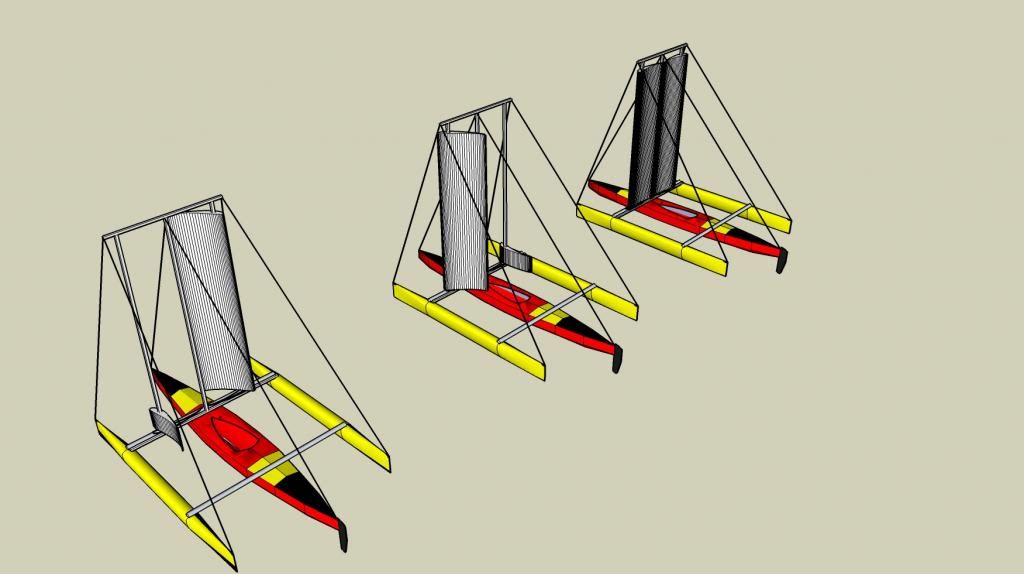
Thought I'd post a status update about this idea. First a rendering of the test rig:

Image

This shows the rig on three points of sail: Downwind, Port close reach and Starboard broad reach. Notice that the wing moves inside the frame, not outside, and each wing only spans 180 of rotation so it doesn't strike the stays. Except when running, only one wing is aloft, and tacking consists of reefing the leeward wing, raising the windward wing, letting it weathervane to the wind, and then sheeting it in ten degrees. The boat should point to within 20 degrees no problem.

I'm moving ahead with testing now, which means building a prototype wing. The built is going to be very simple: 4oz dacron, 1/4" marine-grade plywood ribs, and copper staples build basically "upholstry style". The ribs will all be mounted on a section of 1.5" by 1.5" square-tube aluminum which forms the "mast" at (initially) 2' intervals. The top (headspar) and bottom (boom) ribs will have the sail cloth folded over and stapled along the surface of the wing, and then another 1/4" rib section will be bolted to those two sections to hold the stapled-in sailcloth in a clamp between the two ribs, and also to bulk them up to 1/2" strength. The interstitial ribs will simply be stapled in place at their interval and the sail will pull them into position when it is tensioned. We will be lining the square mast hole in each rib with delrin tape to allow the ribs to move smoothly on the aluminum mast section for raising and lowering the wing.

The rig frame will be built from 8020 "holey tube" square tube aluminum extrusion. As you can see in the render, there's a bottom crossbar, a center mast, and a yardarm at the top. The two rotating masts are set out at 2.5" from the fixed center mast (the wing is 3' x 11' in this render). The rig is stayed in six places because the trimaran is essentially three separate hulls, each of which must be stayed.

Once the wing is built and my partner and I have done static force testing on it to our satisfaction (verifying that it does indeed produce the force necessary to move the boat as predicted), we will purchase a Hobie Adventure Tandem Island for testing. We're first going to test the stock Hobie rig, and then replace that rig with ours and test.

The wing here is designed to generate the same lift as the Hobie stock rig. It's 12' high vice 19' for the stock rig, and shorter.

Once we've tested the 12' rig and determined that its performance is close to the stock rig and that we're not over-stressing the boat, we'll build a performance rig that is has high as feasible (probably 24') to show off the light air performance. With that rig, the boat should be able to exceed windspeed on most points of sail. The boat will likely require additional cross-bracing however.

Once I'm satisfied that the concept works as intended, the next phase will go one of two ways depending on what we determine the market to be: Building a rig on a MacGregor hull, or automating the Hobie and turning it into a sail drone. I'll cross that bridge when I come to it.
Post Reply