

I go out and learn a little more every time I sail, but I think my skill is plateauing.
I am certain I can get more speed consistently and higher pointing if I have a clearer idea of my options.
Just one example: I tend to sail by the foresail telltales (well, just the bottom one - the only one I can see from the helm). I just make sure both read and green are always horizontal.
I know I've got it right by the sound of the water over the rudders (though this is different for every point-of-sail).
That's fine, but I never know if I've got well-balanced sails. The only way I know of to tell if the main is set right is if the leach ticklers are visible about 50% of the time. If they're not, it's sheeted in too tight.
So, I got the basic basics, but I'm really rough. I'd like to know what I'm doing.
I'm open to suggestions about good way to learn this level of sailing. Books? Courses? Lessons? Mentoring? (Obviously, quality of learning rises proportionally to cost of modality.)
Learning to sail better
-
DaveC426913
- Admiral
- Posts: 1912
- Joined: Mon Jul 14, 2008 8:05 am
- Sailboat: MacGregor 26X
- Location: Toronto Canada
- Contact:
-
sailboatmike

- Admiral
- Posts: 1597
- Joined: Thu Mar 12, 2015 10:17 pm
- Sailboat: MacGregor 26X
- Location: Australia
Re: Learning to sail better
Every boat sails differently, I read a heap of books and watch videos BUT nothing compares to actually being out on the water and doing it, trying things while watching you speed to see if you drop a bit or pick up a bit
-
NiceAft

- Admiral
- Posts: 6714
- Joined: Tue Feb 01, 2005 7:28 pm
- Sailboat: MacGregor 26M
- Location: Upper Dublin,PA, USA: 2005M 50hp.Honda4strk.,1979 Phantom Sport Sailboat, 9'Achilles 6HP Merc 4strk
Re: Learning to sail better
And always have fun Dave.sailboatmike wrote:Every boat sails differently, I read a heap of books and watch videos BUT nothing compares to actually being out on the water and doing it, trying things while watching you speed to see if you drop a bit or pick up a bit
Ray
-
Starscream

- Admiral
- Posts: 1562
- Joined: Tue Nov 03, 2009 10:08 am
- Sailboat: MacGregor 26X
- Location: Montreal, Quebec. 2002 26X - Suzi DF90A
Re: Learning to sail better
I agree with Mike, and sympathize with Dave because I feel the same way.sailboatmike wrote:Every boat sails differently, I read a heap of books and watch videos BUT nothing compares to actually being out on the water and doing it, trying things while watching you speed to see if you drop a bit or pick up a bit
I learned to sail by buying a Siren 17 out of a farmer's field, buying "Sailing for Dummies" and reading to about chapter 8. Then I went sailing. I kept that boat for a couple of years and when I felt that I could handle a bigger boat we bought the Mac. I am by no means a good sailor, and I don't really have the time or energy to make it a lifestyle or a big study project. Everything is simple on my boat: original sails with the jib on a roller furler, and the sail controls are only the mainsheet, jibsheet and furler line. To make matters worse, the batten pockets in my mainsail are a bit loose and I only have one batten in the sail. I have a boom vang, but haven't used it yet. So my rig looks really amateur, and I don't care, I just have a blast sailing around. The boat can tack through 110 degrees going upwind into a river current, and has a strong weather-helm in the gusts. One day I'll upgrade the sails, and figure out the boom vang, and adjust my rig for the right amount of weather helm, but later, not now. Oh, and I have the original Genoa in a bag, never used, and it will probably stay there because tacking a jib is easier.
I follow Mike's advice about just going out and trying things. It's a bit challenging in my area where we have extremely variable currents throughout the "lake" where I sail, which is really a very wide portion of the St. Lawrence River where it meets the Ottawa River. That makes for huge changes in the current, exacerbated by multiple islands and bays causing the current to swirl downriver. The current can vary from 2kn downstream to 1/2kn upstream, invisibly, in the space of a few feet. The winds are not regular at all, but very gusty and variable. Add short, steep river-waves to that mix, and it makes it really hard to figure out whether that change in speed came from a sail tweak or a change in one of the other variables. I can't go two minutes without something changing in the wind or water, and I never really have a chance to set the sails in constant conditions, and then relate my tweaks to performance changes.
I took a friend of mine out on Sunday for about 6 hours, probably the longest time I've ever been under sail, and we did a lot of experimentation. We had a total blast, and learned some stuff. According to Environment Canada the wind was 10kn, gusting 20kn, and subjectively it seemed correct. Waves were 1 to 2 ft, and very closely spaced, wind and current more or less directly aligned out of the West. Full main and full jib.
Sailing upwind into the wind and current on 10 minute tacks, we could only fight about 300 ft upstream per tack. We lost a lot of ground at the point of tacking because of those darn waves, and the light bow. We lost so much speed going around through the wind that we were often dead in the water after completing the tack, and had to regain headway but not before being blown and carried far downstream. We tried several different ways of tacking, from rapid rudder motion, to gradual rudder motion, to progressive rudder motion, and weren't really satisfied with any of them. We were trying not to use the rudder as a sea brake during the tack, but with that wind and those waves we really had to be agressive at times, or the bow we would run out of momentum before the bow came around. The best speed (GPS over ground) we could get close-hauled into the wind and current was about 3.6 kn. Cracked off just a bit and we were consistently in the 5's, with a couple of spurts to 5.9 kn. I thought that was pretty good since we were going up-current, and the water-speed must have been in the low 6's. My buddy was helming, and we were talking about other stuff too, so we were tacking through 150 degrees, over ground. Still not too bad, given the conditions. Weather helm was a big issue, with the gusts causing the boat to round up even with full opposite rudder. We started letting the mainsheet out when the boat started to round up, and if that was done fast enough then the roundup would stop and we could continue on. I think a reefed main would have helped with the weather helm, but I don't have reefing lines installed. I also thought about bringing the centerboard up just a touch to reduce weather helm, but didn't get a chance to try that. It's impossible to move the centerboard if it's even slightly loaded, which is basically all the time when sailing as far as I can tell. We were able to keep up with several other boats in terms of speed perpendicular to the current, but they were able to move upriver slightly better. We might have done better with me on the helm, but then again, we might not have.
Coming back downwind was interesting. We maintained over 4 kn with just the jib out. Centerboard up and only the leeward rudder down. When we jibed over with only one rudder down, we simply couldn't control the boat, and it came about to a reach even with full opposite rudder. The leeward rudder has to be down. Lesson learned. We were fast downwind, compared to other boats, and we easily kept up with another boat who had both the main and jib winged out. I find wing-on-wing sailing too hard to do for any length of time with our variable winds. I think the Mac has too narrow of an angle between collapsing the jib and an accidental jibe, when compared to other boats. Also, we learned that we couldn't roll up the jib with the furler while heading downwind, we had to bring her about to loosen the pressure on the sail.
-
DaveC426913
- Admiral
- Posts: 1912
- Joined: Mon Jul 14, 2008 8:05 am
- Sailboat: MacGregor 26X
- Location: Toronto Canada
- Contact:
Re: Learning to sail better
Agree. And I've bene doing that, but I want to go further and supplement my seat-of-pants skill with actual know-how.Starscream wrote:Every boat sails differently, I read a heap of books and watch videos BUT nothing compares to actually being out on the water and doing it, trying things while watching you speed to see if you drop a bit or pick up a bit
Wow. I've got it sweet, out here in L.Ontario. There's a bit of current but it's very consistent.Starscream wrote: It's a bit challenging in my area where we have extremely variable currents throughout the "lake" where I sail, which is really a very wide portion of the St. Lawrence River where it meets the Ottawa River. That makes for huge changes in the current, exacerbated by multiple islands and bays causing the current to swirl downriver. The current can vary from 2kn downstream to 1/2kn upstream, invisibly, in the space of a few feet.
Yup. This is the latest in my arsenal of tactics. In a fresh wind, especially with gusts, I keep the main sheet in-hand, and ease it when the boat tries to round up. This has put and end to what I call 'scalloping'. Without easing the mainsheet, I'd round up and fall off every minute or two, never being able to keep any speed going.Starscream wrote:with the gusts causing the boat to round up even with full opposite rudder. We started letting the mainsheet out when the boat started to round up,
I reef manually. Sometimes (gasp) I will reef before going out Even though I know I can handle a 30 degree heel, it does not make for steady sailing.Starscream wrote: I think a reefed main would have helped with the weather helm, but I don't have reefing lines installed.
If I want to raise the keel under sail (which I never do), I'll head up into irons just, briefly, long enough to yank the board up, then fall off again. It's the only way.Starscream wrote: I also thought about bringing the centerboard up just a touch to reduce weather helm, but didn't get a chance to try that. It's impossible to move the centerboard if it's even slightly loaded, which is basically all the time when sailing as far as I can tell.
Lately, I've taken to dropping the main when on a run so the jib can fill. On a run, the main doesn't provide any more power than the jib alone.Starscream wrote: Coming back downwind was interesting. We maintained over 4 kn with just the jib out.
Centerboard up and only the leeward rudder down. When we jibed over with only one rudder down, we simply couldn't control the boat, and it came about to a reach even with full opposite rudder. The leeward rudder has to be down. Lesson learned. [/quote]
I've never tried just one rudder. Especially not if I'm tacking regularly.
I find wing-on-wing sailing too hard to do for any length of time with our variable winds. I think the Mac has too narrow of an angle between collapsing the jib and an accidental jibe, when compared to other boats.[/quote]
Agree.
Odd, You should be able to. If you head straight downwind, the jib should not be able to fill well, then you can furl it with less pressure.Starscream wrote: Also, we learned that we couldn't roll up the jib with the furler while heading downwind, we had to bring her about to loosen the pressure on the sail.
I confess, my yanking on the furler line has caused it to cut its way mostly through that forward deck ring - which is just plastic; it has no metal insert.
-
Tomfoolery

- Admiral
- Posts: 6135
- Joined: Tue Jul 05, 2011 7:42 am
- Sailboat: MacGregor 26X
- Location: Rochester, NY '99X BF50 'Tomfoolery'
Re: Learning to sail better
That's where a whisker pole comes in, along with a preventer on the main.DaveC426913 wrote:I find wing-on-wing sailing too hard to do for any length of time with our variable winds. I think the Mac has too narrow of an angle between collapsing the jib and an accidental jibe, when compared to other boats.
I use a couple of small blocks attached to the lifeline stanchion braces to guide the line. It doesn't touch any white gel coat. Or black, for that matter.DaveC426913 wrote:I confess, my yanking on the furler line has caused it to cut its way mostly through that forward deck ring - which is just plastic; it has no metal insert.

Unless you're talking about a bullseye fairlead, in which case it should have a SS insert. Or better yet, a sheave.
-
DaveC426913
- Admiral
- Posts: 1912
- Joined: Mon Jul 14, 2008 8:05 am
- Sailboat: MacGregor 26X
- Location: Toronto Canada
- Contact:
Re: Learning to sail better
Ya. Gonna get one of those.Tomfoolery wrote:That's where a whisker pole comes in, along with a preventer on the main.DaveC426913 wrote:I find wing-on-wing sailing too hard to do for any length of time with our variable winds. I think the Mac has too narrow of an angle between collapsing the jib and an accidental jibe, when compared to other boats.
As for preventer, the MacX has a lifeline loop on each armpit rail, in the perfect spot to attach the main sheet snapshackle.
I have those too. But you still need the deck ring.Tomfoolery wrote:I use a couple of small blocks attached to the lifeline stanchion braces to guide the line. It doesn't touch any white gel coat. Or black, for that matter.DaveC426913 wrote:I confess, my yanking on the furler line has caused it to cut its way mostly through that forward deck ring - which is just plastic; it has no metal insert.
Yes. Stock 2000 MacX cheaped out on the ... fairlead. Plastic only.Tomfoolery wrote:Unless you're talking about a bullseye fairlead, in which case it should have a SS insert. Or better yet, a sheave.
I have bought a replacement with the SS insert, but have as yet been unable to get at the nuts on the underside to change it. I simply cannot reach that high up into the cavity.
I'm considering putting a small block in its place, but that would be near the anchor locker hatch and easily crushed underfoot.
-
Highlander

- Admiral
- Posts: 5995
- Joined: Wed Sep 21, 2005 8:25 pm
- Sailboat: MacGregor 26M
- Location: Maccutter26M 2008 75HP Merc. 4/S Victoria BC. Can. ' An Hileanto'ir III '
- Contact:
Re: Learning to sail better
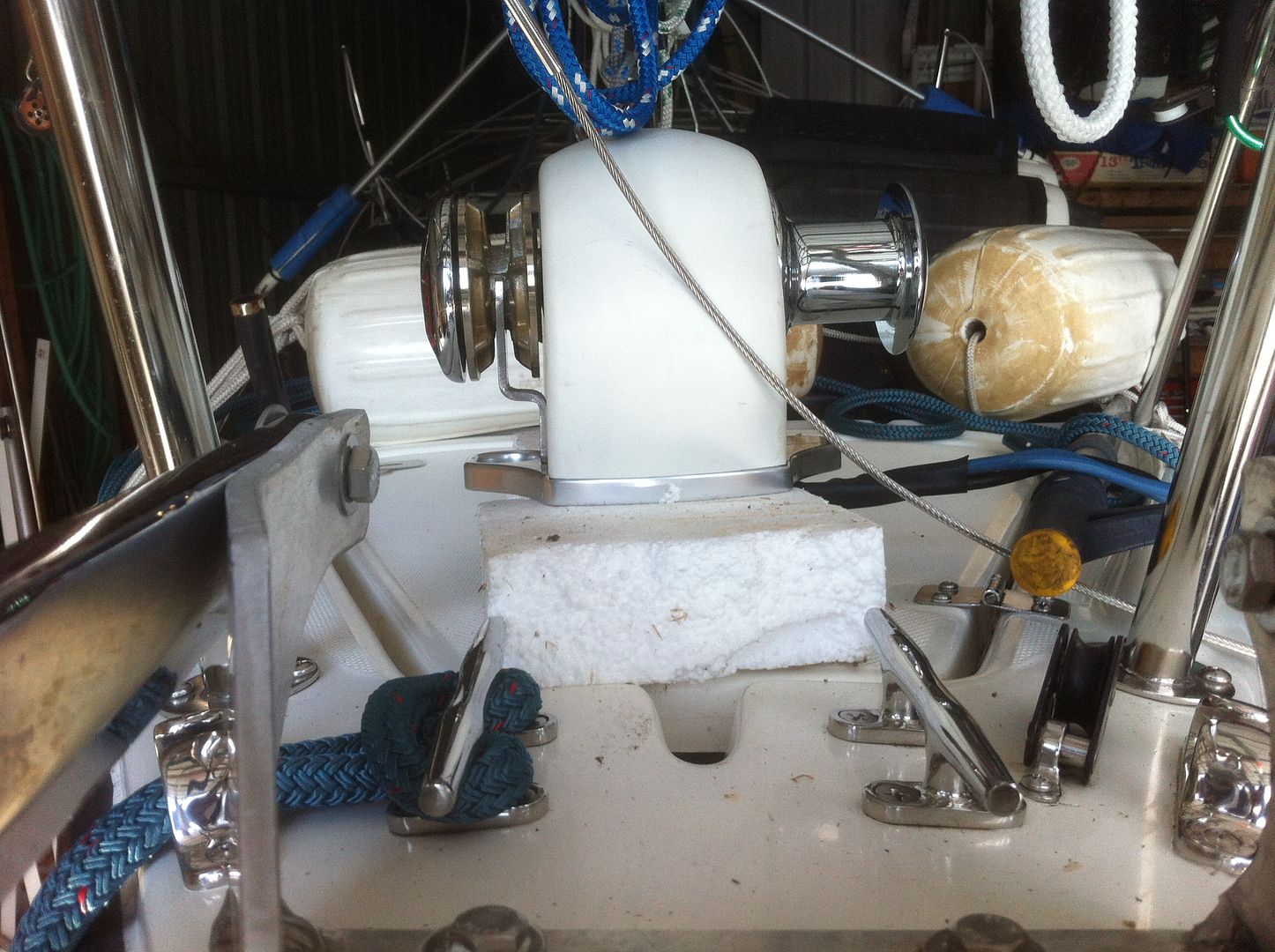
Here,s my furling line block for my jib furler u can see it beside the front port side cleat it came from the factory installed
http://i844.photobucket.com/albums/ab1/ ... f27b05.jpg
J
http://i844.photobucket.com/albums/ab1/ ... f27b05.jpg
J

Re: Learning to sail better
Since you got the basics the best way to advance IMO is crewing on a raceboat. Find a casual marina with weeknight races and show up about 90 minutes before the races and introduce yourself to someone getting ready. Generally if they don't need crew they will suggest a boat that does.
-
sailboatmike
- Admiral
- Posts: 1597
- Joined: Thu Mar 12, 2015 10:17 pm
- Sailboat: MacGregor 26X
- Location: Australia
Re: Learning to sail better
Crewing with others can be a great help OR find a good old sailor to crew with you, I did some race boat crewing and found it an interesting interchange of ideas but I thought I was probably a better sailor than the skipper I crewed for, in my book he made some horrible mistakes and while we discussed ideas he wasnt going to change his battle plan, I suppose his boat, his race.Seapup wrote:Since you got the basics the best way to advance IMO is crewing on a raceboat. Find a casual marina with weeknight races and show up about 90 minutes before the races and introduce yourself to someone getting ready. Generally if they don't need crew they will suggest a boat that does.
I have a couple of lovely old bokes that I get to crew with me on occasion, they are awesome to sail with, nothing phases them and they take everything in their stride, it really builds confidence if things start to go to hull in a handbasket.
The other thing thats good is getting involved in racing, we all know that X and M's are far from race boats but you can watch the other sailors close up and see what they do, also sailing a actual course builds skills because you just cant sail on the easiest point of sail. We got smashed last week racing, but I learned heaps and my still hard new sails just didnt work in only a couple of knots of wind, but I did learn I can go with them the few times we gusted up to around 10 knts and my pointing was almost as good as theirs, overall pretty happy considering all our rigging setup is new and we had a few teething problems, we will see what happens in the next race round in a couple of weeks
-
BOAT

- Admiral
- Posts: 4969
- Joined: Fri Oct 19, 2012 5:12 pm
- Sailboat: MacGregor 26M
- Location: Oceanside, CA MACMJ213 2013 ETEC60
Re: Learning to sail better
This a hard one - often I will be sailing along solo in my lazy way and just start looking around all over the boat and then start adjusting things - sheets, cars, traveler, and I don't even think I am aware of it - it's like a habit, something triggered me to do it and I don't even know what. I have been sailing like that for so long now - I can't even remember the reasons for half the things I do anymore, now with this MAC M boat I have my wife on board and sometimes she makes me think about it: - I look at my wife and say "move for a second while I set that traveler okay?" and invariably when ever I suddenly start moving things around she asks, "what does that do?" And i have to stop and think about why I am doing what I am doing - it's really weird.DaveC426913 wrote:I go out and learn a little more every time I sail, but I think my skill is plateauing.
I am certain I can get more speed consistently and higher pointing if I have a clearer idea of my options.
Just one example: I tend to sail by the foresail telltales
I know I've got it right by the sound of the water over the rudders . . .
For specific things you need to talk to other X boat drivers - there are tricks for that boat - not all boats are the same - but there are general things that apply to all small boats like ours.
Pointing:
Get the sails as close to the middle of the boat as you can:

That means using the jib cars on top of the cabin. ALL small boats point better with a jib sheeted close to the mast.
Also the main - a traveler will help pull the main over center to really get it close and help pointing - if the boat will not behave or your pulling up too hard on the tiller to keep the boat from rounding up:

Keep rolling up the main onto the boom if you have a roller boom until the boat settles down (or reef in our case, man i sure miss the roller boom) and a slight 10 degree pull on the tiller (1/4 turn on our wheels) is okay to overcome a weather helm, but 20 degree rudder of anything over a half turn on the wheel is too much and reef some more!
The whole point of the reef is NOT to stop the boat from heeling - if the boat is heeling with only a 1/4 turn on the helm and is tracking in a stable manner you really do not need to reef to go faster: just based on speed. If speed is what you want then often with the MAC M a 45 degree heel with no reef is faster than a 30 degree heel with a reef. Some boats sail well on their side - some don't. Cruising comfort is a different matter - you asked for more speed in your post. Many say the MAC is slow because they never push the boat to the limits it can go - they depower the boat when it heels. You don't absolutely need to do that - the boat will not sink - and if your not dragging the rudders your speed will increase in SOME cases (not all) - again talk to the X drivers on that point because they will know better when heeling vs. speed takes over - there is a point.
Wing and wing is better with a working jib on a whisker pole:

But I find that the M boat does wing on wing with the genoa just fine with no pole. It's different depending on the boat and the sail. i have many poles but have never needed to use it because my genoa is so big is fills pretty easy - another good way to wing on wing is to tie the genoa sheet to the aft docking cleat, (don't tell highlander i said that). That will make it bloom like a big spinnaker.
Your boat is getting pulled though the water by the sheets, the stays, and the mast. Feel the pressure on the lines - adjust for maximum pull on the lines. The GPS speed will help tell you what's working, and what's not.
-
DaveC426913
- Admiral
- Posts: 1912
- Joined: Mon Jul 14, 2008 8:05 am
- Sailboat: MacGregor 26X
- Location: Toronto Canada
- Contact:
Re: Learning to sail better
Oops. Maybe I should have mentioned this in my OP.Seapup wrote:Since you got the basics the best way to advance IMO is crewing on a raceboat. Find a casual marina with weeknight races and show up about 90 minutes before the races and introduce yourself to someone getting ready. Generally if they don't need crew they will suggest a boat that does.
I raced for two years aboard a friend's boat at my club. I picked up stuff but not enough.
(This crazy guy - every day the wind is different he pulls down his jib and hanks on a new one!!! Who'd'a thunk!
 )
)-
DaveC426913
- Admiral
- Posts: 1912
- Joined: Mon Jul 14, 2008 8:05 am
- Sailboat: MacGregor 26X
- Location: Toronto Canada
- Contact:
Re: Learning to sail better
The little back wheel? I'm not sure my furling line will cooperate to line up neatly from furler to stanchion block.Highlander wrote:Here,s my furling line block for my jib furler u can see it beside the front port side cleat it came from the factory installed
http://i844.photobucket.com/albums/ab1/ ... f27b05.jpg
J
-
DaveC426913
- Admiral
- Posts: 1912
- Joined: Mon Jul 14, 2008 8:05 am
- Sailboat: MacGregor 26X
- Location: Toronto Canada
- Contact:
Re: Learning to sail better
Ah yes, well. That might require me to fly something other than my 150 Genoa.BOAT wrote: Pointing:
Get the sails as close to the middle of the boat as you can:
That means using the jib cars on top of the cabin. ALL small boats point better with a jib sheeted close to the mast.
The only thing I want more than speed and high pointing - is to not have to change my head sail.
Now that I think about it, using the Genoa may be the single biggest factor preventing me from max pointing.
Not me. As I said, I'm quite comfortable at 30 degrees. I used see if I could pin the inclinometer at 45 degrees, long enough to get a pic.BOAT wrote: Many say the MAC is slow because they never push the boat to the limits it can go - they depower the boat when it heels.
It's not the heeling that causes me to reef, it's that the boat rounds up. I can't stop it.
Well, I'm getting more skilled easing the main to keep it balanced.
That sounds like it makes sense, but the main is on a 4:1 block. Surely I can't compare it to a jib sheet to see if they're balanced.BOAT wrote: Your boat is getting pulled though the water by the sheets, the stays, and the mast. Feel the pressure on the lines - adjust for maximum pull on the lines. The GPS speed will help tell you what's working, and what's not.
-
BOAT
- Admiral
- Posts: 4969
- Joined: Fri Oct 19, 2012 5:12 pm
- Sailboat: MacGregor 26M
- Location: Oceanside, CA MACMJ213 2013 ETEC60
Re: Learning to sail better
You CAN put the genoa sheets into the jib cars on the deck – I do it all the time. It not only brings the sail into the boat but also moves the force of the sail forward - the more force forward the better the boat pulls through the water without rounding up. If the boat is being pulled through the water by it's ass it will round up.
Furl the genoa - remove the sheet that you want to sail on from the aft track and move to the cabin top – then unfurl the genoa until it’s even with the mast. The other sheet will wrap around the side stay and the mast. Some M boat drivers furl the genoa completely to point. That’s an option too, but slower.
You’re an experienced sailor and you’re having problems due to the nature of the boat, not because of your skill.
That rounding up thing sounds like a bit of an issue – I hear about it a lot from X boat drivers. I do not get that on my M and can sail for many hours at 45 degrees over 6 knots – it never rounds up or experiences a serious weather helm. I have many pictures and videos. I too would be frustrated with what your describing.
The fact that your main is a 4:1 block should be a hint to you as to how much horsepower is really coming from that main sheet! It’s 4:1 because that’s where so much of the pull dragging the boat through the water comes from! That's a lot of power on the back of the boat. The Genoa sheets are pulling directly on the back of the boat too - you can put a dynamometer on the jib sheet to see how much – I often think about creating a “Loose Gauge” for the Genoa sheet that any sailor can quickly install on his jib sheet to check the pressure – if I ever create one I will post you guys but for now use your hands to feel the pressure. I suspect it would help the X boat to move more of that mainsheet “pull” towards the mast by transferring it with a boom Vang – if you’re not using one, maybe you should – that would move the force into a more balanced place. The M boat already has the main sheet forward. Again, ask other X drivers to confirm.
You mentioned “balance” several times, if you’re having issues with rounding up then the boat is having issues with balance. This is something that the other X boat drivers would need to address. See if they have solved the problem and how. IMO the boat should not round up – mine doesn’t, so I am not sure what’s happening on your boat – that is an issue you must get controlled. The rear of your boat might be getting pulled around it's own keel.
It sounds like you have lots of experience with sailing – and your just asking about the particulars regarding the MAC hybrids. That is normal, very experienced sailors get on a MAC hybrid and have all kinds of issues they were not expecting – it does not sail like a “regular” sailboat they often say. An experienced sailor first time on a MAC will have trouble with the wheel too. A rudder indicator is a great help: I have one and I use it. You can go faster using the rudder indicator. It puts the feel of a tiller back in your hands.
Once you get the overall feel of the rudder (like it’s a tiller) and the wind pressure on the lines and all the other feedback you have been used to as an experienced sailor on other boats you will indeed start to feel like your old self. The MAC is like a horse, it has personality, but you can get comfortable riding it once you get to know it.
I expect the other X drivers here to help you sort out any issues – you’re getting into the fine tuning aspects of the X and the guys who have been sailing them for many years need to respond. I am just going to tell you things you already know so my opinion will not help.
Furl the genoa - remove the sheet that you want to sail on from the aft track and move to the cabin top – then unfurl the genoa until it’s even with the mast. The other sheet will wrap around the side stay and the mast. Some M boat drivers furl the genoa completely to point. That’s an option too, but slower.
You’re an experienced sailor and you’re having problems due to the nature of the boat, not because of your skill.
That rounding up thing sounds like a bit of an issue – I hear about it a lot from X boat drivers. I do not get that on my M and can sail for many hours at 45 degrees over 6 knots – it never rounds up or experiences a serious weather helm. I have many pictures and videos. I too would be frustrated with what your describing.
The fact that your main is a 4:1 block should be a hint to you as to how much horsepower is really coming from that main sheet! It’s 4:1 because that’s where so much of the pull dragging the boat through the water comes from! That's a lot of power on the back of the boat. The Genoa sheets are pulling directly on the back of the boat too - you can put a dynamometer on the jib sheet to see how much – I often think about creating a “Loose Gauge” for the Genoa sheet that any sailor can quickly install on his jib sheet to check the pressure – if I ever create one I will post you guys but for now use your hands to feel the pressure. I suspect it would help the X boat to move more of that mainsheet “pull” towards the mast by transferring it with a boom Vang – if you’re not using one, maybe you should – that would move the force into a more balanced place. The M boat already has the main sheet forward. Again, ask other X drivers to confirm.
You mentioned “balance” several times, if you’re having issues with rounding up then the boat is having issues with balance. This is something that the other X boat drivers would need to address. See if they have solved the problem and how. IMO the boat should not round up – mine doesn’t, so I am not sure what’s happening on your boat – that is an issue you must get controlled. The rear of your boat might be getting pulled around it's own keel.
It sounds like you have lots of experience with sailing – and your just asking about the particulars regarding the MAC hybrids. That is normal, very experienced sailors get on a MAC hybrid and have all kinds of issues they were not expecting – it does not sail like a “regular” sailboat they often say. An experienced sailor first time on a MAC will have trouble with the wheel too. A rudder indicator is a great help: I have one and I use it. You can go faster using the rudder indicator. It puts the feel of a tiller back in your hands.
Once you get the overall feel of the rudder (like it’s a tiller) and the wind pressure on the lines and all the other feedback you have been used to as an experienced sailor on other boats you will indeed start to feel like your old self. The MAC is like a horse, it has personality, but you can get comfortable riding it once you get to know it.
I expect the other X drivers here to help you sort out any issues – you’re getting into the fine tuning aspects of the X and the guys who have been sailing them for many years need to respond. I am just going to tell you things you already know so my opinion will not help.