

Reefing main downwind
Reefing main downwind
Just curious if any of u all have any tips or tricks to reefing the main when wind picks up when you are going downwind .....with the swept back spreaders even tightening vang the main is in the spreaders and with that and the load put on the main in challenging winds it's very difficult to get down....i know the easy way is turn into the wind but thats not always an option
-
Highlander

- Admiral
- Posts: 5995
- Joined: Wed Sep 21, 2005 8:25 pm
- Sailboat: MacGregor 26M
- Location: Maccutter26M 2008 75HP Merc. 4/S Victoria BC. Can. ' An Hileanto'ir III '
- Contact:
Re: Reefing main downwind
If u have main sail slugs u can try adding a down haul line too the second or third top slug but I still think u r gonna have to turn off the wind to some degree !
J
J
-
Tomfoolery

- Admiral
- Posts: 6135
- Joined: Tue Jul 05, 2011 7:42 am
- Sailboat: MacGregor 26X
- Location: Rochester, NY '99X BF50 'Tomfoolery'
Re: Reefing main downwind
Depending on the wind speed, I've never really had much luck dowsing the main unless it's luffing, even with a downhaul. Maybe my slugs need more lube, but turning upwind to luff the sail is my go-to move. If space is tight and there's some urgency, I fire up the OB and use that to hold a heading.
Sorry, not much help, I know.
Sorry, not much help, I know.
-
Jimmyt
- Admiral
- Posts: 3402
- Joined: Sat Jul 18, 2015 9:52 am
- Sailboat: MacGregor 26M
- Location: Mobile AL 2013 26M, 60 Etec
Re: Reefing main downwind
Reefing a loaded sail is risky for personnel and equipment. Running downwind in a blow can be a bit unnerving by itself. Adding trying to reef seems over the top. Recommend you don't try it.
Now that the disclaimer is done...
If you have a boom brake, you could center the boom while the headsail is driving the boat downwind, similar to prepping for a gybe. This will unload the sail. If you could keep the sail tight and centered while reefing, you might pull it off. Note that if you let it get loose, it will load up and possibly put you and/or crew in the water in the process. As Highlander suggests, downhauls at the reef points might allow you to control the sail as you bring it down, while keeping the halyard tight. With enough rigging and crew, and practicing in light air, you might be able to do it.
Ideally you would reef as you see weather coming, or turn up to reef. If a blow caught me off guard, I'd start the Etec and turn up to get the sails reefed. I see that big outboard as a safety feature, allowing us to overpower our lack of preparation when necessary. Ticking off "real sailors" is just a perk...
Good luck.
Now that the disclaimer is done...
If you have a boom brake, you could center the boom while the headsail is driving the boat downwind, similar to prepping for a gybe. This will unload the sail. If you could keep the sail tight and centered while reefing, you might pull it off. Note that if you let it get loose, it will load up and possibly put you and/or crew in the water in the process. As Highlander suggests, downhauls at the reef points might allow you to control the sail as you bring it down, while keeping the halyard tight. With enough rigging and crew, and practicing in light air, you might be able to do it.
Ideally you would reef as you see weather coming, or turn up to reef. If a blow caught me off guard, I'd start the Etec and turn up to get the sails reefed. I see that big outboard as a safety feature, allowing us to overpower our lack of preparation when necessary. Ticking off "real sailors" is just a perk...
Good luck.
-
Sumner

- Admiral
- Posts: 2375
- Joined: Sun Jan 04, 2009 3:20 pm
- Sailboat: MacGregor 26S
- Location: SE Utah
- Contact:
Re: Reefing main downwind
Is the question about dousing the main or reefing it to the next reef point? If reefing, what do you have now for a reefing system?
Do you run preventers? I do and almost always use them running to control the boom but I've never been in a situation yet where I had to reef or douse the main running. Always was able to turn the boat first. Here is a link to a discussion about this, but for boats larger than ours and don't know if you want to set up this much rigging to handle the problem...
http://www.cruisersforum.com/forums/f90 ... 42303.html
I would recommend preventers if you don't have them now. They can help position the boom and hold it there, like was mentioned about the boom brake, and I also use them to bring the boom across in a controlled manner if I need to change course slightly where the boom would gybe and load suddenly on the other side of the boat.
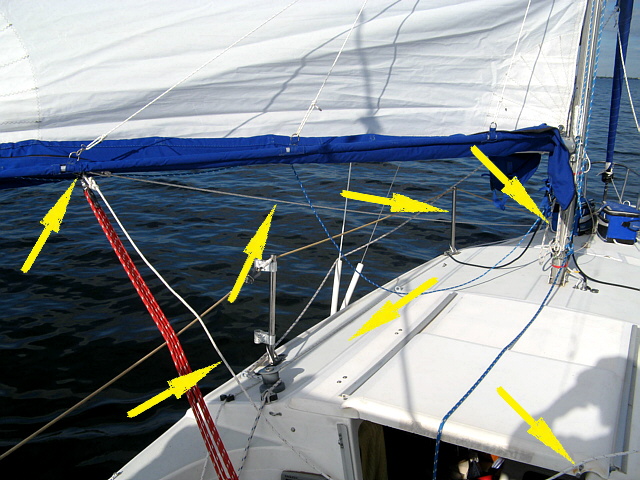
Once in the Bahamas with the prevailing easterlies I was able to do a lot of running while there and on the way back and I don't like the idea of an accidental gybe and having to worry about it for hours on end. You will be able to run on the same tack for hours at a time. I also have often used the preventers here in the states also. More lines to setup but not that much more, maybe another 10 minutes to the setup time. More here....
http://purplesagetradingpost.com/sumner ... ing-9.html
Sumner
============================
1300 miles to the Bahamas and back -- 2015
The MacGregor 26-S
The Endeavour 37
Trips to Utah, Wyoming, Idaho, Canada, Florida
Mac-Venture Links
Do you run preventers? I do and almost always use them running to control the boom but I've never been in a situation yet where I had to reef or douse the main running. Always was able to turn the boat first. Here is a link to a discussion about this, but for boats larger than ours and don't know if you want to set up this much rigging to handle the problem...
http://www.cruisersforum.com/forums/f90 ... 42303.html
I would recommend preventers if you don't have them now. They can help position the boom and hold it there, like was mentioned about the boom brake, and I also use them to bring the boom across in a controlled manner if I need to change course slightly where the boom would gybe and load suddenly on the other side of the boat.
Once in the Bahamas with the prevailing easterlies I was able to do a lot of running while there and on the way back and I don't like the idea of an accidental gybe and having to worry about it for hours on end. You will be able to run on the same tack for hours at a time. I also have often used the preventers here in the states also. More lines to setup but not that much more, maybe another 10 minutes to the setup time. More here....
http://purplesagetradingpost.com/sumner ... ing-9.html
Sumner
============================
1300 miles to the Bahamas and back -- 2015
The MacGregor 26-S
The Endeavour 37
Trips to Utah, Wyoming, Idaho, Canada, Florida
Mac-Venture Links
-
Jimmyt
- Admiral
- Posts: 3402
- Joined: Sat Jul 18, 2015 9:52 am
- Sailboat: MacGregor 26M
- Location: Mobile AL 2013 26M, 60 Etec
Re: Reefing main downwind
Seemed to me he was asking about reefing while running in a blow. Maybe I missed his question. As my dad always said, l ain't the brightest bulb in the box...
Re: Reefing main downwind
Yeah was talking about reefing main in a blow ....ive only had to do it once but wow was it challenging .... only way we could do it was crank in the main sheet as much as we could to take some of the load off the slugs and get it out of the spreaders and just pull down on the mast ...took forever and wasn't very effective as we only made progress when the wind shifted.... it was fairly windy ...enough to reef but wasn't full blown emergency and was still a disaster trying it so wondered if there was an easier way ........ I'm always trying to think of things I need to improve upon and that was one time we struggled
-
yukonbob

- Admiral
- Posts: 1918
- Joined: Mon Feb 14, 2011 6:54 pm
- Sailboat: Other
- Location: Whitehorse Yukon
Re: Reefing main downwind
If you can install a proper adjustable topping lift you can take pressure off the slugs by hoisting the main upward in turn spilling wind and easing the slugs, even this has its limits.
-
Ixneigh

- Admiral
- Posts: 2469
- Joined: Thu Sep 09, 2010 11:00 am
- Sailboat: MacGregor 26M
- Location: Key largo Florida
Re: Reefing main downwind
I never try to reef that way. I always Bring the boat on the wind. When I leave, I take a reef if in doubt. Id rather shake one out than put one in.
Ix
Ix
Re: Reefing main downwind
I wonder if having a footless maimsail would fix that? In the event you did get caught and underestimated the wind a footless sail would allow you to at least take some of the load off by feathering it inside the spreaders some....the battons would still hold some sail out but it would lesson most of the load so you could yank it down in an emergency
Re: Reefing main downwind
Seems to me that trying to reef when running downwind is a good way to shred your mainsail. If I had to do it, I would (also) center and snub down the main hard, then probably ease the topping lift and quickly put in my reef. But it is so much of a better idea to go head to wind to do any of this. But, then again, I often start with a reef in the main, especially when single-handing. It is a lot easier to shake it out than to put on in too late....
-
BOAT

- Admiral
- Posts: 4969
- Joined: Fri Oct 19, 2012 5:12 pm
- Sailboat: MacGregor 26M
- Location: Oceanside, CA MACMJ213 2013 ETEC60
Re: Reefing main downwind
$$
I had to do this a lot as a kid and I have seen a lot of folks do this going down wind in the San Pedro Channel. It's a problem that kite flyers run into a lot. Today the term is "turning away" - how to do that when your in a channel or even worse - under a kite.
I do not have a kite on 'boat' yet. On any other boat I could not wait to get one because of so many times I tired myself sailing home after a trip to an island and after 7 hours of slogging downwind bobbing in the Pacific I was still barley catching the lights of the harbor because it's getting dark. Anyone on a normal boat wants to buy a kite the next day, but I am embarrassed to admit I'm a big cheater now on a new fangled MAC 26M 'cuz when it's 6PM and the sun is setting and I'm still 5 knots from the harbor and I'm tired - well, yeah, you know - I pull up the DB, raise the rudders and turn the key. Not only is it easy to lower the main when I'm going 10 knots and the wind is 8 knots but after that I just push the throttle open and at 18 knots I'm home in less than 20 minutes.
Yup, I have become old and soft and spoiled -
But enough about me, back to your problem:
If you sail a kite a lot this is actually a problem you run into all the time. If you sail the islands in Southern Ca you soon realize getting to Avalon or Santa Rosa is fast and easy but then you need to get back to shore - well - in Southern California the wind is almost always blowing TOWARDS the shore. So, your trying to make port before dark and you have a long ways to go on one tack so you tend to fly a spinnaker if you have one. Sailing long legs downwind in a calm moderate Pacific Breeze is great but later in the day as you get out of the lee of the island you just departed you realize California is a lee shore because the wind gets stronger the closer you get.
And that is the formula for "running stuck" California style - you can turn upwind but you don't want to because to do that you need to dowse the kite, or get it very wet - or worse - tangled. Most folks do it right and dowse the kite. (This is why asyms are so popular now)
But there is a trick that a lot of salty so cal sailors use that my dad taught me, and it involves having a proper topping lift. (And I mean "proper", not that junky thing you get from BWY, I mean a REAL. "proper" topping lift). A topping lift should go from the end of the boom, to the top of the mast, AND BACK DOWN TO THE BASE OF THE MAST. If it does not go thru a turn block at the top of the mast back to the deck it's not really a topping lift. There are SO MANY great uses for a proper topping lift, like adjusting your boom bimini at anchor so you can stand and drink beer in the cockpit! (or pee over the transom without kneeling). It's great for rigging a bosuns chair, or hanging enemies after a battle. So many uses I can't name here but one of the best is raising the boom while your under sail going downwind. A proper topping lift allows you to go to the mast and raise a boom hanging over the water without getting wet.
So this is the secret to reefing a main while "running stuck" or the turning away problem. You raise the boom. It helps depower the main and takes a LOT of stress off the slugs. Usually it's enough free up the main enough to get the next cringle to the horn. With boom raised it's also easier to get the halyard tight again.
Footless sails are a lot easier to reef when running too. I do see a lot of folks over here running with kites and I see them reef the main at the same time and it almost always involves a proper topping lift.
I had to do this a lot as a kid and I have seen a lot of folks do this going down wind in the San Pedro Channel. It's a problem that kite flyers run into a lot. Today the term is "turning away" - how to do that when your in a channel or even worse - under a kite.
I do not have a kite on 'boat' yet. On any other boat I could not wait to get one because of so many times I tired myself sailing home after a trip to an island and after 7 hours of slogging downwind bobbing in the Pacific I was still barley catching the lights of the harbor because it's getting dark. Anyone on a normal boat wants to buy a kite the next day, but I am embarrassed to admit I'm a big cheater now on a new fangled MAC 26M 'cuz when it's 6PM and the sun is setting and I'm still 5 knots from the harbor and I'm tired - well, yeah, you know - I pull up the DB, raise the rudders and turn the key. Not only is it easy to lower the main when I'm going 10 knots and the wind is 8 knots but after that I just push the throttle open and at 18 knots I'm home in less than 20 minutes.
Yup,
I have become old and soft and spoiled - But enough about me, back to your problem:
If you sail a kite a lot this is actually a problem you run into all the time. If you sail the islands in Southern Ca you soon realize getting to Avalon or Santa Rosa is fast and easy but then you need to get back to shore - well - in Southern California the wind is almost always blowing TOWARDS the shore. So, your trying to make port before dark and you have a long ways to go on one tack so you tend to fly a spinnaker if you have one. Sailing long legs downwind in a calm moderate Pacific Breeze is great but later in the day as you get out of the lee of the island you just departed you realize California is a lee shore because the wind gets stronger the closer you get.
And that is the formula for "running stuck" California style - you can turn upwind but you don't want to because to do that you need to dowse the kite, or get it very wet - or worse - tangled. Most folks do it right and dowse the kite. (This is why asyms are so popular now)
But there is a trick that a lot of salty so cal sailors use that my dad taught me, and it involves having a proper topping lift. (And I mean "proper", not that junky thing you get from BWY, I mean a REAL. "proper" topping lift). A topping lift should go from the end of the boom, to the top of the mast, AND BACK DOWN TO THE BASE OF THE MAST. If it does not go thru a turn block at the top of the mast back to the deck it's not really a topping lift. There are SO MANY great uses for a proper topping lift, like adjusting your boom bimini at anchor so you can stand and drink beer in the cockpit! (or pee over the transom without kneeling). It's great for rigging a bosuns chair, or hanging enemies after a battle. So many uses I can't name here but one of the best is raising the boom while your under sail going downwind. A proper topping lift allows you to go to the mast and raise a boom hanging over the water without getting wet.
So this is the secret to reefing a main while "running stuck" or the turning away problem. You raise the boom. It helps depower the main and takes a LOT of stress off the slugs. Usually it's enough free up the main enough to get the next cringle to the horn. With boom raised it's also easier to get the halyard tight again.
Footless sails are a lot easier to reef when running too. I do see a lot of folks over here running with kites and I see them reef the main at the same time and it almost always involves a proper topping lift.
-
sailboatmike

- Admiral
- Posts: 1597
- Joined: Thu Mar 12, 2015 10:17 pm
- Sailboat: MacGregor 26X
- Location: Australia
Re: Reefing main downwind
But boat, that is what a Mac is ALL about, being able to turn the key and you go, unlike traditional boats that you pull the cord and still go at 6knts max
-
Hamin' X

- Site Admin
- Posts: 3464
- Joined: Sat Aug 27, 2005 6:02 pm
- Sailboat: MacGregor 26X
- Location: Hermiston, OR-----------2001 26X DF-50 Suz---------------(Now Sold)
- Contact:
Re: Reefing main downwind
I would just heave-to, reef and fall off the wind to continue. Even in a channel, this takes almost no lateral room at all. I've done this in open ocean and the Columbia River, it works fine there.
~Rich
~Rich
-
Signaleer

- First Officer
- Posts: 263
- Joined: Sat Feb 14, 2015 11:58 am
- Sailboat: MacGregor 26X
- Location: Foley, Alabama...2002 26x & 2002 90 HP Mercury Salt Water 2-stroke
Re: Reefing main downwind
So, ... to reef a sail it has to be depowered.
How does someone do this downwind?
(Yes, I've had a few).
The answer is... you don't.
You can come to a reach and not head directly up wind, but the apparent wind must be forward of the mainsail to depower it for it to be reefed in a controlled manner.
In short, we are in Mac's why is this an issue? Head to wind, sail with the headsail, reef under conveneince and safety and head back in the direction desired.
(sorry for the whiskey tone.. )
How does someone do this downwind?
(Yes, I've had a few).
The answer is... you don't.
You can come to a reach and not head directly up wind, but the apparent wind must be forward of the mainsail to depower it for it to be reefed in a controlled manner.
In short, we are in Mac's why is this an issue? Head to wind, sail with the headsail, reef under conveneince and safety and head back in the direction desired.
(sorry for the whiskey tone.. )